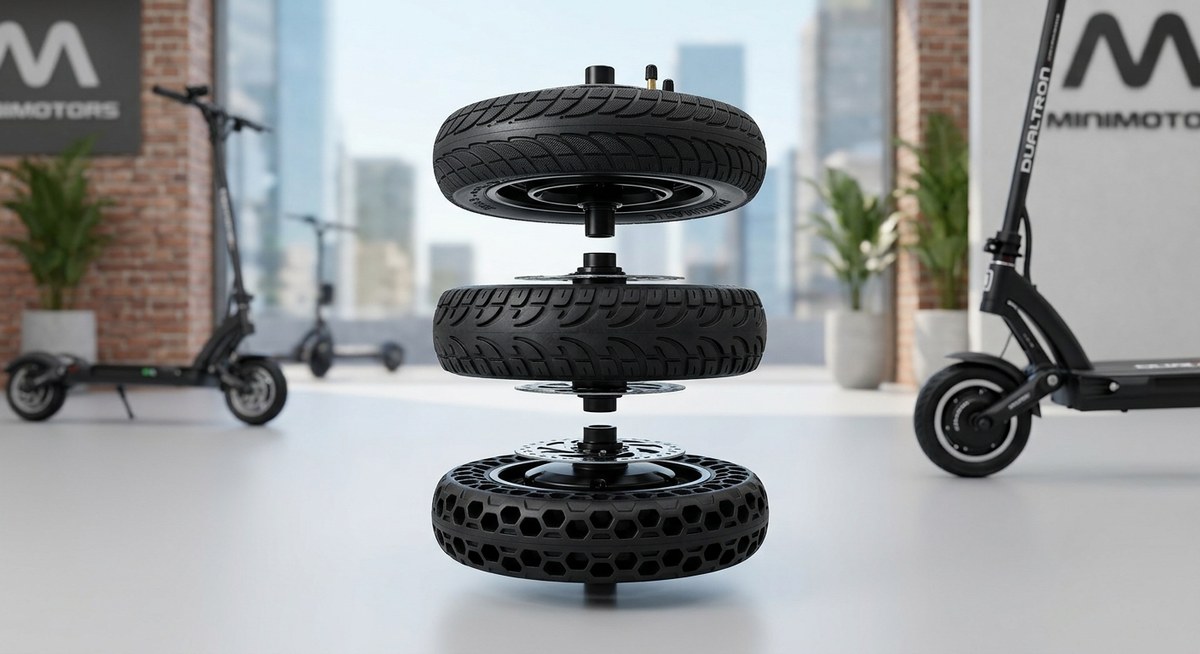
Which E-Scooter Tires Are Best for You? Pneumatic, Solid, or Honeycomb
The three tires on an electric scooter are what connect you to the road. They soak up bumps, grip the pavement, and take the brunt of every pothole, curb, and glass shard you roll over. Pneumatic, solid, and honeycomb each come with their own trade-offs. One gives you a cloud-like ride but demands constant air checks. Another is practically indestructible but rattles your teeth. The third promises a middle ground that often leaves riders scratching their heads. By the time you finish this guide, you will know exactly which type belongs on your scooter.
Pneumatic tires offer the best comfort and grip but are prone to flats. Solid tires never go flat but deliver a harsh ride and less traction. Honeycomb tires split the difference: better shock absorption than solid, no air to leak, but they can wear faster and feel firmer than pneumatics. Your choice depends on your commute distance, local road conditions, and how much maintenance you want to do.
What Are Pneumatic Tires?
Pneumatic tires are the classic air-filled tires you see on cars and bicycles. They have an inner tube (or are tubeless) that holds pressurized air. When you hit a bump, the air compresses and absorbs the impact. That cushioning makes pneumatic tires the most comfortable option by a wide margin. They also provide excellent grip because the rubber conforms to the road surface, especially in wet conditions.
The catch: They puncture. A single nail, a sharp rock, or even a heavy curb strike can flatten your tire. And when a pneumatic tire goes flat, you are stuck until you patch or replace it. If you ride daily on city streets littered with debris, you will likely deal with flats at some point. Some riders carry a portable pump and patch kit, but not everyone wants that hassle.
Pneumatic tires also require periodic pressure checks. Under-inflated tires cause sluggish acceleration and increase the risk of pinch flats. Over-inflated tires make the ride harsh and reduce grip. The sweet spot is usually between 40 and 60 PSI, but check your scooter’s manual.
Who should choose pneumatic tires? If you prioritize comfort, ride long distances, or frequently ride on uneven pavement, pneumatics are worth the maintenance. They also perform best on loose surfaces like gravel or dirt paths. Many commuters who travel more than 5 miles each way swear by them for the fatigue-free ride.
What Are Solid Tires?
Solid tires are exactly what they sound like: a solid ring of rubber (or sometimes a composite material) that fits onto the wheel rim. They never go flat, ever. That peace of mind is their biggest selling point. You can roll over glass, nails, or broken bottles without a second thought. No air, no pressure checks, no punctures.
The downside: Solid tires transmit every single bump directly to the scooter frame and your body. On a sidewalk with expansion joints, you will feel each crack. On a rough asphalt road, your hands may go numb after a few miles. Solid tires also have less grip than pneumatics, especially in rain. The rubber compound is harder to resist wear, which means less traction on wet surfaces. Cornering at speed can feel sketchy because the tire cannot deform to maintain contact patch.
Solid tires are heavier too. The extra rotating mass can reduce acceleration and top speed slightly, though most riders won’t notice. They also wear faster than pneumatics because they cannot flex, so all the friction is concentrated on the outer surface. A solid tire might last 1,000 to 2,000 miles depending on riding style.
Who should choose solid tires? If your commute is short (under 3 miles), the roads are smooth, or you absolutely detest fixing flats, solid tires are a low-maintenance choice. They are common on budget scooters and rental fleets where durability trumps ride quality. For heavier riders, solid tires can also be a good option because they do not risk pinch flats under high loads.
What Are Honeycomb Tires?
Honeycomb tires look solid from the outside but have a network of hexagonal cells inside the rubber. These cells compress slightly when you hit a bump, giving a bit of shock absorption. They are airless, so punctures are not an issue. This design aims to offer the best of both worlds: no flats with better comfort than solid tires.
The reality: Honeycomb tires are a compromise. They are softer than solid tires, so they do cushion moderate bumps. But they are still far firmer than a properly inflated pneumatic tire. On large potholes or sharp edges, the honeycomb structure can bottom out, transmitting the shock. The ride is closer to a solid tire than a pneumatic, but with a noticeable improvement over the hardest solids.
Honeycomb tires have their own problems. The open cell structure can trap debris or mud, though it usually falls out. They tend to wear faster than pneumatics because the rubber is relatively stiff and the cells flex repeatedly, generating heat. Some riders report that honeycomb tires feel “squishy” when cornering hard, reducing confidence. And they are often more expensive than both pneumatics and solids.
Who should choose honeycomb tires? If you want the no-puncture benefit of solid tires but cannot tolerate the harsh ride, honeycomb is a step up. They work well for urban commuters on decent roads who want to avoid flats without sacrificing all comfort. Three-wheeled scooters and some premium models use honeycomb tires for this reason.
Comparison Table: Pneumatic vs Solid vs Honeycomb
| Feature | Pneumatic | Solid | Honeycomb |
|---|---|---|---|
| Comfort | Excellent. Best shock absorption. | Poor. Very harsh ride. | Fair. Better than solid, worse than pneumatic. |
| Puncture resistance | Low. Prone to flats. | High. No flats ever. | High. Airless design prevents flats. |
| Grip (dry) | Very good. | Good but less responsive. | Good, but can feel vague in corners. |
| Grip (wet) | Good. Rubber conforms to road. | Poor. Hard compound loses traction. | Fair to good. Depends on rubber compound. |
| Maintenance | Requires inflation checks, tube patch/replace. | None. | Minimal. No air, but watch for wear. |
| Weight | Lightest. | Heaviest. | Moderate. |
| Lifespan | 2,000-5,000 miles (with care). | 1,000-2,000 miles. | 1,500-3,000 miles. |
| Cost | Moderate. | Low to moderate. | Higher than pneumatic or solid. |
How to Choose: A Step-by-Step Guide
Use this numbered process to match your riding style with the right tire type.
-
Assess your route. Is your commute mostly smooth asphalt, brick sidewalks, or rough gravel? Smooth roads can handle any tire, but rough terrain demands pneumatics. If you ride dirt trails or cracked pavement, pneumatics are the clear winner.
-
Consider your risk of flats. How often do you roll through construction zones, glass shards, or metal debris? If you get a flat every few months, switching to solid or honeycomb might save you time and frustration. If flats are rare, pneumatics are worth the small risk.
-
Evaluate your comfort tolerance. Are you willing to accept a jarring ride for the sake of zero maintenance? Test ride a scooter with solid tires before buying. Many people start with solids and upgrade to honeycomb or pneumatics later because they cannot handle the vibration.
-
Think about weather. If you ride in rain often, avoid solid tires. Their grip on wet pavement is noticeably worse. Pneumatics and honeycomb tires perform better in the rain, though honeycomb can still be slippery on painted lines or metal grates.
-
Factor in your riding speed. High speeds (above 20 mph) require good grip and stability. Pneumatics shine here. Honeycomb tires can feel vague at speed, and solid tires offer the least confidence in corners.
-
Check your scooter’s compatibility. Not all scooters can accept all tire types. Some rims are designed specifically for solid or honeycomb tires. If you want to switch, verify that your wheel rim and motor allow it. For example, many hub motors only accept one type.
Expert Advice: Pros and Cons from a Mechanic
“I see a lot of riders come in with solid tires and complain about a sore back. Then they switch to pneumatics and think they’ve got a new scooter. However, if you live in an area with lots of broken glass, pneumatics will drive you crazy. Honeycomb tires are my personal recommendation for the average commuter. They offer enough cushion to be comfortable for a 4-mile ride, and you never have to patch a tube. Just don’t expect them to feel like a cloud. The trade-off is real.” — Mike, e-scooter service shop owner, Portland
Maintenance Tips for Each Tire Type
- Pneumatic tires: Check pressure weekly. Use a gauge rated for scooter tires. Keep a patch kit and mini pump in your backpack. Rotate tires if your scooter has two identical sizes to even out wear.
- Solid tires: Inspect for cracks or flat spots monthly. If the tire becomes bald or develops chunks, replace it immediately. Solid tires can slip off the rim if they are too worn.
- Honeycomb tires: Clean out debris from the cells occasionally. Look for signs of separation between the rubber and the honeycomb core. Replace when the tread depth drops below 1mm.
The Tire Type That Suits Your Riding Personality
Think about what frustrates you most on a scooter. Is it pulling over to fix a flat? Then solid or honeycomb will save your sanity. Is it feeling every crack in the pavement for 20 minutes? Then you need pneumatics. Is it a mixture of both? Honeycomb is your Goldilocks option.
No tire is perfect. But once you understand the trade-offs, you can make a choice that keeps you riding longer with fewer headaches. The best e-scooter tire is the one that matches your terrain, your tolerance for maintenance, and your willingness to trade comfort for hassle-free miles.
If you still feel unsure, read through our complete guide to e-scooter classes to see how tire choice fits into the bigger picture of scooter ownership. And when you do pick your tires, remember to check them before every ride. A quick visual once-over can catch a developing problem before it leaves you stranded.
Ride smart, stay safe, and enjoy the miles ahead. Your tires are the only part of the scooter that touches the ground. Treat them right.
