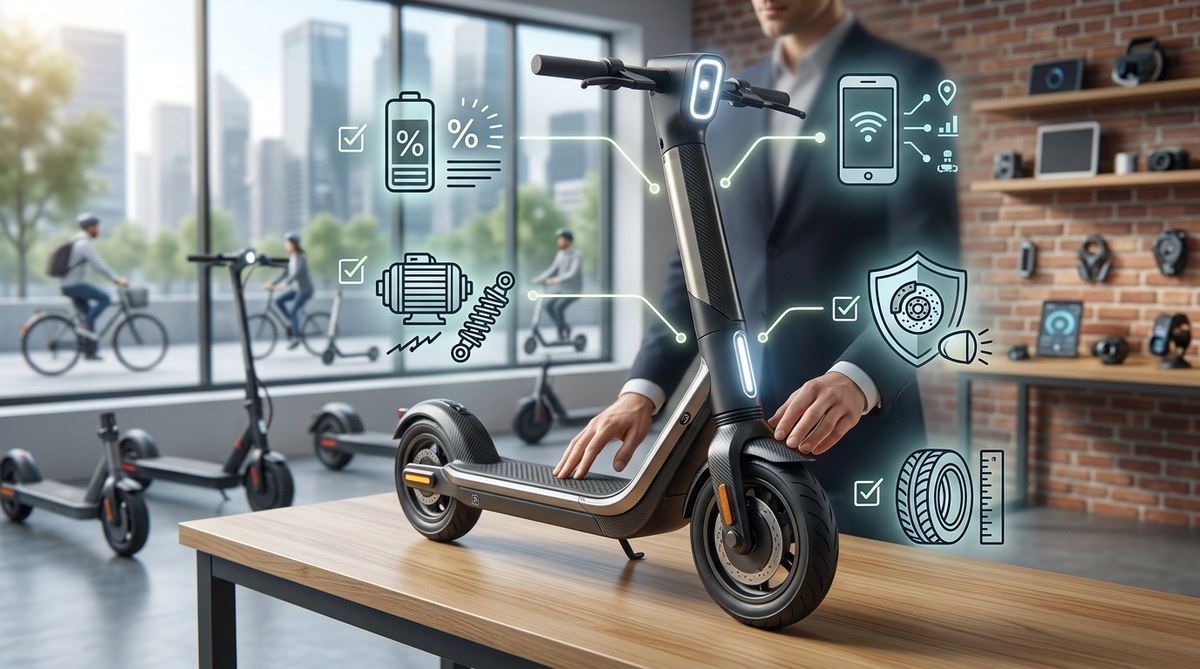
What to Look for in an E-Scooter for 2026: A Buying Checklist
Shopping for your first electric scooter in 2026 can feel overwhelming. There are dozens of models, conflicting spec sheets, and price tags that range from a few hundred dollars to several thousand. The good news is that the technology has matured. Batteries last longer, motors are more efficient, and safety features that seemed like luxury extras a few years ago are now standard on mid-range scooters. This guide cuts through the noise. It gives you a clear, practical checklist for choosing the right e-scooter for your commute, your budget, and your lifestyle. No fluff. No jargon. Just the facts you need before you hit “buy.”
A great electric scooter balances range, motor power, battery safety, and build quality for your specific commute. Start by measuring your daily distance in miles, then add 30 percent buffer for hills and wind. Check the battery chemistry (LG or Samsung cells are best), look for dual braking systems, and never buy a scooter without testing its weight limit against your own. Spend at least $600 for a reliable daily rider.
Start With Your Actual Commute
Before you compare motor wattage or battery voltage, figure out one number: your daily riding distance. This single metric will eliminate more wrong choices than any other factor.
Measure your round trip from home to work or school and back. Add any detours for coffee, errands, or lunch. Now add 30 percent on top of that. That is the minimum range your scooter needs to deliver in real-world conditions.
Why the buffer? Manufacturer range claims are almost always optimistic. They test on flat ground with a light rider at low speeds. Your route probably has hills, stop signs, crosswalks, and wind. Real-world range is typically 60 to 75 percent of what the spec sheet promises.
If your commute is 5 miles each way (10 miles total), look for a scooter rated for at least 15 to 18 miles. If you ride 8 miles each way, aim for 22 to 25 miles of rated range. This buffer keeps you from walking home with a dead battery.
Battery Chemistry Matters More Than Ever
In 2026, battery technology has improved significantly, but not all batteries are built the same. The two most common chemistries in e-scooters are lithium-ion (Li-ion) and lithium iron phosphate (LiFePO4).
- Lithium-ion (Li-ion): Lighter and more energy dense. Common in most portable scooters. Good for riders who need to carry their scooter up stairs or onto a train.
- Lithium iron phosphate (LiFePO4): Heavier but safer and longer lasting. Handles more charge cycles before degrading. Popular in commuter scooters where weight matters less than longevity.
- Solid-state batteries: Emerging in premium models in 2026. Even safer and more energy dense. Still expensive, but worth watching.
Check which brand of cells the manufacturer uses. LG, Samsung, and Panasonic are the gold standard. No-name cells from unknown suppliers are a red flag, even if the price is tempting. A cheap battery can fail early or, in rare cases, pose a fire risk.
For a deeper look at how battery voltage affects performance, read our guide on understanding e-scooter battery voltage.
Motor Power: How Many Watts Do You Need?
Motor power is measured in watts (W). More watts generally means faster acceleration and better hill climbing. But bigger motors also drain the battery faster and add weight.
| Rider Use Case | Recommended Motor Power | Notes |
|---|---|---|
| Flat city streets, under 5 miles | 250W to 350W | Enough for casual rides on pavement |
| Mixed terrain with some hills | 350W to 500W | Handles moderate inclines |
| Hilly city or longer commutes | 500W to 800W | Reliable climbing power |
| Heavy rider (220+ lbs) or steep hills | 800W to 1200W | Needed for safe hill performance |
| Off-road or cargo | 1200W+ | High torque for rough surfaces |
A common mistake is buying a scooter with more power than you need. A 1200W motor on flat ground is overkill. It will eat your battery and cost more upfront. Match the motor to your terrain, not your ego.
If you want to dig deeper into matching motor power to your weight and route, see our electric scooter motor power guide.
Brakes Are Your Most Important Safety Feature
A fast scooter is useless if you cannot stop safely. In 2026, the minimum standard for any commuter scooter is a dual braking system. That means two independent ways to slow down.
- Disc brakes: The most reliable option. Provide strong, consistent stopping power in wet or dry conditions. Look for models with disc brakes on at least one wheel, ideally both.
- Drum brakes: Enclosed and protected from mud and water. Less powerful than disc brakes but nearly maintenance free. A good choice for wet climates.
- Regenerative (electronic) braking: Recovers some energy back to the battery. Good as a secondary brake. Never rely on it as your only brake because it is less powerful at low speeds.
- Foot brake (fender brake): A backup mechanical brake that presses on the rear tire. Useful in emergencies but wears down the tire over time.
Avoid any scooter that uses only a single electronic brake. It is not enough for safe emergency stops.
For a complete breakdown of each braking type, check our guide on understanding e-scooter braking systems.
Weight Limit and Build Quality
Every scooter has a maximum weight rating. Do not exceed it. Riding over the limit strains the motor, reduces range, and increases the risk of frame failure.
A good rule of thumb: choose a scooter with a weight limit at least 20 pounds above your own weight. That gives you room for a backpack, groceries, or a bag.
Build quality shows in the frame material. Aluminum alloy is the standard for portable scooters. It is light and strong. Steel frames are heavier but more durable. Carbon fiber is premium and expensive but offers the best strength-to-weight ratio.
Check the deck size too. A longer deck gives you more stable foot placement. If you wear size 10 shoes or larger, look for a deck that is at least 18 inches long.
For a detailed comparison of weight limits and durability across different models, read our article on best e-scooters for heavy riders.
Tires: Pneumatic vs. Solid
Tire choice affects your ride quality, maintenance, and safety.
- Pneumatic (air-filled) tires: Offer the best comfort and grip. They absorb bumps and provide better traction on turns. The downside is the risk of flats. If you choose pneumatic tires, carry a repair kit and a portable pump.
- Solid (airless) tires: Never go flat. They are low maintenance but transmit more road vibration to your hands and feet. On rough pavement, this can get uncomfortable.
- Honeycomb or foam-filled tires: A compromise between the two. They offer some shock absorption without the risk of flats. Not as smooth as pneumatic but better than solid.
For a daily commute with mixed road surfaces, pneumatic tires are the best choice. Just be prepared to patch or replace them occasionally.
Learn more about tire maintenance in our guide on 5 signs your e-scooter tires need replacement.
Suspension: Do You Need It?
Suspension is not a luxury. It is a safety and comfort feature. A scooter with good suspension keeps your feet planted on the deck and reduces the impact of potholes, cracks, and uneven pavement.
- Front suspension only: Better than nothing. Absorbs bumps at the steering wheel.
- Rear suspension only: Less common. Helps keep the rear tire in contact with the road.
- Dual suspension (front and rear): The best option for any commuter route that includes rough roads. Essential if you weigh over 200 pounds or ride on brick streets.
- No suspension: Acceptable only if you ride exclusively on smooth, new pavement and keep speeds under 12 mph.
If your commute includes any stretch of road that you would not want to ride a skateboard on, get a scooter with dual suspension.
Portability: Folding Mechanism and Weight
If you need to carry your scooter onto a bus, train, or up stairs, portability is critical.
Look for a folding mechanism that locks securely with one hand. The best designs use a lever and latch system that clicks into place. Avoid scooters that require tools to fold or unfold.
Weight is the second factor. A scooter under 30 pounds is easy to carry. Between 30 and 40 pounds is manageable for most adults. Over 40 pounds becomes a burden if you have to carry it more than a few steps.
Test the folded dimensions too. Some scooters fold but remain bulky. If you need to store it under a desk or in a small apartment, measure the folded length and height against your storage space.
For a comparison of folding versus non-folding designs, read should you buy a folding or non-folding electric scooter.
Smart Features and Display
In 2026, many scooters come with connected features. Some are genuinely useful. Others are gimmicks.
Features that actually matter:
– Cruise control: Maintains speed without holding the throttle. Reduces hand fatigue on long straight stretches.
– Regenerative braking levels: Adjustable in an app. Lets you choose how much resistance the electronic brake provides.
– Turn signals: Integrated front and rear lights that blink. Much safer than hand signals at night.
– Anti-theft alarm and GPS tracking: Useful if you park your scooter outside. Not a replacement for a good lock.
Features that are mostly fluff:
– Bluetooth speakers: Drain the battery and annoy people around you.
– RGB underglow lights: Fun for show, but no real safety benefit.
– App-based speed unlocking: Often violates local laws and can overheat the motor.
For a deeper look at how smartphone integration improves safety, see our article on do smartphone apps really make e-scooters safer.
Real Cost of Ownership
The purchase price is just the beginning. Budget for these ongoing costs:
- Replacement battery: $200 to $600 every 2 to 4 years, depending on usage and battery quality.
- Tires and tubes: $15 to $40 per tire. Pneumatic tires need replacing every 500 to 1,000 miles.
- Brake pads: $10 to $30 per set. Replace every 6 to 12 months for daily riders.
- Helmet and safety gear: $50 to $150 for a certified helmet. Add gloves and a jacket if you ride in traffic.
- Insurance or registration: Varies by city and state. Some areas require registration and liability insurance.
A reliable commuter scooter in the $600 to $1,200 range offers the best value in 2026. Below $500, you compromise on battery safety, brake quality, and range. Above $2,000, you are paying for premium performance or exotic materials that most commuters do not need.
If you are shopping on a tighter budget, read our guide on budget e-scooters under $500 to see where you can safely cut costs.
The 5-Step Pre-Purchase Checklist
Follow these steps before you buy any e-scooter.
- Measure your commute distance and add 30 percent for real-world range.
- Match motor power to your terrain. Flat city = 350W. Hilly city = 500W+. Heavy rider = 800W+.
- Confirm the weight limit is at least 20 pounds above your body weight.
- Verify dual brakes. Look for disc brakes on at least one wheel plus a secondary brake.
- Check the battery brand. LG, Samsung, or Panasonic only. Avoid generic cells.
“The most expensive scooter is the one you replace after six months because it did not fit your needs. Buy for your actual route, not for the spec sheet.” This advice from a long-time commuter in my local riders group has saved many people from a bad purchase.
Matching the Scooter to Your Riding Style
Not every scooter fits every rider. Here is a quick way to match your needs to the right category.
- Commuter (5 to 10 miles per day): Look for 350W to 500W motor, 15 to 20 mile rated range, pneumatic tires, dual brakes, folding frame under 35 pounds. This is the sweet spot for most riders.
- Long-distance commuter (10 to 20 miles per day): Need 500W to 800W motor, 25 to 35 mile rated range, dual suspension, larger battery (48V or higher), and comfortable deck. Expect weight to be over 40 pounds.
- Weekend cruiser or recreational rider: Lower speeds, shorter range, more focus on comfort and style. 250W to 350W is fine. Solid tires can work if roads are smooth.
- Off-road or trail rider: High torque motor (800W+), aggressive tread tires, full suspension, durable frame. Weight is less of a concern. Range varies widely depending on terrain.
For a full comparison of commuter and off-road models, read commuter vs off-road e-scooters.
Common Mistakes First-Time Buyers Make
| Mistake | Why It Hurts | How to Avoid |
|---|---|---|
| Buying based on max speed | High top speed drains battery and may be illegal in your city | Focus on range and hill climbing instead |
| Ignoring the weight limit | Overloading strains motor and frame | Add 20 lbs buffer to your weight |
| Choosing solid tires for comfort | Harsh ride on rough pavement | Pick pneumatic or honeycomb tires |
| Skipping the brake test | Weak brakes cause accidents | Test both brakes before buying |
| Trusting manufacturer range claims | Real-world range is 25 to 40 percent lower | Add 30 percent buffer to your commute |
Your Next Step
Finding the right e-scooter in 2026 comes down to three things: knowing your commute distance, choosing safe and reliable components, and setting a realistic budget. Start by measuring your route today. Write down the numbers. Then use this checklist to compare models side by side.
The right scooter will save you time, money, and frustration. It will make your daily trip more enjoyable and keep you safe on the road. Take your time, test ride if possible, and never settle for a model that feels flimsy or underpowered.
If you have questions about a specific model or want more details on any feature we covered, feel free to contact us. We are happy to help you find the perfect ride.
