What Are the Different E-Scooter Classes and Which One Is Right for You?
Walking into a scooter shop can feel overwhelming when sales staff start throwing around terms like Class 1, Class 2, and Class 3. These classifications aren’t just marketing jargon. They determine where you can legally ride, how fast you can go, and whether you need a license or insurance. Understanding these categories before you buy can save you from expensive mistakes and potential legal headaches.
Electric scooter classes are official categories that define speed limits, motor power, and legal riding locations. Class 1 scooters max out at 15 mph with pedal assist only. Class 2 models add throttle control at the same speed. Class 3 scooters reach 28 mph but face stricter regulations. Your choice depends on commute distance, local laws, and riding environment.
What electric scooter classes actually mean
The classification system exists to create clear rules for manufacturers, riders, and city planners. Each class comes with specific technical specifications that affect performance and legal status.
Think of classes like driver’s license categories. Just as you need different credentials to operate a motorcycle versus a regular car, different scooter classes unlock different riding privileges.
Most U.S. states adopted a three-tier system based on speed and assist type. Some regions add a Class 4 for high-performance models, while others keep things simple with just two categories.
The system helps cities decide which scooters belong on bike paths, sidewalks, or roads. It also guides insurance companies in setting premiums and helps law enforcement write sensible tickets.
Breaking down Class 1 electric scooters
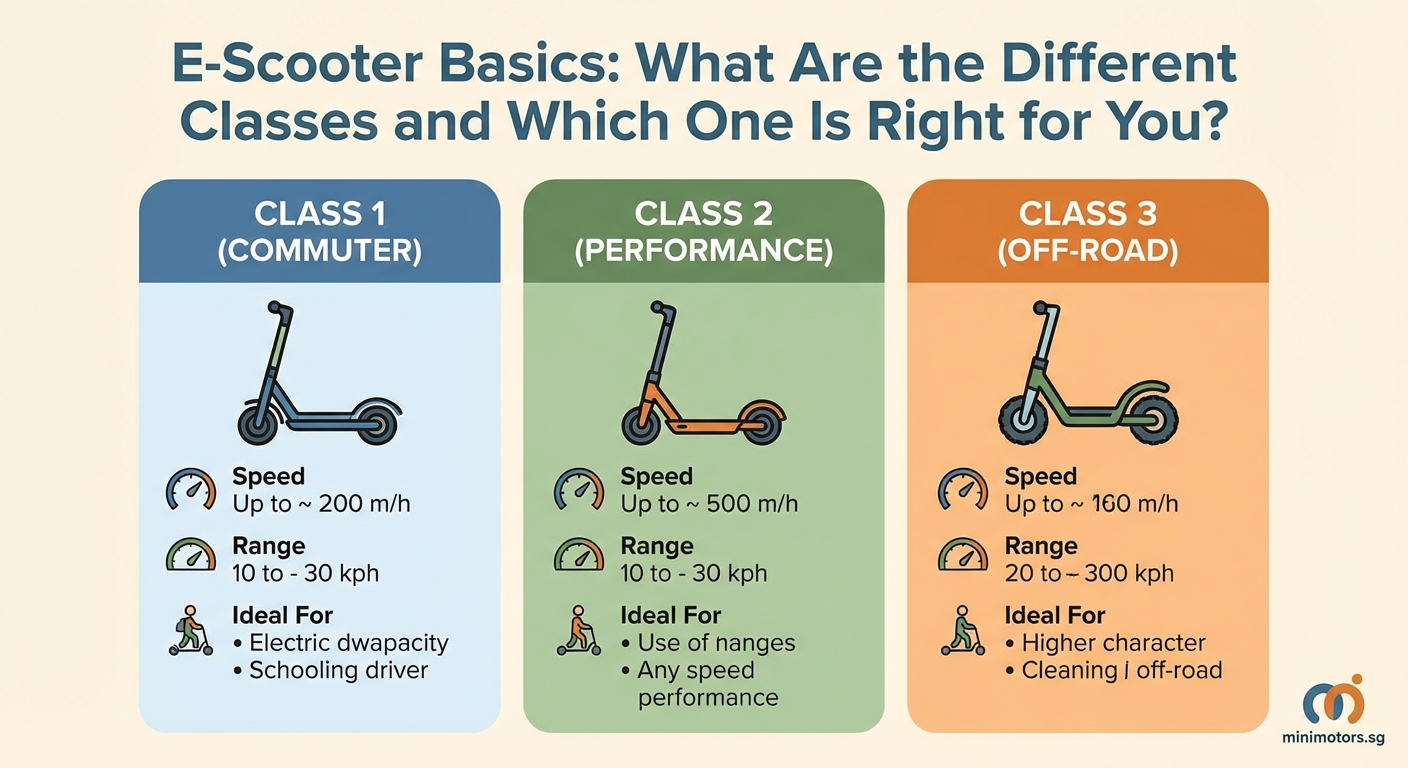
Class 1 scooters provide pedal-assist only, meaning the motor kicks in when you’re actively pedaling or pushing. The motor cuts off automatically at 15 mph.
These models suit casual riders who want a boost on hills without going too fast. You’ll find them popular with commuters who mix scooter rides with public transit.
Most cities allow Class 1 scooters on bike lanes and multi-use paths. Some even permit them on sidewalks, though local ordinances vary widely.
The main limitation? Speed. If your commute involves long stretches where 15 mph feels painfully slow, you’ll quickly outgrow a Class 1 model.
Battery life tends to be excellent since the motor doesn’t work as hard. You can often squeeze 20 to 30 miles from a single charge depending on terrain and rider weight.
Ideal riders for Class 1:
- Beginners testing the waters of electric mobility
- Short-distance commuters covering 3 to 5 miles
- Riders in areas with strict scooter regulations
- Anyone prioritizing safety over speed
Understanding Class 2 scooters and throttle control
Class 2 scooters add a throttle, letting you accelerate without pedaling or pushing. The motor still cuts off at 15 mph, matching Class 1 speed limits.
This throttle feature makes a huge difference in stop-and-go traffic. You can zip away from intersections without the awkward push-off dance.
Legal access mirrors Class 1 in most places, though some bike paths ban throttle-equipped models. Always check local rules before assuming you can ride anywhere a Class 1 goes.
The throttle drains batteries faster than pedal-assist. Expect 15 to 25 miles per charge, depending on how heavily you lean on the throttle versus using leg power.
Many riders appreciate having both options. You can pedal-assist on long stretches to conserve battery, then switch to throttle when you’re tired or carrying groceries.
“The throttle isn’t about laziness. It’s about having options when you’re exhausted after a 10-hour shift or need to navigate a tricky intersection safely.” – Urban mobility researcher
Class 3 scooters for serious commuters
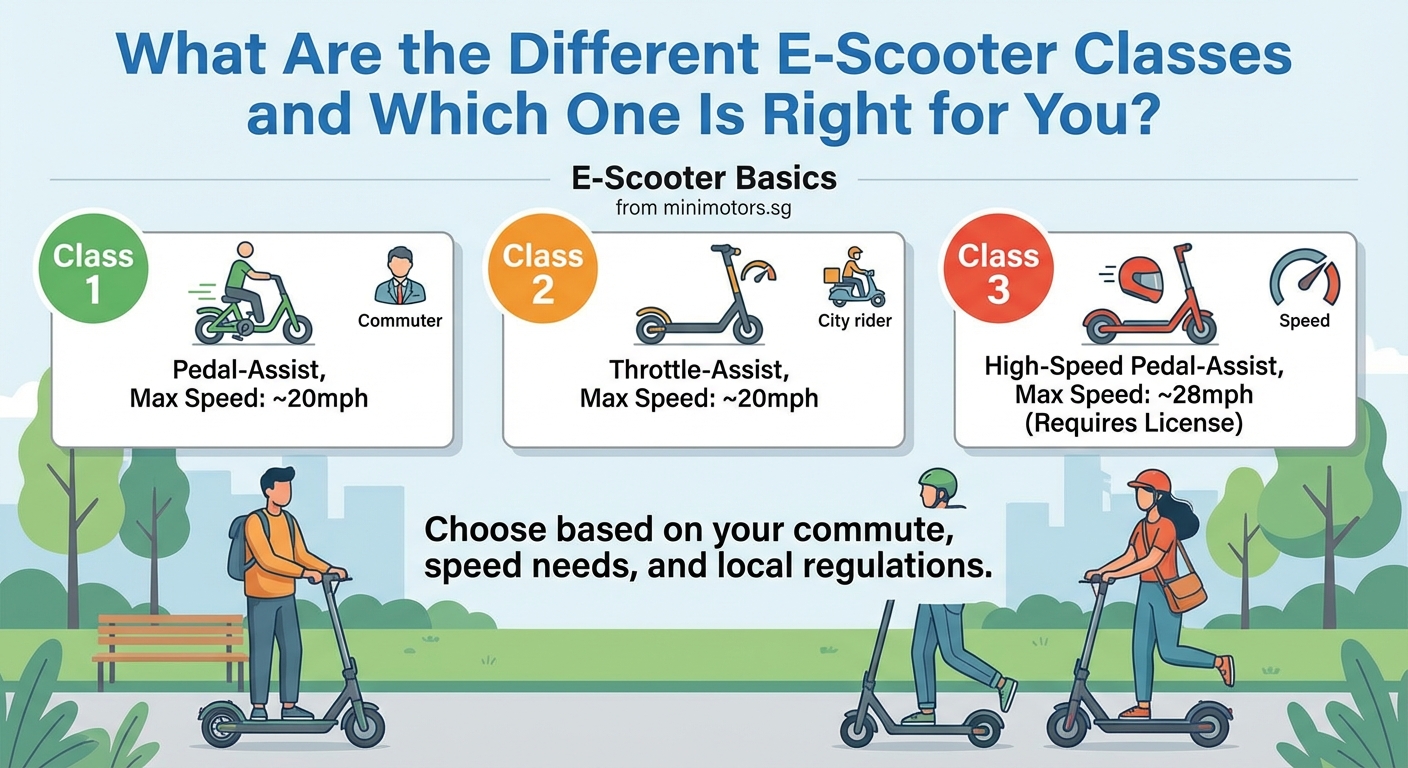
Class 3 models bump the speed limit to 28 mph, opening up longer commutes and mixed-traffic riding. Most require pedal-assist only, though some jurisdictions allow throttles up to 20 mph.
This extra speed transforms your range. Routes that took 45 minutes on a Class 1 might drop to 25 minutes on a Class 3.
The tradeoff? Stricter regulations. Many areas require helmets for Class 3 riders, even if they’re optional for lower classes. Some cities ban them from bike paths entirely, forcing you onto roads.
You might also need to register your scooter or carry liability insurance, depending on where you live. These requirements vary wildly by state and city.
Battery capacity jumps significantly to support higher speeds. Premium Class 3 models pack 500Wh to 1000Wh batteries, compared to 250Wh to 400Wh on Class 1 and 2 scooters.
Class 3 considerations:
- Helmet laws often mandatory
- Road riding required in many jurisdictions
- Higher insurance costs in some regions
- Increased maintenance from wear on components
Comparing all three classes side by side
| Feature | Class 1 | Class 2 | Class 3 |
|---|---|---|---|
| Top speed | 15 mph | 15 mph | 28 mph |
| Throttle | No | Yes | Varies by region |
| Typical range | 20-30 miles | 15-25 miles | 25-40 miles |
| Bike path access | Usually yes | Usually yes | Often restricted |
| Helmet requirement | Rarely | Rarely | Often mandatory |
| Minimum age | Varies | Varies | Usually 16+ |
This table simplifies complex regulations. Your actual legal requirements depend on state, county, and city laws that can contradict each other.
How to match class to your commute
Start by measuring your typical route. Anything under 5 miles works fine on Class 1 or 2. Routes from 5 to 15 miles benefit from Class 2 or 3. Longer distances really need Class 3 speed.
Consider your route terrain. Flat cities like Miami let you maximize range on any class. Hilly areas like San Francisco demand more powerful motors that drain batteries faster.
Traffic patterns matter too. If you’ll ride mostly on protected bike lanes, Class 1 or 2 makes sense. Routes mixing with car traffic benefit from Class 3 speed to keep pace.
Check your local laws before buying. Some cities have bizarre carve-outs. New York allows Class 1 and 2 but bans Class 3 entirely. California permits all three but with different rules for each.
Think about where you’ll store and charge your scooter. Class 3 models weigh 50 to 70 pounds with their larger batteries. Hauling one up three flights of stairs gets old fast.
Legal requirements you can’t ignore
Most states don’t require licenses for Class 1 or 2 scooters, but Class 3 often demands a standard driver’s license. Some jurisdictions require a motorcycle endorsement for anything over 20 mph.
Age minimums typically start at 16 for Class 3, while Class 1 and 2 might allow riders as young as 12 or 14. Schools often set their own rules regardless of state law.
Insurance requirements remain murky. Personal liability coverage through your homeowner’s or renter’s policy might cover Class 1 and 2 incidents. Class 3 sometimes requires dedicated micro-mobility insurance.
Registration varies wildly. California requires zero paperwork for any class. Alabama wants you to register Class 3 scooters like mopeds. Check with your local DMV before assuming anything.
Helmet laws split along class lines in many states. Oregon mandates helmets for Class 3 riders over 16 but makes them optional for Class 1 and 2. Florida requires helmets for everyone under 16 regardless of class.
For detailed guidance on navigating these regulations, our how to register your electric scooter guide walks through the documentation process.
Making your first purchase decision
Follow these steps to narrow your options:
- Map your most common routes and calculate total weekly mileage
- Research your city, county, and state scooter regulations
- Test ride at least one model from each class you’re considering
- Calculate total cost including accessories, insurance, and registration
- Factor in maintenance costs based on how hard you’ll ride
Don’t skip the test ride. A scooter that looks perfect on paper might feel unstable at speed or have uncomfortable ergonomics for your height.
Budget for essential accessories. A quality helmet runs $50 to $150. Lights for night riding cost $30 to $80. A sturdy lock adds another $40 to $100.
Consider future needs too. Buying a Class 1 to save $300 seems smart until you realize you need Class 3 speed six months later. Upgrading costs more than buying right the first time.
Read owner reviews from riders in your climate. Cold weather devastates battery range. Heat can trigger thermal shutdowns. Make sure your chosen model handles your local conditions.
If you’re new to electric scooters entirely, check out our guide on choosing your first electric scooter for broader buying advice.
Common mistakes when choosing a class
Many riders buy based solely on price, grabbing whatever’s on sale. Then they discover their $400 Class 1 can’t handle their 12-mile commute or isn’t legal on their route.
Others overestimate their needs. Spending $2,000 on a Class 3 speed demon makes no sense if you’re just cruising 2 miles to the coffee shop.
Ignoring weight becomes painful fast. That 65-pound Class 3 beast seems fine in the showroom. Carrying it up subway stairs twice a day breaks your spirit.
Assuming all models in a class perform identically leads to disappointment. A cheap Class 2 with a 250W motor struggles on hills where a quality 500W Class 2 climbs easily.
Forgetting about battery longevity causes budget problems. Cheap batteries need replacement after 300 cycles. Premium cells last 1,000 cycles or more.
Safety considerations across all classes
Speed increases danger exponentially. A crash at 15 mph might leave you bruised. The same crash at 28 mph can mean broken bones or worse.
Braking systems become critical at higher speeds. Class 3 scooters need hydraulic disc brakes front and rear. Class 1 models can get away with basic drum brakes.
Tire size affects stability. Larger 10-inch pneumatic tires handle road imperfections better than 8-inch solid tires, especially at Class 3 speeds.
Suspension separates premium models from budget options. Even Class 1 scooters benefit from front suspension on rough pavement. Class 3 models absolutely need dual suspension for safe high-speed riding.
Our detailed breakdown of e-scooter braking systems explains what to look for in stopping power.
Essential safety gear by class:
- Class 1: Basic helmet, knee pads optional
- Class 2: Certified helmet, gloves recommended
- Class 3: Full-face helmet, gloves, knee and elbow pads strongly advised
How classes affect insurance and liability
Homeowner’s insurance typically covers Class 1 and 2 scooters under personal property and liability clauses. Class 3 models often fall into a gray area that insurers handle inconsistently.
Some companies now offer dedicated micro-mobility policies starting around $100 annually. These cover theft, damage, and liability for all classes.
Medical payments can exceed $50,000 for serious scooter accidents. Your health insurance covers injuries, but you might face liability claims if you hurt someone else.
Umbrella policies provide extra liability protection beyond your base coverage. They’re worth considering if you ride a Class 3 regularly in heavy traffic.
Document everything after any incident. Take photos, get witness information, and file police reports even for minor crashes. Insurance claims often hinge on proper documentation.
Maintenance differences between classes
Class 1 scooters need basic upkeep: tire pressure checks, brake adjustments, and occasional bearing lubrication. Most owners handle this themselves.
Class 2 models add throttle system maintenance. Electronic throttles rarely fail, but cables and sensors need periodic inspection.
Class 3 scooters demand serious attention. Higher speeds mean faster brake pad wear, more frequent tire replacements, and greater stress on bearings and suspension components.
Battery care becomes crucial across all classes. Proper charging habits extend battery life dramatically. Never let your battery fully discharge, and avoid leaving it at 100% for extended periods.
For comprehensive upkeep guidance, our ultimate e-scooter maintenance checklist covers daily, weekly, and monthly tasks.
Real-world range expectations
Manufacturer range claims assume ideal conditions: flat terrain, 150-pound rider, 68°F temperature, new battery, moderate speed. Real life rarely cooperates.
Add 20 pounds of cargo and you’ll lose 10 to 15% of advertised range. Cold weather below 40°F can cut range by 30% or more. Aggressive acceleration and frequent stops drain batteries faster than steady cruising.
Class 1 scooters might promise 30 miles but deliver 20 in typical use. Class 2 throttle use can drop advertised 25-mile range to 15 miles. Class 3 models running at top speed might get half their rated range.
Plan for worst-case scenarios. If your commute measures 15 miles, a scooter rated for 20 miles won’t cut it when temperatures drop or you’re running late and riding hard.
Carrying a portable charger adds weight but provides peace of mind. Some workplaces let you top off during the day, effectively doubling your range.
Learn more about realistic expectations in our article on average e-scooter range.
Upgrading between classes
Selling a used Class 1 to buy Class 2 or 3 makes financial sense if your needs genuinely changed. But serial upgrading wastes money.
The used market favors sellers in spring and summer. You’ll get 60 to 70% of original price for a well-maintained scooter under a year old.
Winter buyers score deals as demand drops. Patient shoppers can find barely-used Class 3 scooters for 40% off retail in December and January.
Some manufacturers offer trade-in programs, though dealer offers typically come in 20% below private sale prices. The convenience might be worth the discount if you hate dealing with strangers.
Factor in accessories when calculating upgrade costs. Your old helmet, lock, and lights probably transfer to the new scooter, saving $200 or more.
Finding the right fit for your lifestyle
Your ideal class depends on factors beyond just speed and range. Consider how scooter riding fits into your broader transportation mix.
Commuters who combine scooters with trains or buses need portable Class 1 or 2 models that fold easily. Pure scooter commuters benefit from Class 3 power even if the scooter weighs more.
Weekend recreational riders might prefer Class 2 for the throttle fun factor without needing Class 3 speed. Fitness-focused riders often choose Class 1 to force more physical effort.
Parents buying for teens should start with Class 1 regardless of local laws. The lower speed provides a safer learning environment while kids develop road awareness.
Seniors and riders with mobility issues appreciate Class 2 throttles that eliminate the need to push off manually. The ability to rest while still moving helps manage energy.
First-time riders should read our essential things every first-time e-scooter rider should know before making any purchase.
Choosing your path forward
Electric scooter classes exist to create order in a rapidly growing market. Understanding these categories helps you make smarter buying decisions and avoid legal problems.
Start with your actual needs, not aspirational ones. Be honest about your typical routes, fitness level, and willingness to deal with regulations. The perfect scooter matches your real life, not your ideal fantasy version.
Test ride multiple classes before committing. What sounds perfect on paper might feel wrong in practice. Your body knows what works better than any spec sheet.
Remember that classes are just starting points. Individual models within each class vary dramatically in quality, features, and real-world performance. Do your homework on specific models, not just their classification.
The right class transforms your commute from a chore into something you actually look forward to. Choose wisely, and you’ll wonder how you ever lived without your scooter.
