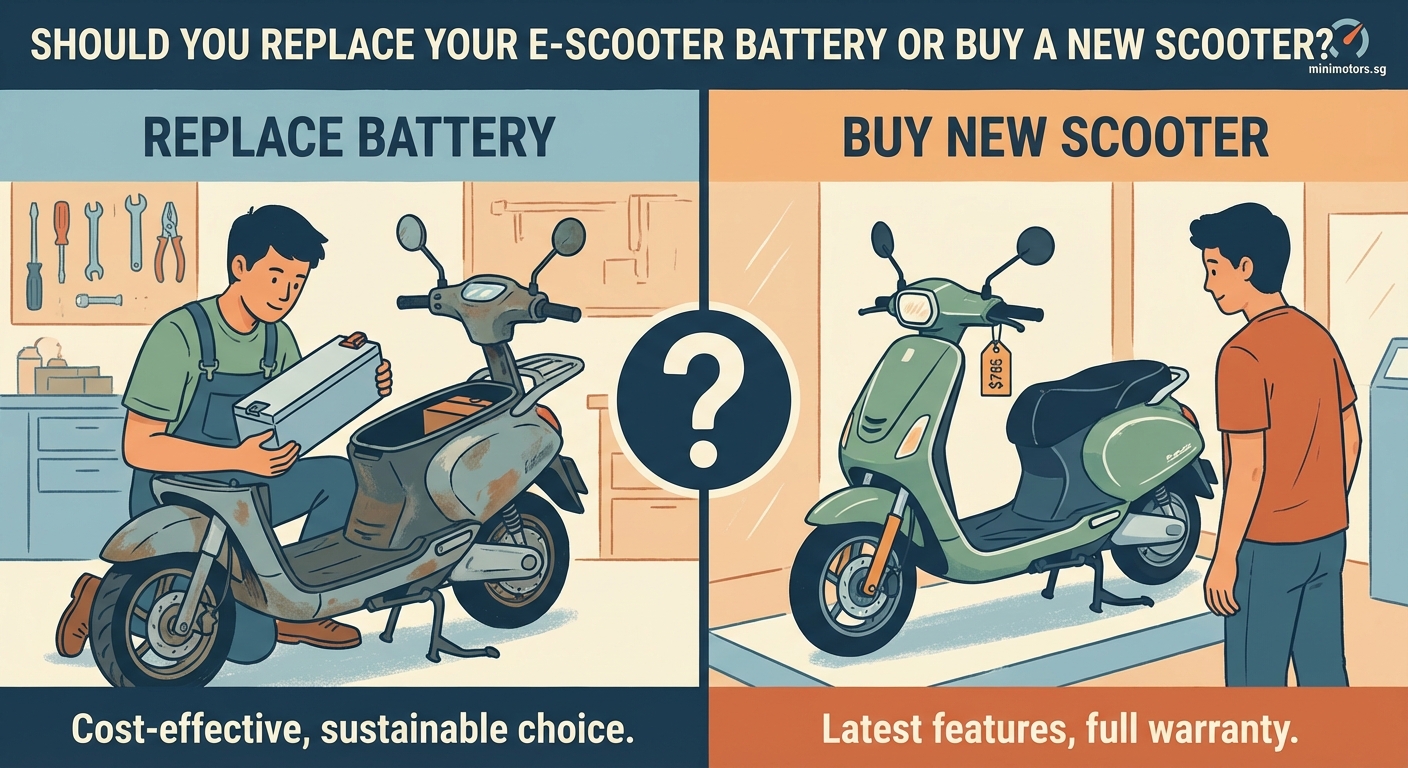
Should You Replace Your E-Scooter Battery or Buy a New Scooter?
Your electric scooter isn’t holding a charge like it used to. The range that once got you across town now barely makes it halfway. You’re stuck wondering whether to invest in a new battery or just bite the bullet and buy a whole new scooter. It’s a frustrating position, and the wrong choice could cost you hundreds of dollars.
Battery replacement makes sense when your scooter is less than three years old, the frame and components are solid, and a new battery costs under 40% of a replacement scooter. Buy new if your scooter has multiple failing parts, outdated technology, or the battery replacement cost approaches 50% or more of a comparable new model with better features.
Understanding battery degradation and what it means for you
Every lithium-ion battery has a finite lifespan measured in charge cycles. Most electric scooter batteries deliver between 300 and 800 full cycles before capacity drops noticeably.
A charge cycle happens when you use 100% of the battery’s capacity, but not necessarily all at once. If you drain 50% today and 50% tomorrow, that counts as one cycle.
After hitting the cycle threshold, your battery might only hold 70% to 80% of its original capacity. How long do e-scooter batteries actually last depends heavily on how you charge and store the battery.
Temperature extremes accelerate degradation. Leaving your scooter in a hot garage all summer or riding in freezing winter conditions puts extra stress on the cells.
Poor charging habits matter too. Letting the battery sit at 0% for weeks or keeping it plugged in at 100% constantly will shorten its life.
When battery replacement makes financial sense
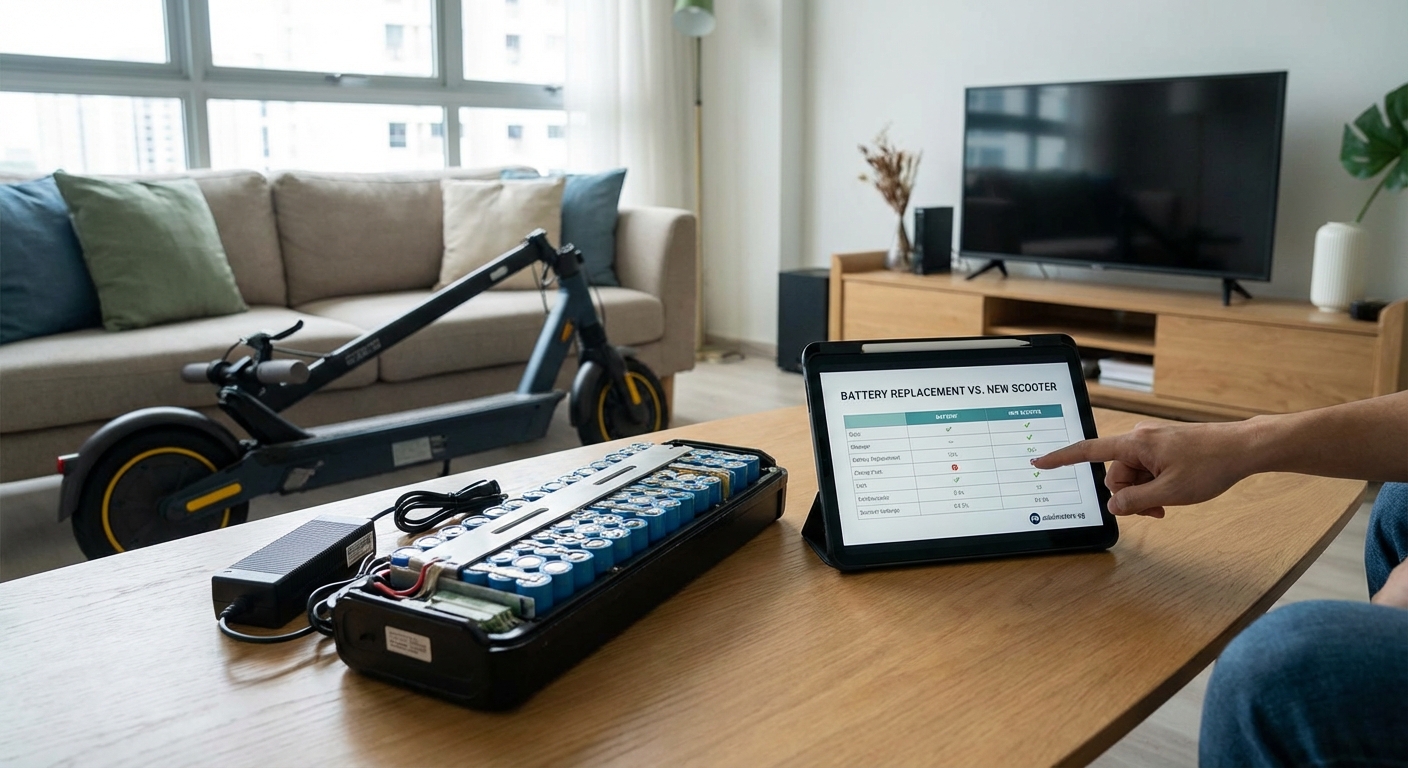
Replacing a battery is the smarter move when the rest of your scooter still performs well.
Check these factors before deciding:
- Calculate the replacement cost ratio. Find out how much a genuine replacement battery costs. Divide that number by the price of a comparable new scooter. If the ratio is under 0.4 (40%), replacement usually wins.
- Assess the scooter’s age. Scooters under two years old with solid frames and motors are prime candidates for battery replacement.
- Evaluate component condition. Inspect brakes, tires, suspension, and the motor. If these parts need replacement soon, the total cost might push you toward buying new.
Budget scooters often have battery replacement costs that approach 60% to 70% of the original purchase price. Premium models typically see ratios closer to 25% to 35%.
A $300 scooter with a $180 battery replacement doesn’t make sense. A $1,200 scooter with a $350 battery swap absolutely does.
“If your scooter’s motor, controller, and frame are in great shape, a new battery can give you another two years of reliable service at a fraction of the cost of buying new.”
Comparing replacement battery costs across scooter types
Different scooter categories have wildly different battery economics.
| Scooter Type | Typical Battery Cost | New Scooter Cost | Replacement Ratio |
|---|---|---|---|
| Budget commuter | $120 to $200 | $250 to $400 | 48% to 67% |
| Mid-range commuter | $250 to $400 | $600 to $1,000 | 30% to 50% |
| Premium commuter | $400 to $700 | $1,200 to $2,000 | 25% to 40% |
| Performance/off-road | $600 to $1,200 | $2,000 to $4,000 | 20% to 35% |
Budget scooters rarely justify battery replacement. The economics just don’t work.
Mid-range and premium scooters offer better value because the battery is a smaller percentage of the total cost, and the other components are built to last longer.
Performance scooters with dual motors and advanced suspension systems almost always favor battery replacement unless the scooter is more than four years old.
Hidden costs that change the equation
Battery replacement isn’t just the sticker price of the cell pack.
Factor in these additional expenses:
- Labor costs. If you can’t install the battery yourself, shop fees range from $50 to $150.
- Shipping fees. Batteries are heavy and classified as hazardous materials. Expect $30 to $80 in shipping.
- Warranty gaps. Third-party batteries often void manufacturer warranties on other components.
- Compatibility risks. Aftermarket batteries might not fit perfectly or communicate properly with your scooter’s controller.
Buying a new scooter includes a fresh warranty covering the entire unit for at least one year. Some manufacturers offer two-year coverage on premium models.
You also get the latest safety features, improved range technology, and better build quality if you choose a newer model.
Signs your scooter needs more than just a battery
Sometimes the battery is just the first domino to fall.
Watch for these red flags:
- Motor makes grinding or clicking noises
- Controller cuts out randomly during rides
- Brake performance has degraded significantly
- Frame shows cracks or structural damage
- Suspension components are worn or leaking
- Wiring harness has visible damage or corrosion
If you’re facing two or more of these issues alongside battery failure, buying new makes more sense.
Replacing multiple components quickly adds up. A motor replacement alone can cost $150 to $500 depending on the model.
Understanding e-scooter braking systems can help you assess whether your brakes need immediate attention.
How to decide if your scooter’s technology is outdated
Electric scooter technology moves fast. A three-year-old model might lack features that are standard today.
Consider these upgrades available on newer models:
- Regenerative braking that extends range by 10% to 15%
- App connectivity for diagnostics and ride tracking
- Improved battery management systems that extend cell life
- Better waterproofing with IP ratings of IP54 or higher
- Dual suspension for smoother rides
- Larger, more stable wheel sizes
If your current scooter lacks these features and you’re already facing battery replacement, the incremental cost of buying new might deliver significantly better performance and longevity.
Top features to look for when buying a premium electric scooter can help you understand what’s available now.
Step-by-step process for evaluating your options
Follow this framework to make a data-driven decision:
- Document your scooter’s current condition. Write down the model, age, total miles ridden, and any issues beyond the battery.
- Get a replacement battery quote. Contact the manufacturer or authorized dealers for exact pricing including shipping.
- Research comparable new models. Find three scooters with similar specs to your current model and note their prices.
- Calculate the total cost of repair. Add battery cost, installation, and any other needed repairs.
- Compare performance specs. Look at range, speed, weight capacity, and features between your repaired scooter and new options.
- Factor in your usage patterns. If you ride daily, reliability matters more than saving $100.
- Make the call. If repair costs exceed 45% of a comparable new scooter with better features, buy new.
This process removes emotion from the decision and focuses on pure value.
Common mistakes that waste money
People make predictable errors when facing this choice.
Avoid these pitfalls:
- Buying the cheapest aftermarket battery without checking reviews
- Ignoring labor costs if you’re not comfortable with DIY installation
- Failing to verify battery compatibility before ordering
- Not considering the resale value of your current scooter
- Overlooking warranty coverage on new scooters
- Assuming all battery cells are equal quality
Cheap batteries from unknown manufacturers often fail within months. Stick with OEM (original equipment manufacturer) batteries or reputable third-party brands with verified reviews.
What to do when your e-scooter battery won’t hold a charge covers troubleshooting steps before you commit to replacement.
Real-world scenarios and what makes sense
Let’s look at three common situations:
Scenario 1: You own a two-year-old mid-range scooter that cost $800 new. The battery replacement is $320, and everything else works perfectly. You ride 15 miles per week.
Decision: Replace the battery. The ratio is 40%, the scooter is relatively new, and your moderate usage means other components have plenty of life left.
Scenario 2: You have a four-year-old budget scooter that cost $350. The battery is $180, but you’ve also noticed the brakes are spongy and the motor occasionally cuts out. Comparable new scooters with better features cost $400.
Decision: Buy new. You’re looking at battery plus brake repairs, and the total will approach or exceed the cost of a better scooter with a warranty.
Scenario 3: You ride a premium performance scooter that cost $2,200 two years ago. The battery replacement is $650. The scooter has dual motors, hydraulic brakes, and premium suspension, all in excellent condition.
Decision: Replace the battery. Even at $650, you’re paying 30% of the original cost to restore full performance on a scooter that would cost $2,500 to replace with equivalent specs today.
Environmental considerations worth thinking about
Battery replacement is the greener choice when it’s financially viable.
Manufacturing a new scooter requires mining raw materials, energy-intensive production, and global shipping. Replacing just the battery reduces your environmental footprint significantly.
Proper disposal of your old battery matters too. Most cities have hazardous waste collection programs that handle lithium-ion batteries safely.
Many scooter manufacturers now offer battery recycling programs. Check with your brand before tossing the old pack in the trash.
If you do buy new, consider selling or donating your old scooter for parts. Someone might need the motor, controller, or frame components.
Making the most of whichever choice you make
Once you’ve decided, maximize your investment.
If you replace the battery:
- Follow proper charging practices to extend the new battery’s life
- Update firmware if your scooter supports it
- Replace worn components like brake pads and tires
- Keep detailed maintenance records for resale value
Can you overcharge your e-scooter battery explains best practices for the new pack.
If you buy new:
- Research models thoroughly before purchasing
- Take advantage of the full warranty period
- Start good maintenance habits from day one
- Consider extended warranty options if you ride daily
How to choose your first electric scooter applies even if it’s your second or third scooter.
Your scooter, your budget, your call
The decision to replace your electric scooter battery or buy new comes down to math, not emotion. Run the numbers honestly, assess your scooter’s overall condition, and factor in how much you value new features versus proven reliability. A well-maintained scooter with a fresh battery can deliver another two years of solid service. A new scooter brings peace of mind, better technology, and a warranty. Neither choice is wrong if it fits your budget and riding needs.
