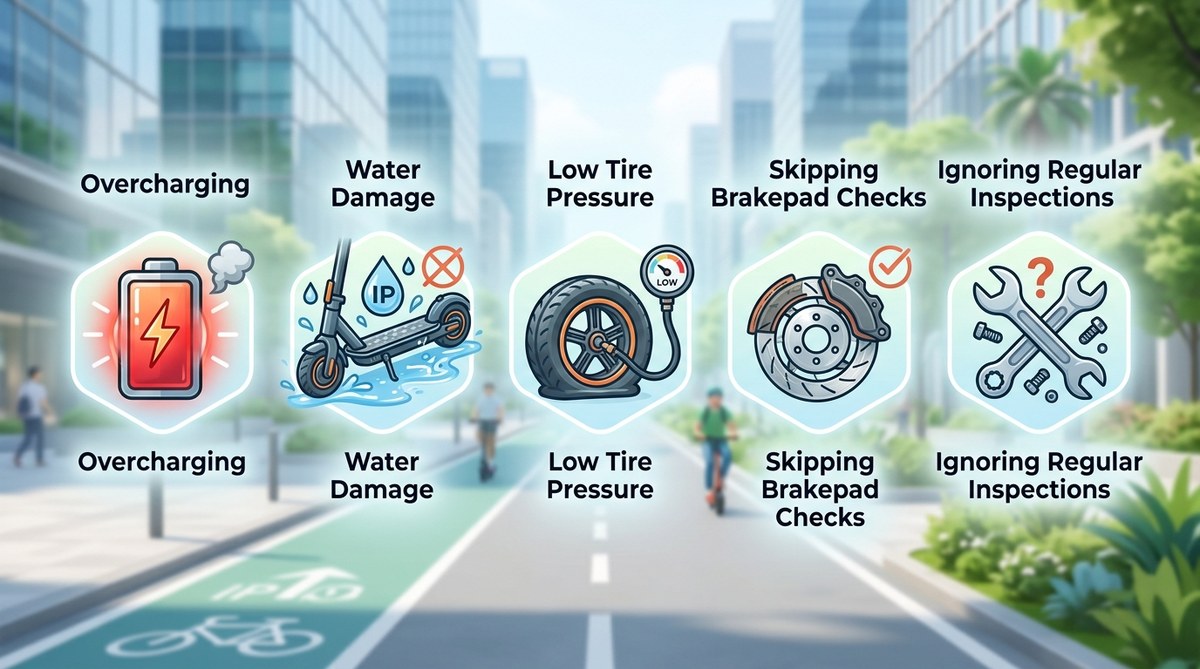
5 Maintenance Mistakes That Are Shortening Your E-Scooter’s Life
Your e-scooter is a precision machine. It blends mechanical parts with sensitive electronics, and it asks very little in return: just a bit of regular care. But many riders accidentally chip away at their scooter’s lifespan without realizing it. A loose bolt here, a neglected brake pad there, or a battery left to drain completely can turn a two-year commuter into a paperweight in half that time. The good news? All these e-scooter maintenance mistakes are easy to fix once you know what to look for.
The five most common e-scooter maintenance mistakes are low tire pressure, dirty or worn brakes, improper battery charging, lack of lubrication on moving parts, and wrong storage conditions. Fixing these five things alone can extend your scooter’s life by thousands of miles and save you hundreds of dollars in repairs.
Mistake 1: Riding on Underinflated or Overinflated Tires
Your tires are the only contact points with the road. If they are not at the correct pressure, everything else suffers. Underinflated tires create more rolling resistance, which drains your battery faster and puts extra strain on the motor. Overinflated tires give a harsh ride and reduce traction, especially on wet pavement or loose gravel.
Many riders assume that if the tire looks fine, it is fine. But a tire can lose 5 to 10 PSI per week through normal microscopic leaks. A scooter rolled out of the garage at 50 PSI on Monday might be at 38 PSI by Friday. That soft tire will heat up more, wear unevenly, and increase the risk of a pinch flat.
The fix: Check your tire pressure at least once a week. Use a simple digital gauge and inflate to the exact PSI recommended by your scooter’s manufacturer. For most commuter models, that falls between 40 and 50 PSI. If your scooter has tubeless tires, carry a small portable pump or a CO2 inflator in your backpack.
| Tire Condition | Effect on Performance | Effect on Lifespan |
|---|---|---|
| Underinflated (>10 PSI low) | Sluggish acceleration, reduced range, harder to steer | Motor and battery work harder; tires wear faster on edges |
| Overinflated (>5 PSI high) | Harsh ride, less grip in corners | Center tread wears quickly; risk of blowout on bumps |
| Correct pressure | Smooth, efficient ride | Even tread wear; components last longer |
Mistake 2: Waiting Too Long to Replace Brake Pads
Brakes are not optional. Yet many riders treat brake squeal or a “soft” lever as a minor annoyance rather than a warning. Worn brake pads increase stopping distance, especially in wet conditions. If you ride in a hilly city like San Francisco or Seattle, you might wear through a set of pads in three months. Even flat-landers should inspect their pads every 200 miles.
How to spot worn pads without tools
- Look at the pad surface through the caliper opening. If the groove is nearly gone or the pad is thinner than a dime, replace them.
- Listen for a metallic scraping sound. That means the pad backing plate is contacting the rotor. Replace immediately to avoid rotor damage.
- Feel for a spongy lever that pulls further toward the handlebar than usual. This can indicate pad wear or air in the hydraulic line.
The routine: Set a reminder on your phone to check brake pads every 30 days. If you ride in rain or dust, check every two weeks. Replacing pads early is cheap. Replacing a scored disc rotor is not.
Expert tip: “Most e-scooter brake pads last between 400 and 800 miles. If you ride aggressively or carry heavy loads, expect to change them twice as often. Keep a spare set in your tool kit so you are never caught without.” – Veteran scooter mechanic, Austin, TX
Mistake 3: Charging the Battery the Wrong Way
Battery care is where most e-scooter maintenance mistakes happen. Lithium-ion batteries are not like old lead-acid cells. They do not like being fully drained. They do not like being stored at 100% charge for weeks. And they absolutely hate extreme heat.
Three battery habits that shorten life
- Letting the battery hit zero percent. The battery management system (BMS) cuts off power before total depletion, but repeated deep discharges stress the cells. Charge when the indicator shows 20-30%, not 5%.
- Charging in a hot garage or under direct sunlight. Heat is the number one enemy of lithium cells. If your scooter has been sitting in 90 degree sun, let it cool for 30 minutes before plugging in.
- Storing the scooter for winter with a full charge. A battery stored at 100% for months will lose capacity faster. Store at 50-60% charge in a cool place (55-70 degrees Fahrenheit is ideal).
If you commute daily, charge after each ride. If you only ride on weekends, top up after the last ride to about 80% and leave it unplugged until your next ride. For more details on charging cycles, see our article on how long do e-scooter batteries actually last.
Mistake 4: Skipping Lubrication on Moving Parts
Scooters have hinges, folding mechanisms, suspension pivots, and bearings that all need periodic lubrication. A dry hinge creaks and wears down metal. A neglected suspension bushing rattles and loses damping ability. A chain-driven scooter without chain lube will stretch and skip.
Many riders think “if it is not squeaking, it is fine.” By the time you hear noise, wear has already started. Vibrations and friction slowly enlarge clearances. Bolts loosen. Components that used to fit snugly develop play, and that play translates into instability at speed.
What to lubricate and how often
- Folding mechanism and stem clamp: Apply a light machine oil every month. Wipe off excess so it does not attract dirt.
- Suspension bushings and swingarm pivots: Use a silicone-based grease every three months. Avoid WD-40 as a lubricant; it is a solvent and will dry out over time.
- Brake and throttle cables: If your scooter uses cables, drip a little cable lubricant into the housing twice a year.
- Wheel bearings: These are sealed on most modern scooters, but if yours are serviceable, inspect and repack grease every 500 miles.
A good rule: whenever you wash your scooter, take an extra five minutes to lubricate the hinge points and pivot areas. Water strips away existing grease, so reapply after every cleaning.
Mistake 5: Storing the Scooter in Extreme Conditions
Where you park your scooter when you are not riding matters more than most people think. Leaving it in a hot car trunk or a damp shed is a recipe for corrosion, battery degradation, and electronic failure.
Common storage mistakes
- Leaving the scooter in direct sunlight for hours. Ultraviolet rays fade displays and crack plastic panels. Heat accelerates battery aging.
- Storing it in a moist basement or garage with condensation. Water vapor seeps into connectors and creates corrosion on circuit boards.
- Propping it against a wall on the kickstand but letting it lean on the handlebar. This bends the stem over time and damages the folding latch.
The better approach: Keep your scooter indoors in a climate-controlled space. If that is not possible, use a waterproof cover and place it off the concrete floor (moisture wicks up through concrete). Always store it with the battery at a moderate charge and disconnect the battery if you plan to leave it for more than a month.
A Simple Weekly Maintenance Checklist
Doing a full pre-ride inspection before every ride is ideal, but most of us have places to be. Instead, aim for this five-minute weekly routine. It catches 90% of problems before they turn into breakdowns.
- Squeeze both brakes and check for firmness. Spin each wheel and listen for scraping.
- Gauge tire pressure and inflate if needed.
- Fold and unfold the scooter three times. Listen for clicks or grinding from the latch.
- Look at the charge level. If it is below 30%, plug it in after the ride.
- Wipe down the deck and stem with a damp cloth. Remove any caked-on mud or salt.
Once a month, add two more tasks: inspect brake pad thickness and lubricate the folding mechanism. Once every three months, check all fasteners for tightness using a hex key set.
If you want a more detailed breakdown, check out the ultimate e-scooter maintenance checklist for daily, weekly, and monthly tasks.
The Hidden Cost of Neglect
A new mid-range e-scooter costs between 500 and 1,200 dollars. A replacement battery can run 200 to 400 dollars. A new motor might set you back 150 to 300. Yet the cost of prevention is near zero: a tire gauge costs 5 dollars, a bottle of silicone lubricant costs 8 dollars, and a set of brake pads costs 15 dollars. The math is simple.
Skipping these small tasks does not just shorten your scooter’s life. It also increases the chance of a breakdown in the middle of your commute, a flat tire on a rainy day, or a brake failure at the bottom of a hill. Those are not just expensive. They are dangerous.
Your Ride, Your Responsibility
You do not need to be a mechanic to take good care of your e-scooter. You just need a little awareness and a few minutes of your time each week. Notice when something feels different. Listen for new noises. Check the board before you ride, not after something breaks.
Your scooter gives you freedom from traffic jams, crowded buses, and expensive parking. Treat it well, and it will give you thousands of miles of reliable service. Start with these five changes. Your future self, the one who is not stranded on the side of the road, will thank you.
