5 Defensive Riding Techniques Every E-Scooter Commuter Should Know
Every time you step onto your electric scooter, you share the road with cars, bikes, pedestrians, and unexpected obstacles. Defensive riding means staying alert, anticipating hazards, and making smart choices before trouble appears. It is not about being timid. It is about being prepared. For urban commuters, defensive riding techniques can be the difference between a smooth ride and a trip to the ER. Let us walk through five practical skills you can start using today.
Defensive riding for e-scooters is about scanning ahead, controlling your speed, positioning yourself where drivers can see you, braking early, and treating every intersection as a risk zone. These habits cut your chance of being hit or falling. They turn a reactive rider into a proactive one. Practice them daily until they become automatic.
What Is Defensive Riding for E-Scooters?
Defensive riding is a mindset. Instead of assuming others see you or will follow the rules, you prepare for mistakes. You keep a safe distance. You watch for doors opening, cars turning without signals, and potholes hiding in shadows. In 2026, with e-scooter ridership still climbing in U.S. cities like Los Angeles, Austin, and New York, defensive habits matter more than ever.
Think of it as a safety bubble. You maintain three seconds of reaction time in front. You stay out of blind spots. And you never trust a crosswalk.
The 5 Defensive Riding Techniques Every Commuter Needs
If you want to stay upright and unharmed, practice these five techniques on every ride. They are ranked from most foundational to advanced.
-
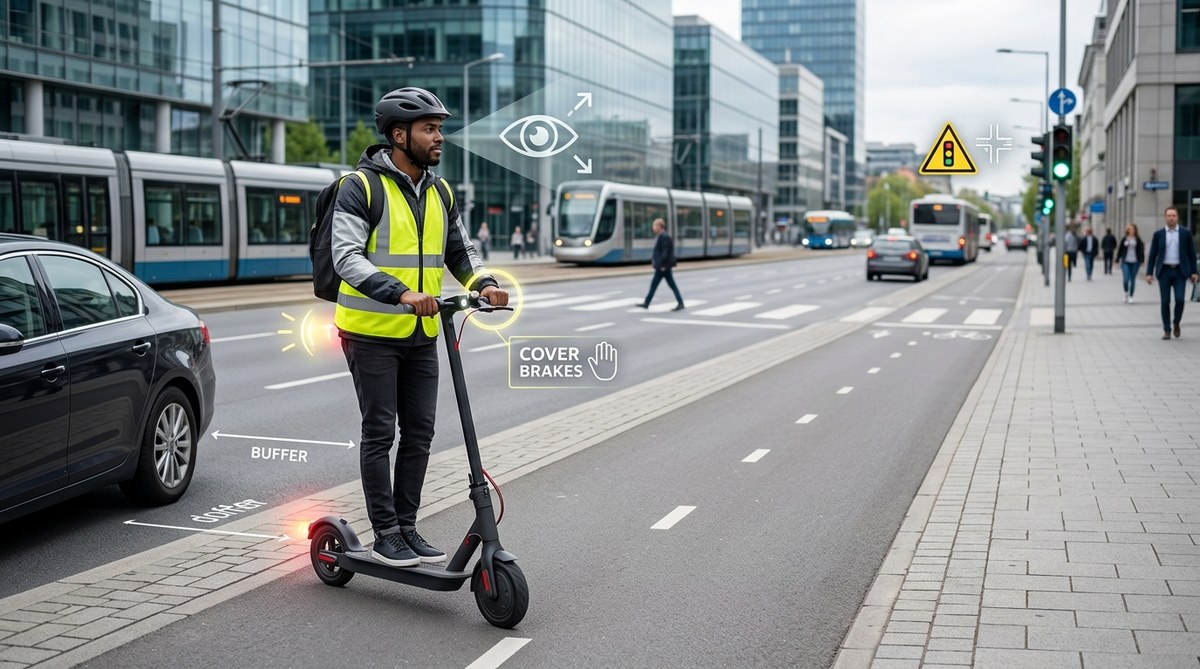
Scan and plan your escape route. Your eyes should move constantly. Look 10 to 15 seconds ahead. Check for turning cars, delivery trucks, and pedestrians stepping off curbs. Ask yourself: if that car pulls out, where can I go? Always have an escape path.
-
Position yourself visibly and predictably. Ride in the center of a bike lane or, if no lane exists, about four feet from parked cars. This prevents dooring and puts you in the driver’s mirror. Avoid weaving between parked and moving traffic. According to the National Highway Traffic Safety Administration, most e-scooter crashes happen when riders merge unexpectedly.
-
Control your speed relative to conditions. Slower is not always safer, but going too fast for the environment is deadly. In wet weather, on loose gravel, or near school zones, reduce your speed. On clear pavement with good visibility, keep a pace that lets you stop within half the distance you can see.
-
Brake early and with both brakes. The common mistake is to grab the front brake hard and flip over the handlebars. Instead, apply the rear brake first, then smoothly add the front. Practice emergency stops in an empty parking lot until you can stop from 15 mph in under 10 feet. Know your scooter’s braking system. If you ride a model with regenerative braking, learn how it engages.
-
Treat every intersection as a kill zone. Accidents happen where two paths cross. Before crossing, make eye contact with drivers. Slow down and cover your brakes. Assume a right-turning car will not see you until you confirm otherwise. This technique alone prevents the most common type of e-scooter crash: the left-cross or right-hook.
Common Mistakes vs. Defensive Actions
The difference between a risky habit and a safe one is often small. The table below shows typical errors and the defensive alternative.
| Mistake | Defensive Action |
|---|---|
| Riding too close to parked cars | Ride 4+ feet away to avoid doors |
| Relying only on the horn or bell | Use eye contact and hand signals |
| Accelerating through yellow lights | Stop and wait for the next green |
| Wearing dark clothes at night | Add reflective gear and a bright headlight |
| Checking your phone while stopped | Pull off the road completely to use it |
Expert advice from a veteran scooter mechanic: “I see riders who upgrade their battery but never their brakes. Strong acceleration without stopping power is like buying a fast car with bald tires. Match your braking system to your riding speed.”
Pre-Ride Checklist for Defensive Riders
A defensive rider starts before the motor turns on. Spend two minutes on this list every day.
- Check tire pressure and look for cuts or embedded glass.
- Test both brakes: front and rear should engage smoothly without squeaking.
- Confirm your headlight and taillight work. In low light, add a secondary light to your helmet or backpack.
- Fold and unfold the stem to ensure the latch is tight. Folding mechanism failures cause crashes.
- Adjust your helmet straps. A loose helmet offers almost no protection in a fall.
If any item fails, do not ride until it is fixed. A properly maintained scooter is half the battle. For more tips on keeping your ride in top shape, see our ultimate e-scooter maintenance checklist.
How to Handle High-Risk Scenarios
Even with good habits, some situations demand extra caution.
Night riding. After sunset, visibility drops dramatically. Use the strongest legal headlight you can find. Wear a reflective vest. Assume every driver cannot see you until you see them react. For more night-specific advice, check out night riding safety essential visibility tips for e-scooter commuters.
Wet roads. Painted lane lines become ice slicks. Manhole covers get slippery. Reduce your speed by at least 30 percent. Avoid sudden braking or sharp turns. Lean your body only, not the handlebars, to make smooth turns.
Intersections with right turn lanes. Drivers often look left for traffic and forget to check right for a scooter coming up the lane. To avoid a right-hook crash, hang back behind the driver’s window until you can see their front wheels start to turn. Then you know it is safe to proceed.
Your Roadmap to Safer Commuting
Mastering defensive riding techniques does not happen overnight. Pick one technique each week and focus on it until it becomes habit. Start with scanning and escape routes. Then work on positioning. Then speed control. By the end of the month, you will ride with more confidence and fewer close calls.
The road will throw surprises at you. That is part of city life. But with these skills, you can handle them. You will arrive at work or home relaxed, not rattled. And you will avoid the crashes that end rides and careers.
If you want to understand the most common accident patterns so you can predict them, read our guide on 7 common e-scooter accidents and how to avoid them. And always remember: the best ride is the one you finish safely.
