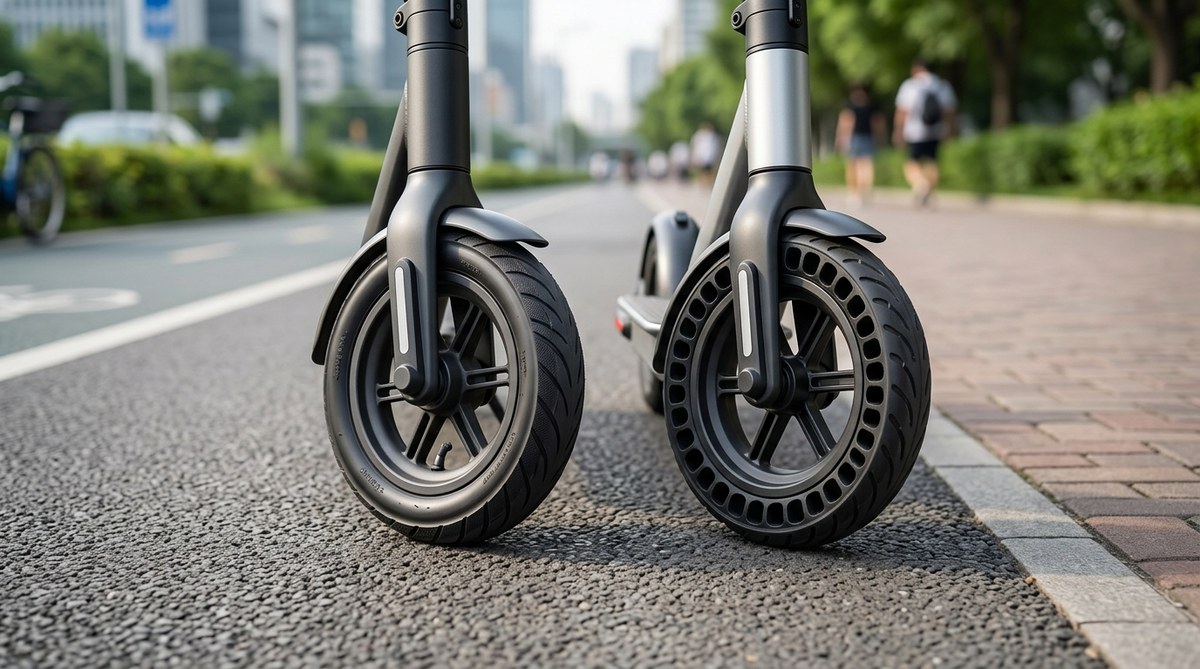
How Do E-Scooter Tires Affect Your Ride? A Beginner’s Guide to Air-Filled vs. Solid
Choosing the right e-scooter can feel like a puzzle, but your first real clue is right under your feet. The tires are the only thing between you and the pavement, and they totally change how your scooter feels, handles, and holds up over time. If you are shopping for your first scooter or just trying to understand why your current ride feels so bumpy, you have landed in the right place. Let’s break down the two main options so you can pick the best one for your daily route.
Air-filled tires give you a smooth, comfortable ride and better grip on uneven roads, but they can get flats and need regular pressure checks. Solid tires are nearly indestructible and maintenance-free, but they transfer every bump straight to your body and offer less traction in wet conditions. Your choice depends on your local roads and how much upkeep you want.
What Makes Air-Filled Tires So Popular
Air-filled tires, also called pneumatic tires, are the standard on most mid-range and premium e-scooters. They work exactly like the tires on your bicycle or car. A layer of rubber holds compressed air inside, which creates a cushion between you and the ground.
The biggest advantage is comfort. When you roll over a crack in the sidewalk or a small pothole, the air inside the tire compresses and absorbs the shock. This makes a huge difference on longer rides. If you commute three miles to work every day, pneumatic tires will leave your legs and back feeling much fresher.
Grip is another strong point. Because the tire conforms to the shape of the road surface, you get more rubber in contact with the pavement. That translates to better traction when you turn a corner or brake suddenly. In dry conditions, pneumatic tires outperform solid tires by a noticeable margin.
But there is a catch. Air-filled tires are vulnerable to punctures. A stray piece of glass, a sharp rock, or even a nail can leave you with a flat tire. Fixing a flat on an e-scooter is more involved than on a bike because the wheels are often split in half or require special tools to open. If you are not handy with repairs, a flat can mean a trip to the shop.
You also need to check the pressure regularly. Running on under-inflated tires makes the scooter sluggish and increases the risk of a pinch flat. Most riders should check pressure at least once a week.
The Case for Solid Tires
Solid tires are exactly what they sound like. They are made from a solid core of rubber or a similar polymer. There is no air chamber inside. You install them and forget about them.
The main selling point is zero maintenance. You will never deal with a flat tire again. That is a huge relief for riders who use their scooter for errands or commuting and cannot afford to be stranded. Solid tires are also great for areas with lots of debris. If you ride through alleys with broken glass or construction zones, solids will keep you moving.
Durability is another win. Solid tires wear down slowly and can last thousands of miles before they need replacement. They are also less likely to suffer damage from hitting curbs or riding over sharp bumps.
So what is the downside? Comfort takes a serious hit. Without air to absorb vibrations, every single bump, crack, and pebble gets transmitted directly through the frame and into your hands and feet. On smooth pavement, this is manageable. On rough city streets, it can be genuinely unpleasant after a mile or two.
Grip also suffers. Solid tires do not deform to match the road surface. On dry pavement, they are fine for normal riding. But on wet roads, metal grates, or painted lane markings, they lose traction much faster than pneumatic tires. If you ride in the rain, this is a real safety concern.
How to Decide Which Tire Type Fits Your Life
Your choice comes down to three factors: your local roads, your tolerance for maintenance, and your riding style. Here is a simple way to think about it.
- If your commute is mostly smooth asphalt or bike lanes, and you want the most comfortable ride possible, go with air-filled tires.
- If you ride on rough sidewalks, gravel paths, or areas with lots of debris, solid tires will save you from constant flat repairs.
- If you weigh more than 220 pounds, pneumatic tires at the correct pressure will give you better shock absorption and reduce strain on the scooter frame.
- If you hate doing any maintenance and just want to ride without thinking about it, solid tires are your best bet.
Expert advice: “Most riders are happier with pneumatic tires if they are willing to carry a small pump and learn basic flat repair. The comfort gain is worth the extra effort. But if you are buying a scooter for a college campus or a dense urban area with broken glass everywhere, solid tires will save you a headache every week.” — Micah Toll, electric scooter reviewer
Comparing Air-Filled and Solid Tires Side by Side
This table gives you a quick reference for the key differences between the two tire types.
| Feature | Air-Filled (Pneumatic) | Solid |
|---|---|---|
| Ride Comfort | Excellent, absorbs shocks | Poor, transfers all vibrations |
| Puncture Risk | High, requires repair | None, never goes flat |
| Maintenance | Weekly pressure checks needed | Zero maintenance |
| Traction (Dry) | Superior, conforms to road | Good, but less surface contact |
| Traction (Wet) | Good, manageable | Reduced, more slippery |
| Lifespan | Moderate, depends on care | Very long, slow wear |
| Weight | Lighter | Heavier |
| Cost to Replace | Lower | Slightly higher |
A Practical Step-by-Step Guide to Checking Your Tires
If you already own an e-scooter with pneumatic tires, or if you are test driving one before buying, here is a quick routine to make sure your tires are in good shape.
- Locate the valve stem on the tire. It looks like a small metal or rubber nub sticking out from the wheel hub.
- Remove the valve cap and press a tire pressure gauge firmly onto the stem. Read the number on the gauge.
- Compare the reading to the recommended PSI printed on the sidewall of the tire. Most e-scooter tires run between 40 and 60 PSI.
- If the pressure is low, attach a pump and fill to the correct level. Do not overfill, as this reduces traction and makes the ride harsh.
- Spin each wheel and look for cuts, embedded glass, or bulges in the rubber. Any damage means it is time for a replacement.
For solid tires, the check is much simpler. Look for deep cuts or chunks missing from the rubber. If the tread is worn smooth in one area, the tire should be replaced.
Common Mistakes New Riders Make With Tires
Even experienced riders slip up sometimes. Here are the most frequent errors and how to avoid them.
- Running pneumatic tires at the wrong pressure. Too low and you risk pinch flats. Too high and you lose grip. Use a gauge, not your fingers.
- Ignoring a slow leak. A tire that loses pressure over a few days has a small puncture. Fix it early before it leaves you stranded.
- Buying solid tires for a scooter that has no suspension. Without air or springs, the ride will be extremely harsh.
- Mixing tire types. Running one pneumatic and one solid tire creates an unbalanced ride and uneven wear.
- Forgetting to check tire pressure in cold weather. Cold air contracts, so PSI drops. Check more often in winter.
Why Tire Choice Connects to Your Overall Scooter Setup
Your tires do not work in isolation. They interact with your scooter’s suspension, motor power, and even your battery range. A scooter with pneumatic tires and good suspension will feel like gliding on a cloud. The same scooter with solid tires will feel like a shopping cart with a wobbly wheel.
If you are buying a scooter primarily for comfort, look for models that pair pneumatic tires with a front or dual suspension system. For maximum durability, solid tires on a scooter with a heavy-duty frame and a powerful motor make a solid urban warrior.
For more details on how to match your scooter to your daily needs, check out our guide on how to choose your first electric scooter. And if you ride in wet weather often, our article on riding an e-scooter in the rain covers what you need to stay safe.
Picking Your Perfect Pair
There is no universal winner in the air-filled vs solid tire debate. The best choice is the one that matches your local streets and your personal patience for maintenance. If your route is smooth and you value comfort above all else, pneumatic tires will make every ride more enjoyable. If you ride through rough terrain or simply want to eliminate flats from your life, solid tires are a reliable workhorse.
Take a look at the roads you ride every day. Think about how much time you want to spend on upkeep. Once you have those two answers, the right tire type becomes obvious. Your scooter will thank you, and so will your hands and back at the end of the week.
