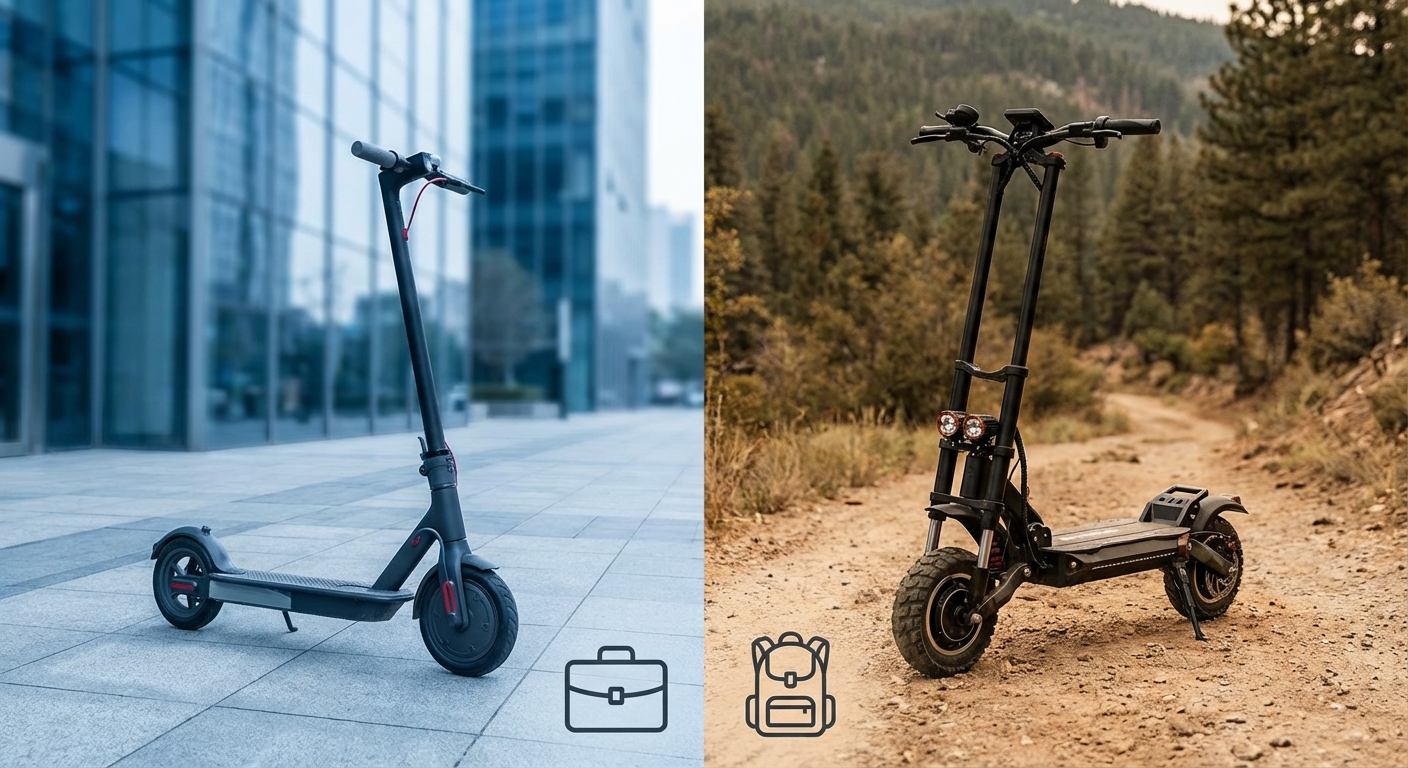
Commuter vs Off-Road E-Scooters: Which Type Should You Buy?
Picking the wrong e-scooter type can cost you hundreds of dollars and months of frustration. The difference between commuter and off-road models isn’t just about where you ride. It’s about motor power, suspension design, tire construction, battery capacity, and how much weight you’re willing to carry.
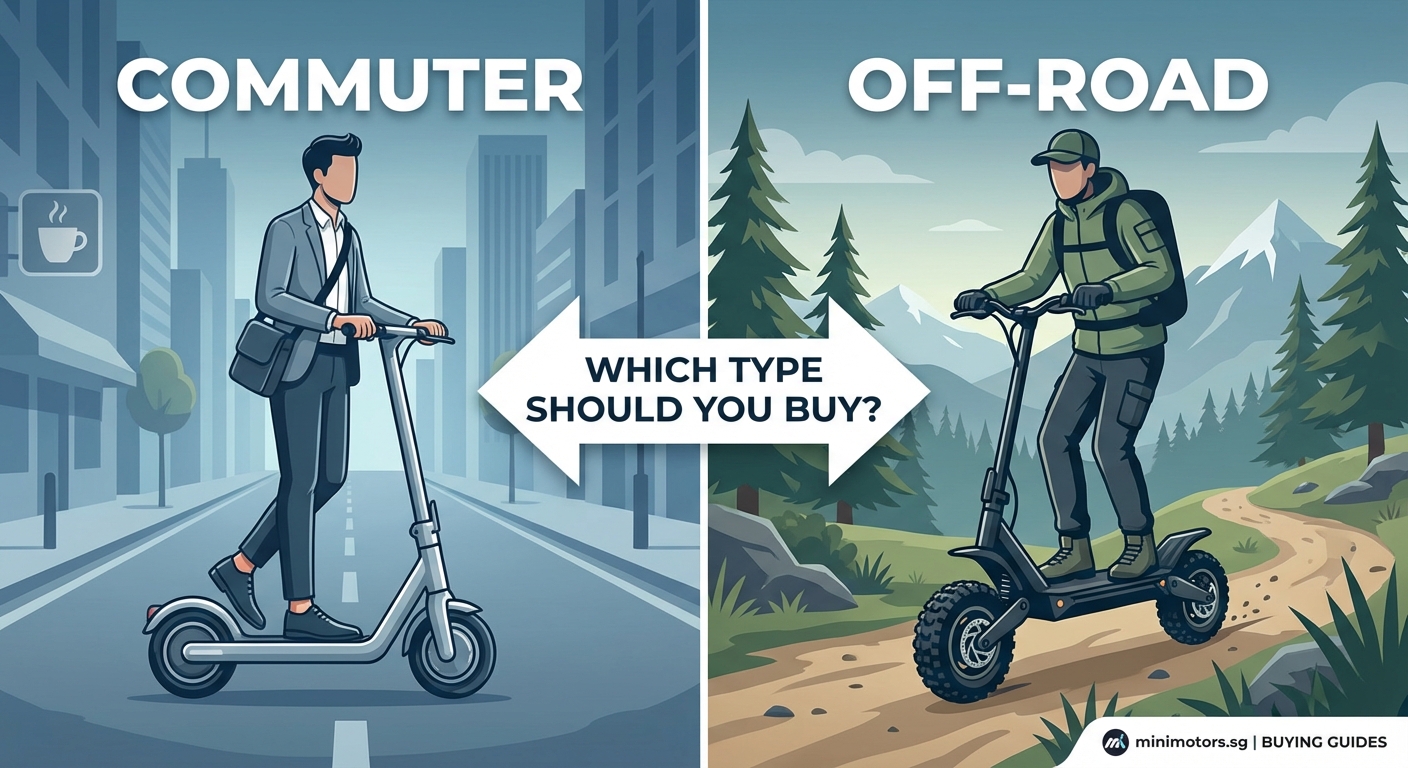
Commuter e-scooters prioritize portability, smooth pavement performance, and daily reliability with lighter frames and smaller motors. Off-road models sacrifice weight and convenience for rugged suspension, powerful motors, and aggressive tires that handle dirt, gravel, and steep inclines. Your terrain dictates your choice more than any other factor.
Understanding the core differences
Commuter e-scooters typically weigh between 25 and 35 pounds. They fold in seconds. They fit under desks and in car trunks.
Off-road e-scooters weigh 50 to 80 pounds. Many don’t fold at all. Some require two people to lift into a vehicle.
The weight difference exists for a reason. Off-road frames use thicker tubing to handle impacts. Suspension systems add pounds but absorb bumps that would crack a commuter deck. Larger batteries power bigger motors that climb hills and push through loose terrain.
Motor power tells the story clearly. Commuter models run 250 to 500 watts. Off-road machines start at 1000 watts and climb to 5000 watts for dual-motor setups.
“The motor isn’t just about speed. It’s about torque. Off-road riding demands power to maintain momentum through sand, mud, and steep grades where commuter motors would overheat and fail.” – Electric mobility engineer
Tire construction separates these categories dramatically. Commuter scooters use solid or air-filled tires between 8 and 10 inches. They’re designed for asphalt and concrete. Off-road tires measure 10 to 11 inches with deep tread patterns that grip loose surfaces.
What commuter e-scooters do best
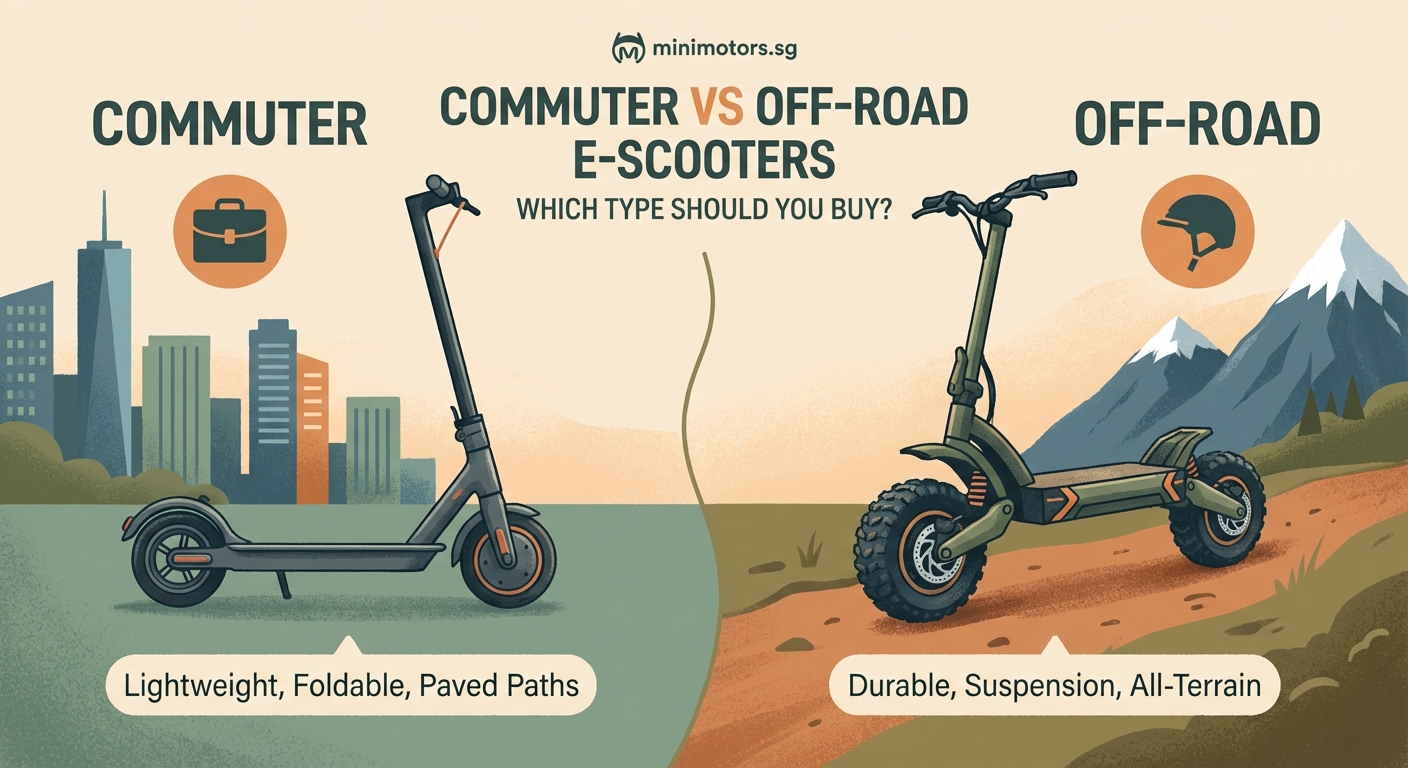
Daily urban transportation defines the commuter category. These machines handle:
- Bike lanes and paved paths
- Smooth sidewalks (where legal)
- Office lobbies and public transit
- Apartment elevators and storage closets
- Light rain with IP54 or IP65 ratings
Portability matters more than raw performance. A 28-pound scooter you can carry beats a 60-pound beast you leave at home.
Battery range on commuter models typically spans 15 to 25 miles per charge. That covers most round-trip commutes with power to spare. Charging takes 4 to 6 hours from a standard outlet.
Speed limits hover around 15 to 20 mph. That’s fast enough for efficient travel but slow enough to stay legal in most cities. Some models include speed modes that cap performance in pedestrian zones.
Braking systems on commuter scooters favor electronic or drum brakes. They’re low maintenance and work well on flat surfaces. Regenerative braking adds a few percentage points back to your battery while slowing down.
If you’re just starting out, how to choose your first electric scooter covers the fundamentals that apply to any category.
Where off-road e-scooters excel
Rough terrain demands different engineering. Off-road scooters handle:
- Dirt trails and gravel paths
- Grass fields and park shortcuts
- Steep hills and mountain roads
- Wet conditions and muddy tracks
- Uneven surfaces and potholes
Suspension systems make the difference. Dual spring or hydraulic suspension absorbs impacts that would throw a rider off a rigid commuter deck. Travel distances of 3 to 5 inches let wheels move independently over obstacles.
Ground clearance increases from 4 inches on commuters to 6 or 7 inches on off-road models. That extra space prevents the deck from scraping on rocks or roots.
Motor placement affects performance. Dual motors provide all-wheel drive that maintains traction when one wheel slips. Single rear motors work for moderate trails but struggle in loose conditions.
Battery capacity jumps to support hungry motors. Off-road scooters pack 20 to 40 amp-hour batteries that deliver 30 to 50 miles of range. Charging can take 8 to 12 hours without a fast charger.
Speed capabilities reach 30 to 45 mph on high-end models. That power helps maintain momentum uphill and through challenging terrain. It also raises safety concerns and legal restrictions in many areas.
Comparing key specifications side by side
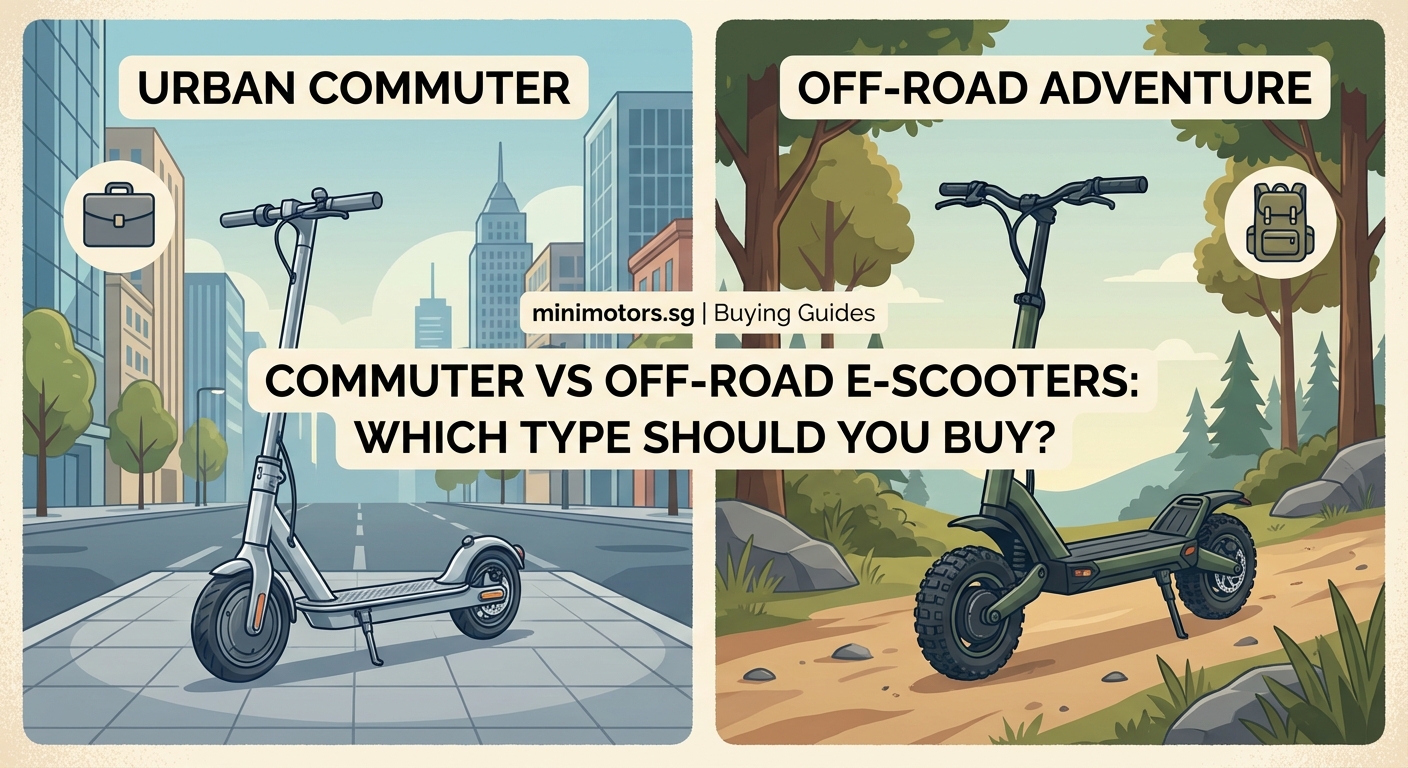
| Feature | Commuter E-Scooter | Off-Road E-Scooter |
|---|---|---|
| Weight | 25-35 lbs | 50-80 lbs |
| Motor Power | 250-500W | 1000-5000W |
| Top Speed | 15-20 mph | 30-45 mph |
| Range | 15-25 miles | 30-50 miles |
| Tire Size | 8-10 inches | 10-11 inches |
| Suspension | Minimal or none | Dual spring/hydraulic |
| Price Range | $300-$800 | $1,200-$4,000 |
| Portability | Folds easily | Limited or none |
| Terrain | Paved surfaces | Mixed and rough |
The price gap reflects component quality and engineering complexity. Off-road scooters cost more to build and maintain.
Evaluating your actual riding conditions
Your daily route matters more than aspirational weekend plans. Be honest about where you’ll ride 90% of the time.
- Map your regular routes and note surface types
- Measure distance from home to work or school
- Check elevation changes using a phone app
- Identify storage locations at both ends
- Research local regulations about power and speed
Urban commuters rarely need off-road capability. A smooth bike path doesn’t require 3000 watts and dual suspension. You’re paying for features you won’t use while carrying extra weight every day.
Suburban riders face mixed conditions. Some neighborhoods have poorly maintained roads. Others include dirt shortcuts through parks. A mid-range commuter with pneumatic tires might handle both better than a pure pavement machine.
Rural riders and trail enthusiasts need off-road specs. Gravel driveways, unpaved roads, and actual trails destroy commuter scooters. The repair costs quickly exceed the price difference between categories.
Weather patterns affect your choice. Heavy rain and snow demand better waterproofing. Off-road scooters typically carry higher IP ratings because they’re built to handle mud and water crossings. Commuter models with IP54 ratings handle light rain but shouldn’t be submerged.
Understanding what’s the best e-scooter range for your daily commute helps match battery capacity to your actual needs without overspending.
Storage and transport realities
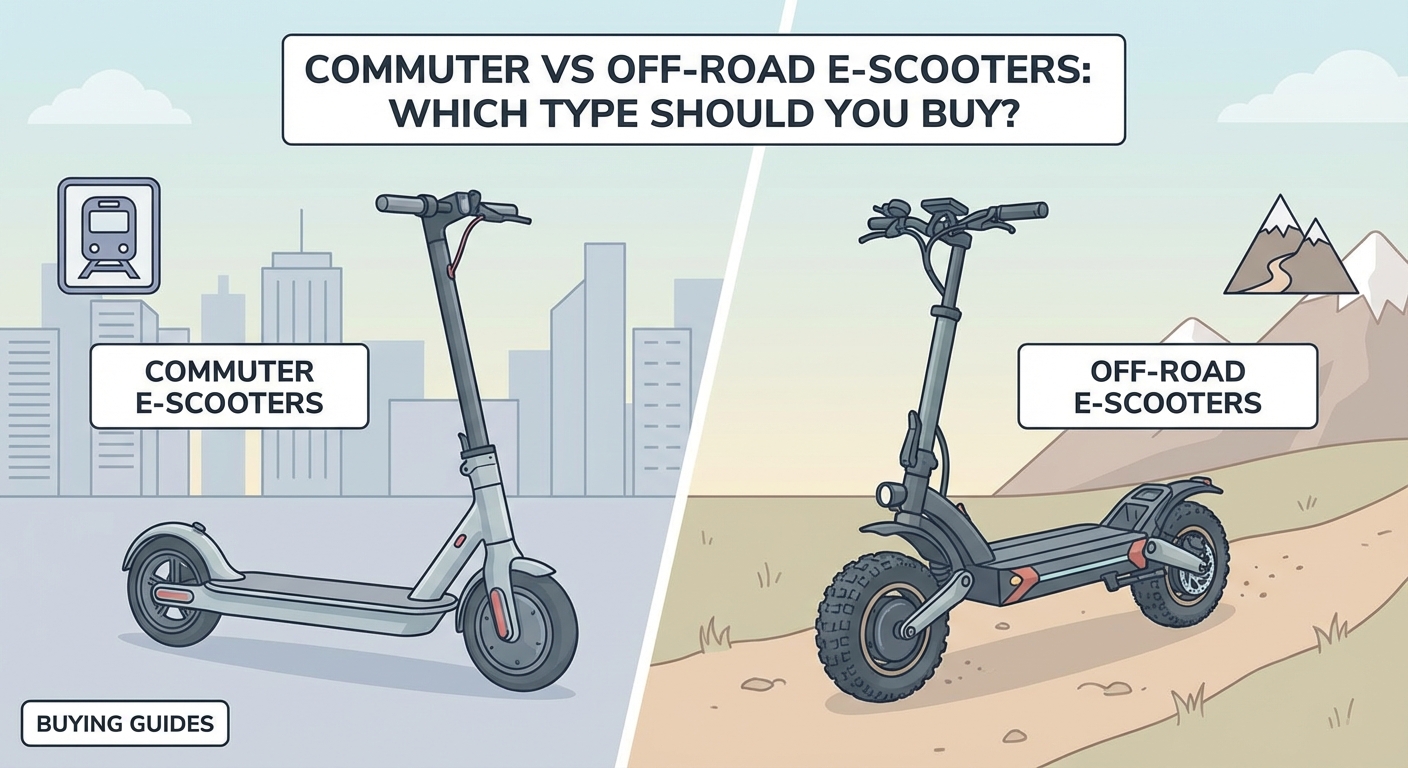
Portability sounds abstract until you’re carrying 65 pounds up three flights of stairs.
Commuter scooters fold in 3 to 5 seconds. Most use a simple lever or latch. Folded dimensions fit in car trunks, under desks, and in coat closets. You can roll them on their wheels when folded.
Off-road scooters either don’t fold or require tools and time. The robust frame design resists folding mechanisms. When they do fold, they’re still heavy and awkward.
Storage space requirements differ dramatically:
- Commuter folded: 42 x 18 x 16 inches typical
- Off-road: 48 x 24 x 48 inches standing
- Weight carried: 28 lbs vs 65 lbs average
Public transit policies usually ban scooters over 50 pounds. Check your local bus and train rules before buying. A scooter you can’t take on transit loses half its utility.
Apartment dwellers face elevator and hallway constraints. A 30-pound folded scooter fits easily. A 70-pound off-road machine blocks walkways and annoys neighbors.
Car transport works for both types with planning. Commuter scooters fit in sedans. Off-road models need SUVs or truck beds. Some riders install hitch racks, but that adds $200 to $400 to your total cost.
Maintenance and repair differences
Off-road riding destroys components faster than pavement cruising.
Tire replacement frequency:
– Commuter solid tires: Never (until worn smooth)
– Commuter pneumatic: Every 1,000 to 2,000 miles
– Off-road tires: Every 500 to 1,000 miles
Brake maintenance:
– Electronic brakes: Minimal, mostly software
– Drum brakes: Adjustment every 500 miles
– Hydraulic disc brakes: Fluid change annually, pad replacement every 1,000 miles
Suspension service adds complexity. Spring systems need inspection for cracks. Hydraulic suspension requires occasional oil changes. Commuter scooters skip this entirely.
Battery longevity depends on discharge cycles. Off-road riding drains batteries faster through high power draws. You’ll hit 500 charge cycles sooner, reducing range by 20% to 30%. Commuter batteries last longer with gentler discharge patterns.
Cleaning requirements differ. Commuter scooters need occasional wipe-downs. Off-road machines require deep cleaning after muddy rides. Dirt in motors and bearings causes premature failure.
For detailed maintenance guidance, the ultimate e-scooter maintenance checklist breaks down tasks by riding style.
Cost analysis beyond the purchase price
The sticker price tells part of the story. Total ownership cost includes accessories, maintenance, and replacements.
Commuter e-scooter budget:
– Base scooter: $400 to $700
– Helmet and lights: $80 to $150
– Lock: $40 to $80
– Annual maintenance: $50 to $100
– Three-year total: $550 to $1,030
Off-road e-scooter budget:
– Base scooter: $1,500 to $3,000
– Safety gear: $150 to $300
– Spare tires and tubes: $100 to $200
– Annual maintenance: $200 to $400
– Three-year total: $2,350 to $4,700
Insurance costs vary by model value. Basic liability runs $100 to $200 annually. Comprehensive coverage for expensive off-road machines can hit $400 per year. Learn more about whether you need insurance for your electric scooter.
Electricity costs remain minimal for both types. A full charge costs $0.10 to $0.50 depending on battery size and local rates. Annual energy costs rarely exceed $50 even with daily charging.
Depreciation hits harder on expensive models. A $3,000 off-road scooter loses 40% to 50% of its value in two years. A $500 commuter loses similar percentages but fewer absolute dollars.
Safety considerations for each type
Speed capability increases risk exponentially. A 15 mph commuter scooter causes different injuries than a 40 mph off-road machine.
Commuter safety focuses on:
– Visibility in traffic
– Brake response time
– Stability on smooth surfaces
– Pedestrian interaction
– Weather adaptability
Off-road safety emphasizes:
– Impact protection
– Traction control
– Suspension performance
– Emergency stopping power
– Helmet and body armor
Protective gear requirements scale with speed and terrain. Commuter riders need helmets and gloves. Off-road riders should add knee pads, elbow pads, and chest protection for serious trail work.
Braking distances increase with speed and surface type. A commuter scooter stops in 10 to 15 feet from 15 mph on dry pavement. An off-road scooter needs 30 to 50 feet from 30 mph on loose gravel.
Night riding demands better lighting. Commuter scooters often include basic front and rear lights. Off-road riders need powerful headlights (1000+ lumens) and multiple rear flashers for trail visibility. Check out night riding safety tips for detailed guidance.
Weight limits matter more on rough terrain. Commuter scooters handle 220 to 265 pounds. Off-road models support 265 to 330 pounds. Exceeding limits causes frame stress and component failure. For riders near these limits, best e-scooters for heavy riders provides specific recommendations.
Legal restrictions by scooter type
Local regulations often separate categories by power and speed.
Many cities limit scooters to:
– 250 to 500 watts motor power
– 15 to 20 mph maximum speed
– Bike lane or road use only
– Minimum age 16 or 18
Off-road scooters with 1000+ watt motors and 30+ mph speeds often fall into motorcycle or moped categories. That triggers requirements for:
- Vehicle registration
- License plates
- Motorcycle license
- Insurance coverage
- Helmet laws
Some jurisdictions ban high-power scooters entirely on public roads. You’re restricted to private property for legal use.
Sidewalk riding rules vary dramatically. Most places prohibit scooters on sidewalks regardless of type. Some allow low-speed commuter models but ban anything over 15 mph.
Trail access depends on land management policies. National and state parks often prohibit motorized vehicles on hiking trails. Some allow e-bikes and scooters on fire roads. Local mountain bike trails may ban motors completely.
Before buying, research regulations in your area. A $3,000 off-road scooter becomes expensive yard art if you can’t legally ride it anywhere. Understanding e-scooter speed limits helps you stay compliant.
Making the final decision
Most buyers should choose commuter scooters. They handle 80% of real-world use cases at 40% of the cost.
Buy a commuter scooter if you:
– Ride primarily on paved surfaces
– Need to carry it regularly
– Use public transit
– Store it in small spaces
– Want low maintenance
– Follow a predictable route
Buy an off-road scooter if you:
– Regularly ride unpaved terrain
– Have dedicated storage space
– Transport it by vehicle
– Prioritize performance over portability
– Accept higher maintenance costs
– Ride for recreation, not just transport
Budget constraints matter. A quality commuter scooter costs $500 to $700. An entry-level off-road machine starts at $1,200. Cheap off-road scooters under $800 use inferior components that fail under stress.
Don’t buy off-road capability you won’t use. The extra weight and cost provide no benefit on smooth pavement. You’re better off with a premium commuter model that includes better build quality and longer range.
Consider a mid-range option for mixed conditions. Some scooters blend categories with moderate motors (750 to 1000 watts), decent suspension, and reasonable weight (40 to 50 pounds). They handle occasional rough patches without the bulk of true off-road machines.
Test ride before buying when possible. Weight, handling, and comfort feel different than specs suggest. A scooter that seems perfect on paper might feel wrong in person.
For first-time buyers unsure about their needs, start with a commuter model. You can always upgrade later with better knowledge of your actual riding patterns. Starting with an expensive off-road machine you rarely use wastes money and garage space.
Choosing the right tool for your terrain
The best e-scooter matches your actual riding conditions, not your weekend fantasies. A commuter model handles daily transportation efficiently. An off-road machine conquers challenging terrain. Buying the wrong type means paying for features you don’t need while missing capabilities you do.
Measure your routes. Check your storage space. Calculate total ownership costs. Then choose the category that fits your life. Your back will thank you every time you carry it up stairs, and your wallet will appreciate the maintenance savings over three years of ownership.
