How to Choose the Right Motor Power for Your E-Scooter Needs
You’re standing in front of two e-scooters with nearly identical specs. One has a 350W motor. The other has 500W. The price difference is $200. Which one do you actually need?
Most first-time buyers fixate on battery range or top speed, but motor power determines whether your scooter will struggle up that bridge to work or breeze past it like it’s nothing. It affects how much weight you can carry, how fast you accelerate from a stoplight, and whether you’ll arrive sweating or relaxed.
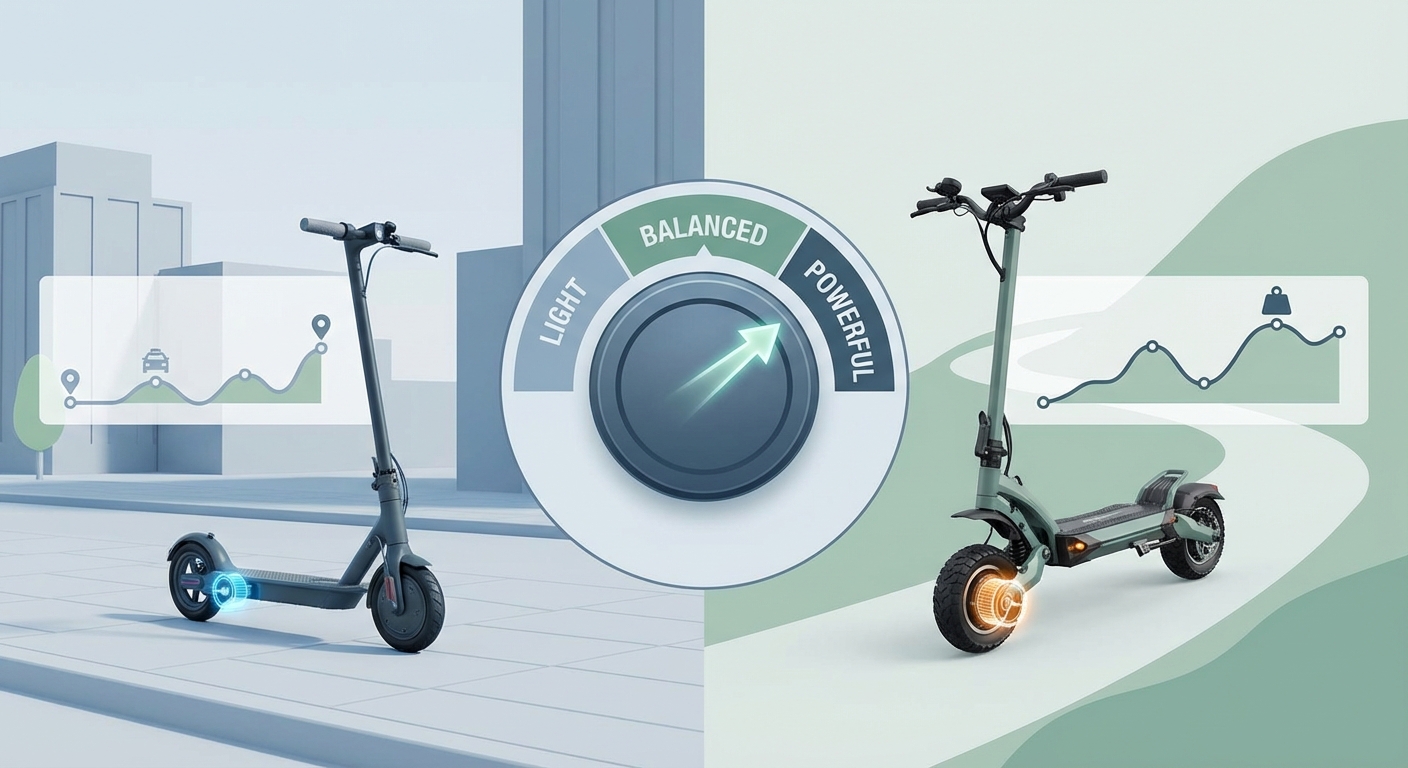
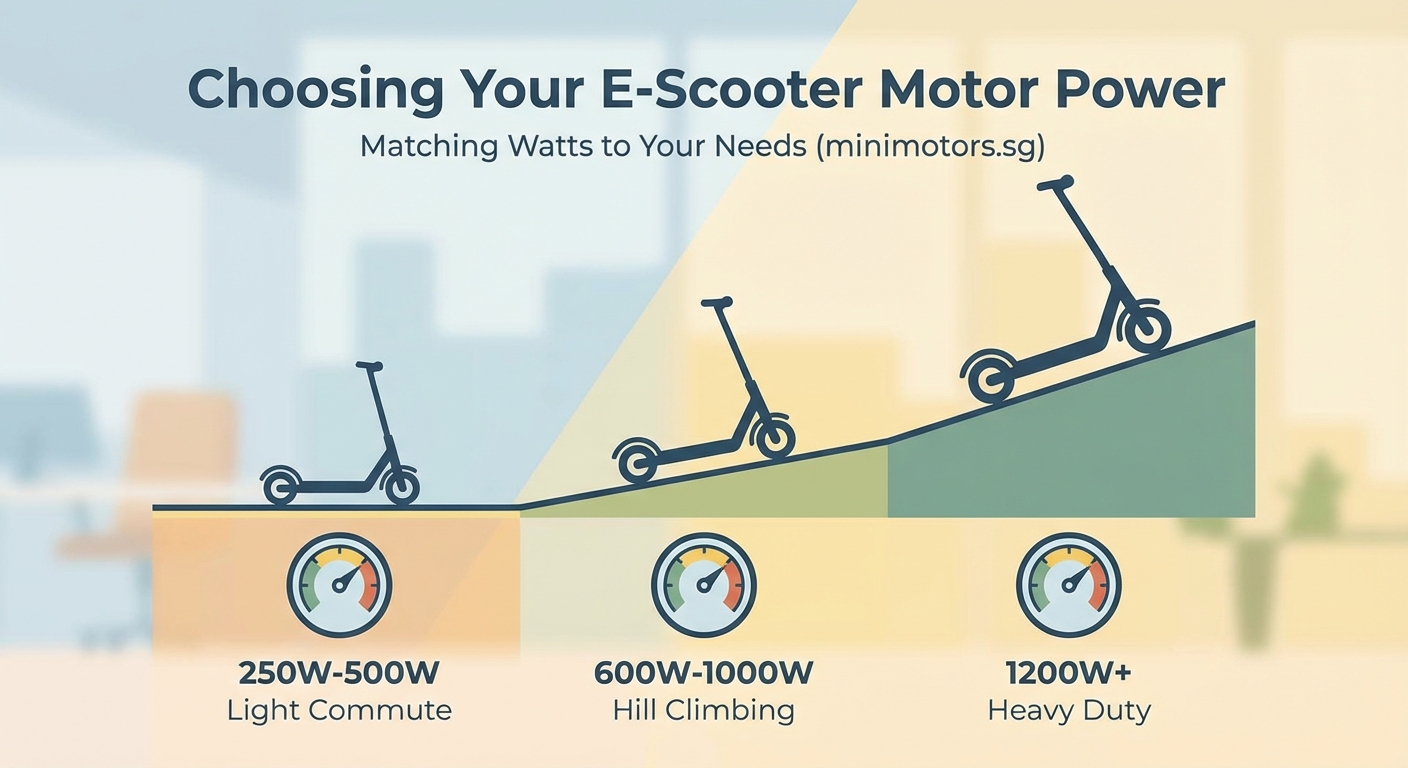
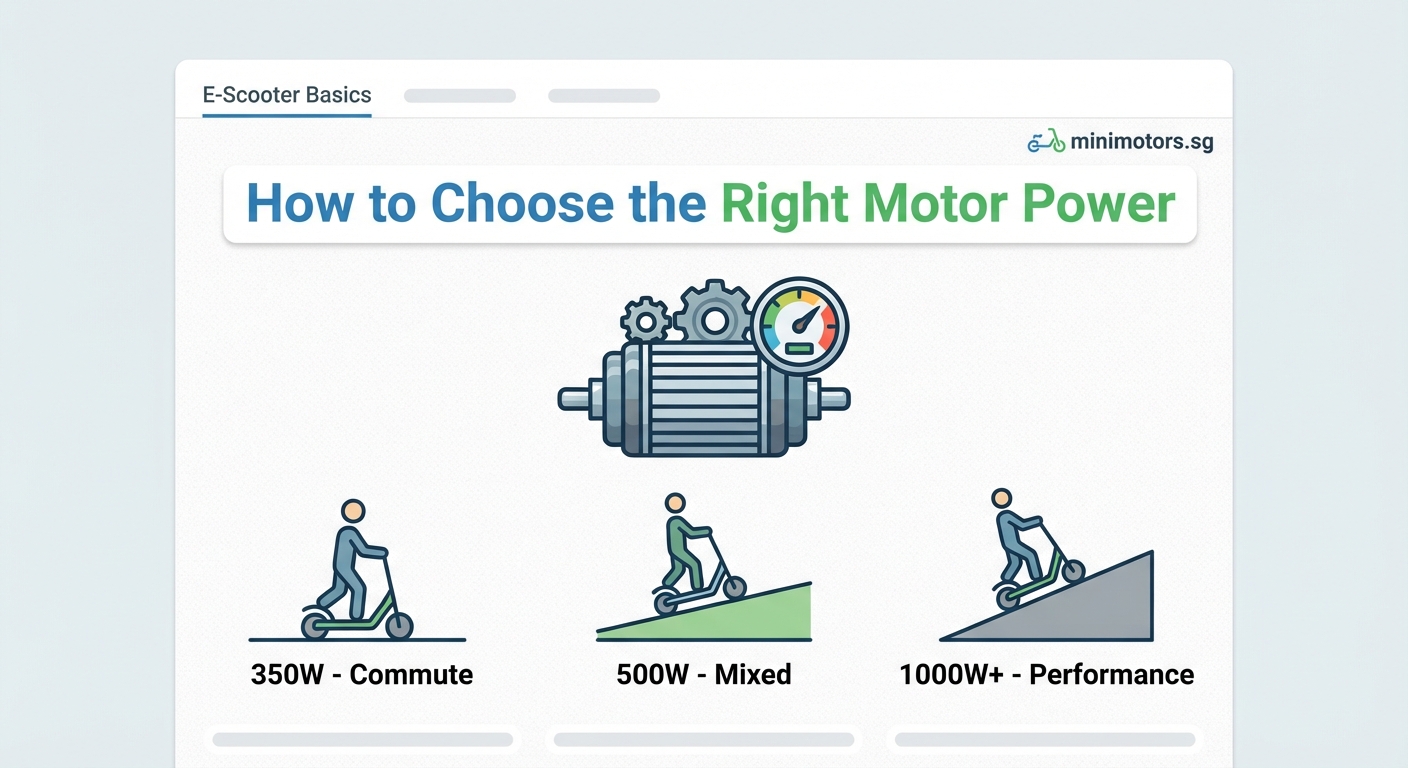
Motor power (measured in watts) determines your e-scooter’s acceleration, hill climbing ability, and load capacity. For flat urban commutes under 200 lbs, 250-350W works fine. Hilly routes or heavier riders need 500W minimum. Dual motors (1000W+) handle steep grades and off-road terrain but cost more and drain batteries faster. Match motor power to your specific route, weight, and terrain rather than chasing the highest number.
Understanding motor wattage and what it actually means
Watts measure how much power your motor can deliver continuously. A 500W motor can sustain 500 watts of output without overheating or losing performance.
But here’s where it gets confusing. Manufacturers list two different numbers.
Nominal power is what the motor can run at all day without problems. Peak power is the short burst it can handle for a few seconds when you need extra oomph, like accelerating from a stop or climbing a sudden hill.
A scooter advertised as “500W” might have 500W nominal and 800W peak. Another brand might list the peak power prominently and bury the nominal rating in fine print.
This matters because two “500W” scooters can perform very differently based on which number the manufacturer is advertising.
Real-world performance depends on three things working together:
- Motor wattage (how much power it can deliver)
- Controller quality (how efficiently it manages that power)
- Battery voltage (higher voltage means more efficient power delivery)
A well-designed 350W system with a 48V battery can outperform a cheap 500W scooter running on 36V.
Matching motor power to your body weight
Your weight directly affects how hard the motor has to work. Physics doesn’t care about marketing claims.
Here’s a practical breakdown based on total load (your weight plus backpack, groceries, or whatever you’re carrying):
| Total Weight | Flat Terrain | Moderate Hills | Steep Hills |
|---|---|---|---|
| Under 150 lbs | 250W | 350W | 500W |
| 150-200 lbs | 350W | 500W | 800W |
| 200-250 lbs | 500W | 800W | 1000W+ |
| Over 250 lbs | 800W | 1000W | Dual motor |
A 180-lb rider on a 250W scooter won’t break anything, but you’ll max out at 12 mph on flat ground and walk up any hill steeper than a parking garage ramp.
The same rider on a 500W scooter will hit 20+ mph and climb moderate grades without slowing down noticeably.
Weight affects more than just speed. Heavier loads mean:
- Longer acceleration times
- Reduced range (motor works harder, drains battery faster)
- More brake wear
- Greater stress on the frame and suspension
If you’re close to the upper limit of a power category, go up one level. Your scooter will last longer and perform better throughout its life.
How terrain changes your power needs
Flat city blocks and hilly neighborhoods require completely different motor strategies.
Flat urban commuting (less than 5% grade most of the time):
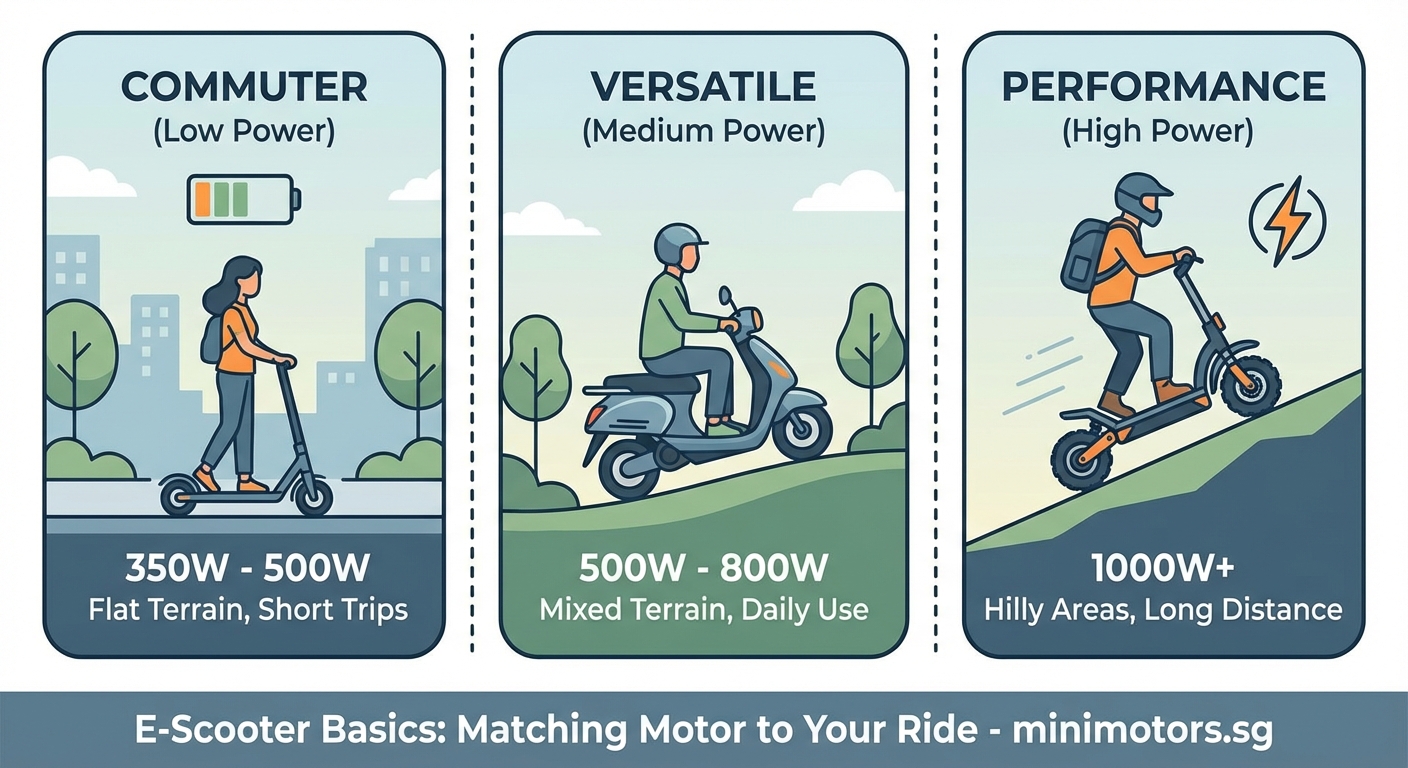
A 350W motor handles this easily for most riders. You’ll maintain 15-18 mph cruising speed without the motor straining. Battery efficiency stays high because the motor isn’t working overtime.
Rolling hills (5-10% grades):
You need at least 500W. Anything less will slow to a crawl on inclines, forcing you to kick-push or walk. A 500W motor maintains 10-12 mph on moderate climbs.
Steep hills (10-15% grades):
This is 800W minimum territory. San Francisco, Seattle, and Pittsburgh riders know this pain. A 500W scooter will technically climb these, but at walking speed while the motor screams.
Very steep or off-road (15%+ grades, unpaved paths):
You want dual motors totaling 1000W or more. Single motors under 1000W will overheat on sustained steep climbs.
Test your actual route before buying. That “small hill” you barely notice in your car might be a 12% grade that turns a budget scooter into an expensive paperweight.
One rider in Austin bought a 350W scooter for a “mostly flat” commute. Turns out the bridge over the highway was an 8% grade for a quarter mile. He arrived at work drenched in sweat every day until he upgraded to 500W.
Speed expectations across different power levels
Motor power and top speed aren’t perfectly linked, but here’s what to expect in real conditions (not manufacturer claims):
250-350W motors:
– Flat ground: 12-15 mph
– Slight incline: 8-10 mph
– Moderate hill: 5-7 mph (if it makes it at all)
500W motors:
– Flat ground: 18-22 mph
– Slight incline: 15-18 mph
– Moderate hill: 10-12 mph
800-1000W motors:
– Flat ground: 25-30 mph
– Slight incline: 20-25 mph
– Moderate hill: 15-18 mph
Dual motors (1500W+ combined):
– Flat ground: 30-40 mph
– Slight incline: 25-30 mph
– Steep hill: 18-22 mph
These numbers assume a 170-lb rider with no cargo in good weather.
Add 20 lbs of backpack weight and you’ll lose 2-3 mph across the board. Cold weather (below 40°F) can cut performance by another 10-15% because batteries deliver less power when cold.
Speed limits matter too. Many cities cap e-scooters at 15 mph legally, making a 1000W motor overkill unless you need the hill climbing power or plan to ride outside city limits.
Battery drain and range trade-offs
More powerful motors don’t automatically mean worse range. It depends on how you use them.
A 500W motor cruising at 15 mph on flat ground uses less power than a 350W motor struggling up a hill at 8 mph. The struggling motor runs at maximum output constantly, draining the battery faster.
Three factors control how much range you lose to motor power:
-
How often you run at full throttle: Constantly maxing out acceleration kills range on any motor.
-
Terrain: Hills force high power output regardless of motor size.
-
Your weight: Heavier riders make motors work harder at any speed.
A 500Wh battery paired with a 350W motor might give you 20 miles of range on flat ground. The same battery with a 500W motor might give you 18 miles because the bigger motor has slightly more internal resistance.
But take both scooters up a hilly route and the 350W scooter’s range drops to 12 miles (because it’s maxed out the whole time) while the 500W scooter still gets 15 miles (because it’s working comfortably within its capabilities).
For understanding how far you can actually travel, motor efficiency matters more than raw power.
Single motor vs dual motor configurations
Dual motor scooters put one motor in each wheel. Total power is the sum of both motors.
Single motor advantages:
– Lower purchase price ($300-800 typically)
– Lighter weight (easier to carry upstairs)
– Simpler maintenance (one motor to worry about)
– Better range per watt (less system complexity)
Dual motor advantages:
– Much better hill climbing (power to both wheels)
– Faster acceleration (two motors working together)
– Better traction in rain or loose surfaces
– More stable at high speeds
Most commuters don’t need dual motors. A single 500W motor handles typical urban riding beautifully.
You benefit from dual motors if you:
- Regularly climb hills steeper than 10%
- Weigh over 220 lbs with gear
- Want speeds above 25 mph
- Ride off-road or on unpaved paths
- Live somewhere with frequent rain (dual motors reduce wheel slip)
Dual motor scooters cost $1,200-3,000 compared to $400-1,200 for comparable single motor models. That’s a significant premium for capabilities most riders use occasionally at best.
One exception: if your commute includes one brutally steep hill, a dual motor scooter in single-motor mode for flat sections and dual-motor mode for the hill gives you range efficiency most of the time with power when you need it.
How to test if a motor has enough power for your needs
Before you buy, run these three tests (if possible):
-
The acceleration test
From a complete stop, twist the throttle fully. You should reach 15 mph within 5-7 seconds. If it takes 10+ seconds, the motor is underpowered for your weight. -
The hill test
Find a hill similar to what you’ll ride daily. A properly sized motor should climb it at 10+ mph without the motor sound changing noticeably. If you hear strain or smell burning, it’s too weak. -
The sustained speed test
Ride at your desired cruising speed for 5 minutes straight. The motor should stay quiet and the deck shouldn’t get hot. Excessive heat means the motor is working too hard.
Can’t test ride before buying? Use this formula:
Minimum watts = (your weight in lbs + 20 lbs gear) × 2.5
A 180-lb rider should look for: (180 + 20) × 2.5 = 500W minimum
This gives you comfortable power with headroom for hills and cargo.
For routes with serious hills, multiply by 3.5 instead of 2.5.
Common mistakes when choosing motor power
Mistake 1: Buying based on top speed alone
A scooter advertised at “30 mph top speed” might only hit that going downhill with a tailwind. Look at sustained speed on flat ground instead.
Mistake 2: Ignoring peak vs nominal power
That “1000W” scooter might be 500W nominal with 1000W peak. You’re getting a 500W scooter with brief bursts of extra power, not continuous 1000W performance.
Mistake 3: Assuming more power always means better
A 1500W scooter for flat city commuting wastes money and battery. You’ll never use that power, but you’ll pay for it in weight, cost, and reduced range.
Mistake 4: Not accounting for cargo
Your laptop bag, groceries, and backpack add 15-30 lbs. That changes your power needs significantly.
Mistake 5: Forgetting about legal limits
Some cities restrict motor power to 500W or 750W. A 1000W scooter might be illegal on bike paths or certain streets. Check local regulations before buying.
Mistake 6: Overlooking controller quality
A cheap controller with a powerful motor delivers jerky, inefficient power. A quality controller makes a smaller motor feel stronger through smooth power delivery.
Matching power to specific use cases
Short urban commutes (under 3 miles, mostly flat):
250-350W works perfectly. You don’t need speed or power, just reliability. First-time buyers often do well with entry-level motors for this use case.
Medium commutes (3-7 miles with some hills):
500W hits the sweet spot. Enough power for moderate inclines without overkill. This covers 80% of commuters.
Long commutes (7+ miles or significant elevation change):
800W minimum. You need sustained power that won’t strain on your longest days. Consider which type of scooter fits your specific route.
Recreation and weekend rides:
Depends on your playground. Bike paths and parks: 500W. Mountain trails and off-road: 1000W+ dual motor.
Multimodal commuting (train + scooter):
350W maximum. Higher power means heavier scooters that are miserable to carry up subway stairs. Portability beats power here.
Heavy cargo or passenger (child seat, delivery bags):
Add 50-100 lbs to your calculations. A parent carrying a 40-lb child needs to plan for 240 lbs total load, pushing you into 800W+ territory.
Cost implications of different power levels
Motor power directly affects price in predictable ways:
- 250-300W: $300-500
- 350-500W: $500-900
- 500-800W: $800-1,400
- 1000W single motor: $1,200-2,000
- Dual motor (1500W+): $1,800-3,500
But the motor isn’t the only cost factor. Higher power scooters typically include:
- Larger batteries (to feed the hungry motor)
- Better brakes (to stop the higher speeds safely)
- Stronger frames (to handle the extra stress)
- Suspension (because you’re going faster over bumps)
A $400 scooter with a “500W” motor probably has a cheap motor with poor efficiency, a small battery, and weak brakes. A $900 scooter with a 500W motor from a reputable brand gives you the whole package designed to work together.
Operating costs scale with power too:
- Electricity is negligible (pennies per charge regardless of motor size)
- Tire wear increases with power and speed
- Brake maintenance becomes more frequent
- Higher-powered scooters typically need service every 500-750 miles vs 1000+ miles for lower-powered models
For budget-conscious buyers, a quality 350W scooter beats a sketchy 500W model every time.
Motor power and safety considerations
More power means higher speeds, which means more risk if something goes wrong.
Stopping distance by motor power:
- 250W (12 mph cruise): 8-10 feet
- 500W (18 mph cruise): 15-20 feet
- 1000W (25 mph cruise): 30-40 feet
You need better brakes and faster reaction times as power increases. Many accidents happen when riders upgrade to powerful scooters without adjusting their riding style.
Understanding braking systems becomes critical with motors above 500W.
Acceleration safety:
Powerful motors can throw you backward if you’re not prepared. Dual motor scooters especially can accelerate so fast that you lose balance or overcorrect into traffic.
Always test new scooters in empty parking lots before riding in traffic, regardless of your experience level.
Weather performance:
High-powered motors maintain speed better in wind and rain, but they also make it easier to lose traction. A 1000W motor can spin a wet tire much faster than a 350W motor can.
Riding in rain requires extra caution with powerful motors.
Mechanical stress:
More power means more stress on every component. Frames crack, welds fail, and bearings wear faster. Regular maintenance becomes non-negotiable with motors above 800W.
Future-proofing your motor choice
Your needs might change over the next 2-3 years. Consider:
Weight changes: If you’re planning to lose or gain significant weight, buy for your expected weight in six months, not today.
Job changes: A new job might mean a different commute. A motor that works for 2 flat miles won’t cut it for 5 hilly miles.
Family changes: Adding a child seat or cargo rack later requires power headroom.
Fitness changes: Starting an e-scooter commute often improves fitness. You might want to ride faster or farther as you get comfortable.
Buy one power level higher than your minimum if you can afford it. The extra capability gives you options as your situation evolves.
But don’t buy two levels higher. That’s wasted money on power you’ll never use.
Reading between the lines on motor specs
Manufacturers play games with motor specifications. Here’s how to spot the tricks:
“Up to 30 mph!” means 30 mph downhill with a 140-lb rider and fresh batteries. Expect 22-25 mph in real conditions.
“1000W powerful motor” might be 500W nominal, 1000W peak. Look for “nominal” or “continuous” ratings.
“Dual 500W motors” doesn’t mean 1000W of usable power. You get maybe 800W due to system inefficiencies.
“High torque motor” is marketing speak. Look for the actual wattage number.
“Upgraded motor” compared to what? Last year’s model? A competitor? Meaningless without context.
Ask these questions before buying:
- What’s the nominal (continuous) wattage?
- What’s the peak wattage?
- What voltage is the battery?
- How much does the complete scooter weigh?
- What’s the real-world range at my weight?
Reputable sellers answer these clearly. Evasive answers mean the specs probably disappoint.
When to choose less power than you think you need
Sometimes the “right” motor is actually smaller than the formulas suggest.
You have secure storage: Lower-powered scooters are less attractive to thieves and easier to lock up.
You ride short distances: A 2-mile commute doesn’t justify a heavy, expensive high-powered scooter.
You want maximum range: Smaller motors with big batteries give you 30+ mile ranges for all-day riding without charging.
You need portability: Carrying a 35-lb scooter upstairs beats a 55-lb beast, even if the heavier one is faster.
You’re learning: New riders benefit from lower speeds while building skills and confidence. You can always upgrade later.
Legal restrictions apply: If your city caps speeds at 15 mph, a 350W motor gets you there without paying for unused power.
Power requirements for specific rider profiles
College student (flat campus, 1-2 mile trips):
250-350W. Prioritize portability and price over power. You’ll carry this thing into classrooms and dorm rooms constantly.
Suburban commuter (5 miles, moderate hills, train connection):
500W. Balance of power for hills and weight for carrying onto trains.
Urban professional (3-4 miles, mostly flat, need to look presentable):
350-500W. Enough power to avoid sweating but not so much that you arrive windblown.
Delivery rider (all day, mixed terrain, cargo):
800W minimum. You need power that won’t fade after 6 hours of constant use.
Weekend adventurer (trails, parks, varied terrain):
1000W+ dual motor. You want capability for whatever you encounter.
Fitness enthusiast (long rides, challenging routes):
500-800W. Enough power to tackle big rides without making it too easy.
Making your final decision
Here’s how to choose in five steps:
-
Calculate your total load: Your weight + typical cargo + 10 lbs buffer
-
Map your worst hill: Use your phone’s bike computer app to measure the grade percentage
-
Determine minimum power: Use the weight formula (total load × 2.5) and add 200W if your worst hill exceeds 8%
-
Set your budget: Look at scooters in your power range from reputable brands
-
Test ride if possible: Confirm the motor feels strong enough on your actual route
If you’re between two power levels and the price difference is under $150, go higher. If it’s over $300 difference, the lower power probably works fine.
Motor power isn’t everything, but it’s the foundation of your riding experience. Too little and you’ll regret it daily. Too much and you’ve overpaid for capabilities you don’t use.
Getting the power you actually need
The best motor is the one that makes your specific ride easy without breaking your budget or your back.
A 350W scooter that handles your commute comfortably beats a 1000W monster that’s too heavy to carry upstairs or too expensive to replace if stolen.
Start with your real route, your real weight, and your real needs. The right motor power follows naturally from those facts. Test ride when possible, read reviews from riders with similar profiles, and don’t let marketing hype push you toward power you don’t need.
Your perfect scooter probably has less power than you first imagined, costs less than you feared, and works better than the overpowered alternative. Match the motor to your life, not your ego, and you’ll ride happy for years.
