Understanding E-Scooter Battery Voltage: What 36V, 48V, and 60V Really Mean for Your Ride
You’re staring at spec sheets, comparing e-scooters, and one number keeps popping up: voltage. Is 36V enough? Will 48V drain your wallet? Does 60V mean you’ll be flying down the street at dangerous speeds? The truth is simpler than the marketing hype suggests, and understanding voltage will save you from buying the wrong scooter for your needs.
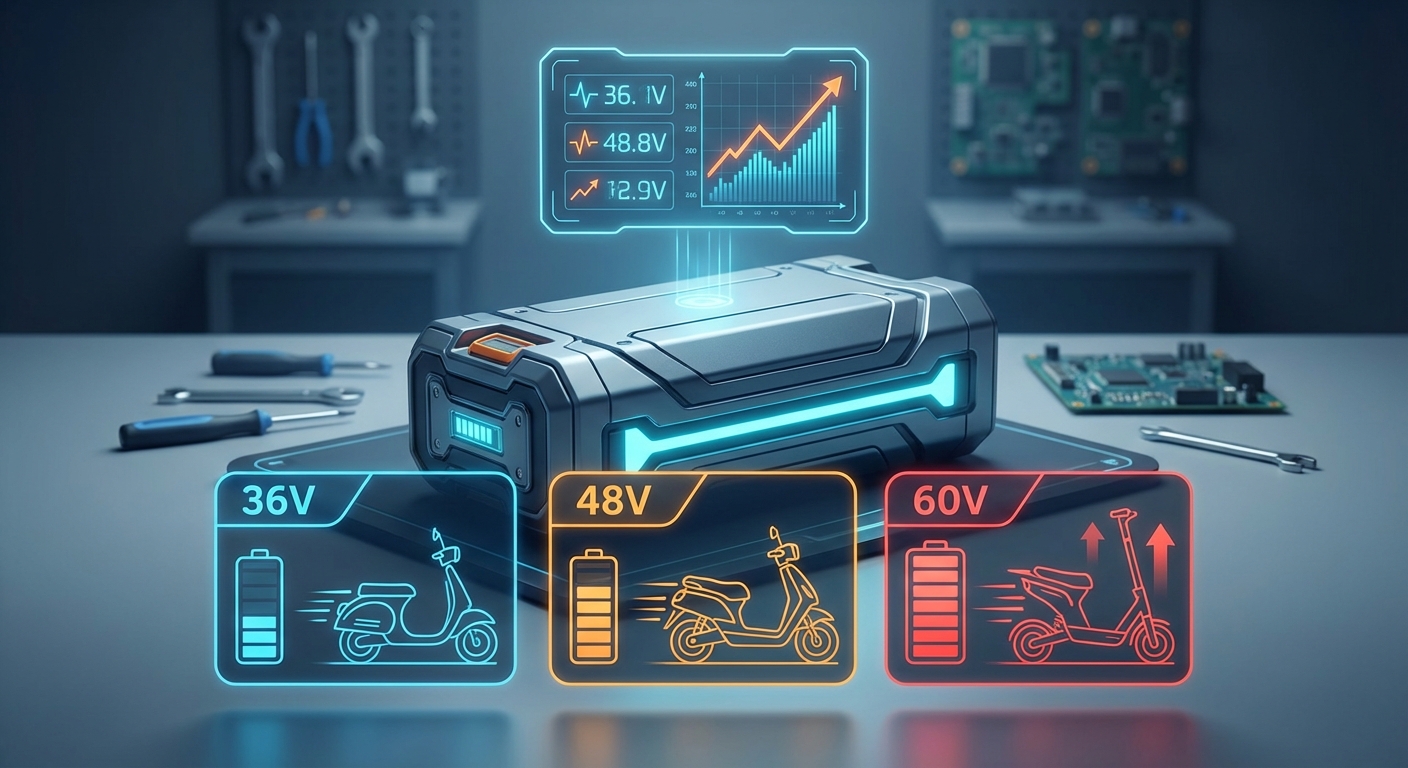
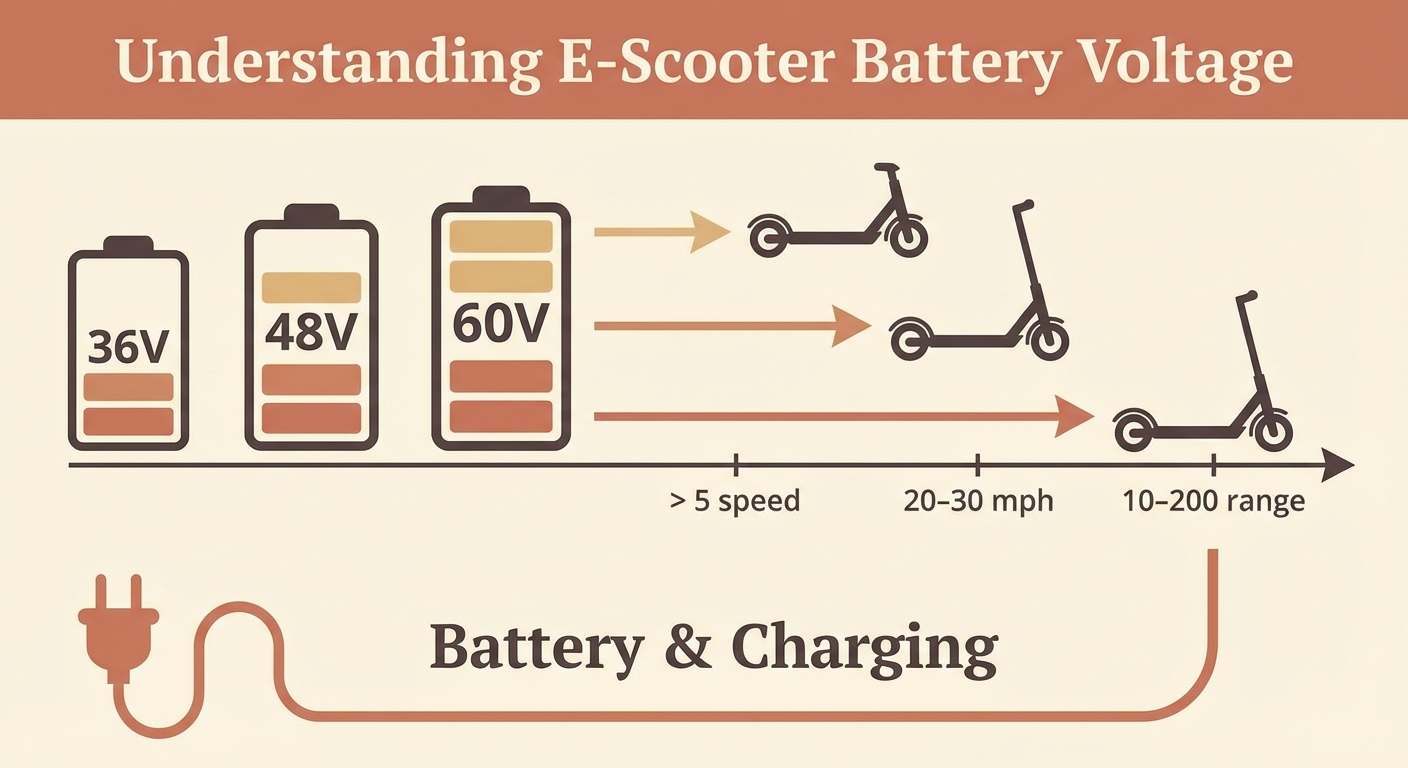
Battery voltage determines how much electrical pressure your e-scooter’s motor receives. Higher voltage means stronger acceleration, better hill climbing, and higher top speeds. A 36V system suits flat urban commutes, 48V handles moderate hills and longer distances, while 60V delivers performance for steep terrain and heavier riders. Voltage alone doesn’t determine range; that depends on battery capacity measured in amp-hours.
What voltage actually means for your ride
Voltage is electrical pressure. Think of it like water pressure in a hose. Higher pressure pushes water faster and farther. Higher voltage pushes electrons through your motor with more force, translating to more power at the wheel.
Your e-scooter’s battery voltage directly affects three things: acceleration, top speed, and hill climbing ability. It does not directly control range. That’s a common misconception we’ll clear up shortly.
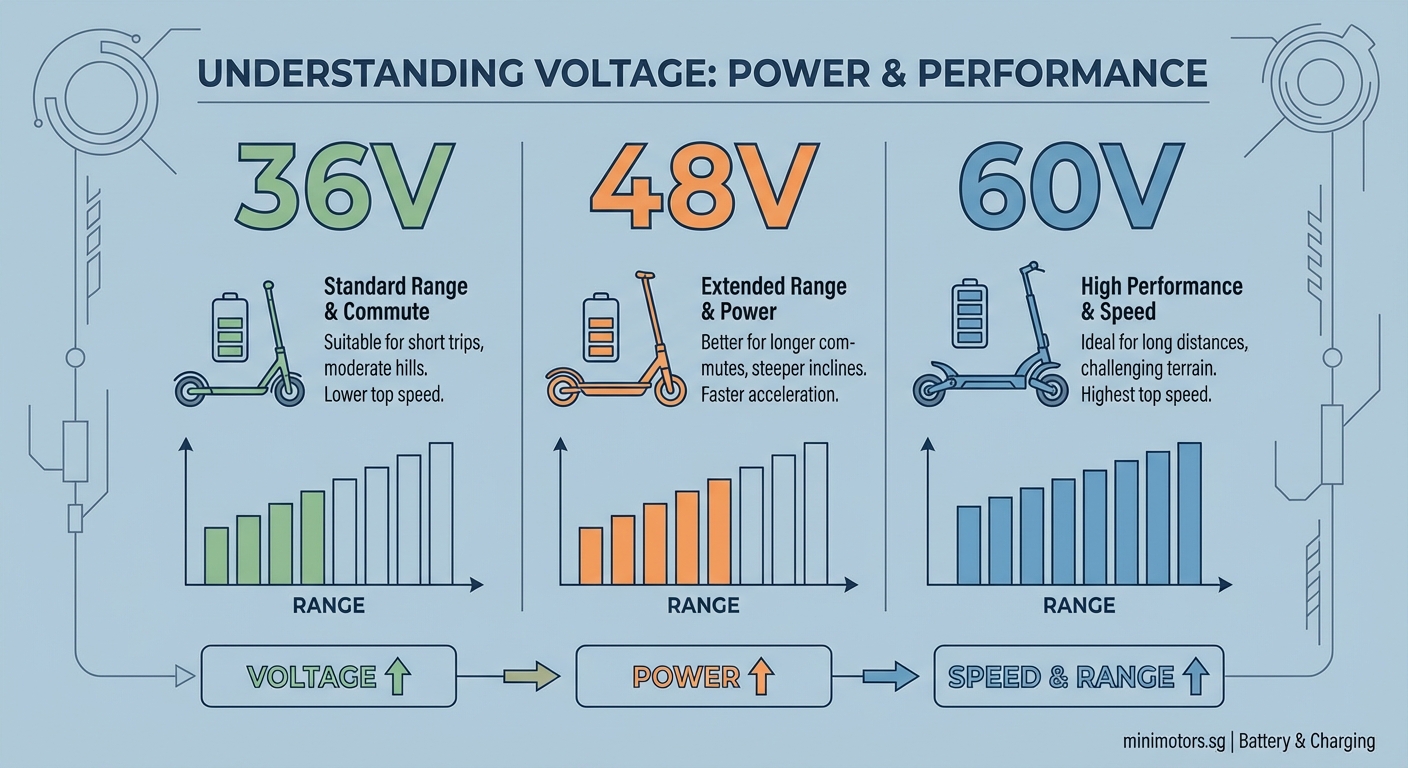
A 36V battery pushes electrons at lower pressure. Your motor spins, but without the urgency or force of higher voltage systems. You’ll reach moderate speeds and handle gentle slopes, but steep hills will slow you down noticeably.
A 48V battery increases that pressure. Your motor responds faster. Acceleration feels punchier. Hills that made your 36V scooter struggle become manageable. Top speed climbs by several miles per hour.
A 60V battery delivers serious pressure. Your motor has the force to tackle steep inclines without losing momentum. Acceleration becomes assertive. Top speeds enter territory that requires careful handling and proper safety gear.
The motor and controller work together with the battery. Your controller regulates how much power flows from the battery to the motor. A 48V battery paired with a weak controller won’t perform like a properly matched 48V system. Always check that voltage, motor wattage, and controller ratings align.
Breaking down 36V systems
A 36V battery typically consists of 10 lithium-ion cells connected in series. Each cell delivers 3.6V, totaling 36V when fully charged (actually closer to 42V at full charge, but rated at 36V nominal).
This voltage level suits riders who:
- Commute on flat or gently rolling terrain
- Weigh under 180 pounds
- Prioritize affordability over performance
- Ride short distances under 10 miles per trip
- Don’t need speeds above 15-18 mph
The advantages are real. Lower voltage systems cost less to manufacture, so you’ll find more budget-friendly scooters in this category. Battery replacements run cheaper. The system draws less current for the same power output, which can mean slightly better efficiency on flat ground.
But limitations become obvious on hills. A 36V motor lacks the torque to maintain speed on inclines steeper than 10-15 degrees. You’ll slow down, sometimes dramatically. If you’re a heavier rider or carry cargo, expect even more struggle.
Acceleration feels leisurely. From a standstill, a 36V scooter takes its time reaching cruising speed. That’s fine for relaxed neighborhood rides but frustrating in urban traffic where you need to match the flow.
If your commute involves significant hills or you weigh over 180 pounds, a 36V system will disappoint you. Save yourself the frustration and look at higher voltage options from the start.
Understanding 48V systems
A 48V battery uses 13 cells in series, delivering 48V nominal (around 54.6V fully charged). This has become the sweet spot for most urban riders.
The performance jump from 36V to 48V feels substantial. Acceleration improves noticeably. You merge into bike lanes with confidence. Hills that would slow a 36V scooter to a crawl become manageable at reasonable speeds.
Top speeds typically range from 20-28 mph, depending on motor wattage and controller settings. That’s fast enough for efficient commuting without entering truly dangerous territory for inexperienced riders.
A 48V system handles:
- Moderate hills up to 20 degrees
- Riders up to 220 pounds comfortably
- Daily commutes of 10-20 miles (with appropriate amp-hour capacity)
- Mixed terrain including bike paths, roads, and gentle trails
The cost increase over 36V is moderate. You’re paying for better components, but you’re not entering premium territory yet. Battery replacements cost more, but the performance justification makes sense for most riders.
Power delivery feels smoother. The motor operates more efficiently at 48V, generating less heat and experiencing less strain. This translates to longer motor life and more consistent performance over time.
If you’re choosing your first electric scooter, 48V represents the best balance of cost, performance, and versatility for the majority of riders.
Stepping up to 60V systems
A 60V battery uses 16-17 cells, delivering substantially more electrical pressure to your motor. This is where performance becomes the priority.
The difference between 48V and 60V might seem incremental on paper, but the real-world experience tells another story. Acceleration becomes aggressive. Hills that challenged a 48V scooter barely register. Top speeds push into the 30-40 mph range with appropriate motors.
You’ll want 60V if you:
- Face steep hills regularly (over 20 degrees)
- Weigh over 220 pounds
- Need sustained high speeds for longer commutes
- Ride in areas with challenging terrain
- Want dual-motor setups for maximum traction
The trade-offs become more significant. Cost jumps noticeably. A 60V battery pack costs substantially more than 48V, both for initial purchase and eventual replacement. The system draws more current, which can reduce efficiency compared to lower voltage systems doing the same work.
Weight increases too. More cells mean a heavier battery. Combined with the beefier motor and controller required to handle 60V, your scooter will weigh more. That matters when you need to carry it upstairs or load it into a vehicle.
Safety considerations intensify. Speeds above 30 mph require serious respect. You need quality protective gear, excellent braking systems, and solid riding skills. Common e-scooter accidents become more severe at these speeds.
How voltage affects range (and doesn’t)
Here’s where confusion runs rampant. Many riders assume higher voltage automatically means longer range. That’s not how it works.
Range depends primarily on battery capacity, measured in amp-hours (Ah) or watt-hours (Wh). A 48V 20Ah battery stores more energy than a 60V 10Ah battery, even though the 60V system has higher voltage.
To calculate total energy storage, multiply voltage by amp-hours:
- 36V × 15Ah = 540Wh
- 48V × 15Ah = 720Wh
- 60V × 15Ah = 900Wh
The watt-hour figure tells you how much energy is available. Higher watt-hours generally mean longer range, assuming similar riding conditions and rider weight.
But voltage affects efficiency in complex ways. A 60V system might actually be less efficient than a 48V system for casual riding because it’s overkill for the task. The motor and controller operate outside their optimal efficiency range when you’re just cruising at 15 mph.
Conversely, a 36V system struggling up a steep hill burns through battery capacity rapidly because the motor works inefficiently under heavy load. A 48V or 60V system handles that same hill more efficiently, potentially extending range despite the higher voltage.
Understanding average range requires looking at both voltage and capacity together, plus considering your specific riding conditions.
Matching voltage to your riding profile
Choosing the right voltage starts with honest assessment of your needs. Marketing pushes you toward higher specs, but overpaying for performance you won’t use makes no sense.
For flat urban commuters
If your route is mostly flat with occasional gentle slopes, 36V or 48V will serve you well. Save money on the battery and invest in quality tires, brakes, and suspension instead.
A 36V system works fine if you’re under 180 pounds and don’t mind moderate speeds. A 48V system adds confidence and longevity for just a bit more money.
For hilly terrain riders
Hills demand voltage. A 48V system handles moderate hills adequately. For steep sustained climbs, 60V makes the difference between arriving sweaty and frustrated versus cruising up with power to spare.
Don’t underestimate how much hills drain batteries. A 36V system might technically make it up your hill, but it’ll consume battery capacity at an alarming rate doing so.
For heavier riders
Your weight directly impacts how much power you need. Heavier riders should add at least one voltage tier above what lighter riders need for the same terrain.
If you weigh over 220 pounds, start your search at 48V minimum. For hills, look at 60V systems with high-wattage motors.
For performance enthusiasts
If you want an exhilarating ride and have the skills to handle it safely, 60V delivers. Pair it with dual motors and quality components throughout. Just budget accordingly and invest in proper safety gear.
Voltage comparison at a glance
| Voltage | Best For | Top Speed | Hill Climbing | Typical Cost |
|---|---|---|---|---|
| 36V | Flat commutes, light riders, budget-conscious | 15-18 mph | Struggles over 10° | $ |
| 48V | Most urban riders, moderate hills, balanced performance | 20-28 mph | Handles up to 20° | $$ |
| 60V | Steep hills, heavy riders, performance priority | 30-40 mph | Conquers 25°+ | $$$ |
Common voltage mistakes to avoid
Buying based on voltage alone ignores critical factors. A 60V scooter with a 500W motor won’t perform like a 60V scooter with a 2000W motor. Check the complete power system.
Ignoring controller ratings causes problems. Your controller must handle the voltage and current your battery and motor demand. Mismatched components lead to poor performance or component failure.
Assuming you need maximum voltage wastes money. Most riders never use the full capability of 60V systems. A properly specified 48V setup serves them better at lower cost.
Forgetting about battery lifespan when comparing costs skews your math. Higher voltage batteries cost more to replace. Factor that into your long-term ownership costs.
Neglecting weight considerations makes daily use frustrating. That powerful 60V scooter feels great while riding but becomes a burden when you’re carrying it up stairs or loading it into your car.
Choose voltage based on your actual riding conditions, not aspirational scenarios. You’ll ride the scooter you have, not the one you imagine using someday. Match specs to reality.
The relationship between voltage and safety
Higher voltage means higher speeds, which demands greater attention to safety systems. Your braking system must match your scooter’s performance capability.
A 60V scooter needs serious brakes. Mechanical disc brakes at minimum, ideally hydraulic discs front and rear. Electronic braking alone won’t cut it at 35 mph. Understanding braking systems becomes critical as voltage increases.
Tire quality matters more at higher speeds. Cheap tires lose grip, wear quickly, and fail catastrophically when pushed hard. Budget for quality pneumatic tires if you’re running 60V.
Suspension becomes essential rather than optional. Hitting a pothole at 15 mph on a 36V scooter is uncomfortable. Hitting the same pothole at 35 mph on a 60V scooter can throw you off the deck.
Protective gear scales with voltage. A helmet is mandatory at any speed, but 60V systems demand additional protection. Gloves, knee pads, and elbow pads stop being optional when you’re capable of 30+ mph.
Making your voltage decision
Start by mapping your typical route. Note the steepest hills, longest distances, and highest speeds you’ll need. Be realistic about weather conditions and how often you’ll actually ride.
Calculate your total system weight: your body weight plus any cargo you regularly carry. Add 20% as a safety margin. This determines the minimum motor power you need, which influences appropriate voltage.
Set a realistic budget including the scooter, safety gear, and eventual battery replacement. A cheaper 36V scooter that frustrates you daily costs more in satisfaction than a properly specified 48V system.
Test ride different voltage levels if possible. The difference between 36V and 48V becomes immediately obvious on your first hill. Your body will tell you what your commute needs.
Consider future needs but don’t overbuy dramatically. If you might face steeper hills next year, stepping up one voltage tier makes sense. Buying 60V “just in case” when you currently ride flat terrain wastes money.
Steps to evaluate your voltage needs
- Map your regular routes and identify the steepest sustained hill you’ll face regularly.
- Weigh yourself with typical cargo and riding gear to get your total system weight.
- Determine your desired top speed based on local regulations and personal comfort level.
- Calculate your daily distance needs and multiply by 1.5 for battery degradation buffer.
- Set your maximum budget including scooter, gear, and one future battery replacement.
- Match these requirements to voltage tiers, choosing the lowest voltage that meets all needs.
- Verify that motor wattage and controller ratings support your chosen voltage level.
Why the numbers matter more than marketing
Manufacturers love advertising high voltage because it sounds impressive. But a poorly designed 60V system performs worse than a well-engineered 48V setup.
Look beyond the voltage number. Check motor wattage, controller current rating, battery capacity in watt-hours, and component quality. A 48V scooter with a 1000W motor and 20Ah battery outperforms a 60V scooter with a 500W motor and 10Ah battery in most real-world scenarios.
Read actual user reviews from riders with similar weight and terrain. They’ll tell you whether that 36V scooter really handles hills or whether you need to step up to 48V.
Check replacement battery costs before buying. A $300 difference in initial price matters less if the higher voltage scooter needs a $600 battery replacement versus $350 for the lower voltage model.
Verify that replacement parts are readily available. Unusual voltage configurations or proprietary battery designs can leave you stuck when something needs replacement.
Voltage and long-term ownership
Battery degradation affects all voltage levels equally in percentage terms. Your 48V battery will lose roughly the same percentage of capacity over time as a 60V battery with similar chemistry and build quality.
But starting with higher capacity gives you more buffer. A 60V 20Ah battery that degrades to 80% capacity still provides 60V 16Ah, which might still meet your needs. A 36V 10Ah battery degrading to 80% leaves you with just 36V 8Ah, potentially falling short of your range requirements.
Plan for battery replacement at 500-800 charge cycles depending on usage patterns. Higher voltage batteries cost more to replace, but if you needed that voltage for your riding conditions, the cost is justified.
Motor wear correlates more with how hard you push the system than with voltage alone. A 36V motor constantly maxed out climbing hills wears faster than a 60V motor cruising comfortably up the same hills.
Controller quality matters for longevity. Cheap controllers fail more frequently at higher voltages because the electrical stresses are greater. Invest in scooters with quality controllers if you’re choosing 60V.
Finding the sweet spot for your needs
Most riders find their ideal voltage between 48V and 60V. These systems handle real-world conditions without excessive cost or weight penalties.
36V works perfectly fine for specific use cases: lightweight riders on flat terrain with short commutes. Don’t let anyone shame you into higher voltage if 36V genuinely meets your needs.
60V makes sense for demanding conditions: steep hills, heavy riders, long distances, or dual-motor setups. The extra cost pays dividends in performance and satisfaction when you actually need that capability.
The wrong approach is buying maximum voltage “to be safe.” You’ll pay more upfront, spend more on eventual battery replacement, carry extra weight daily, and likely never use the full capability.
The right approach is honest assessment of your actual riding conditions, followed by choosing the minimum voltage that comfortably meets those needs with a small buffer for battery degradation over time.
Voltage matters, but it’s not everything
Understanding e-scooter battery voltage gives you power in the buying process. You can cut through marketing hype and focus on specs that actually matter for your riding.
But voltage is just one piece of the puzzle. Motor quality, battery capacity, controller capability, build quality, and component selection all contribute to real-world performance. A balanced system with appropriate voltage beats a high-voltage system with weak links elsewhere.
First-time riders should prioritize learning proper handling and safety practices alongside technical specifications. The best voltage choice won’t help if you lack the skills to ride safely.
Your perfect voltage exists at the intersection of your needs, budget, and riding conditions. Find that intersection, choose confidently, and enjoy the ride.
