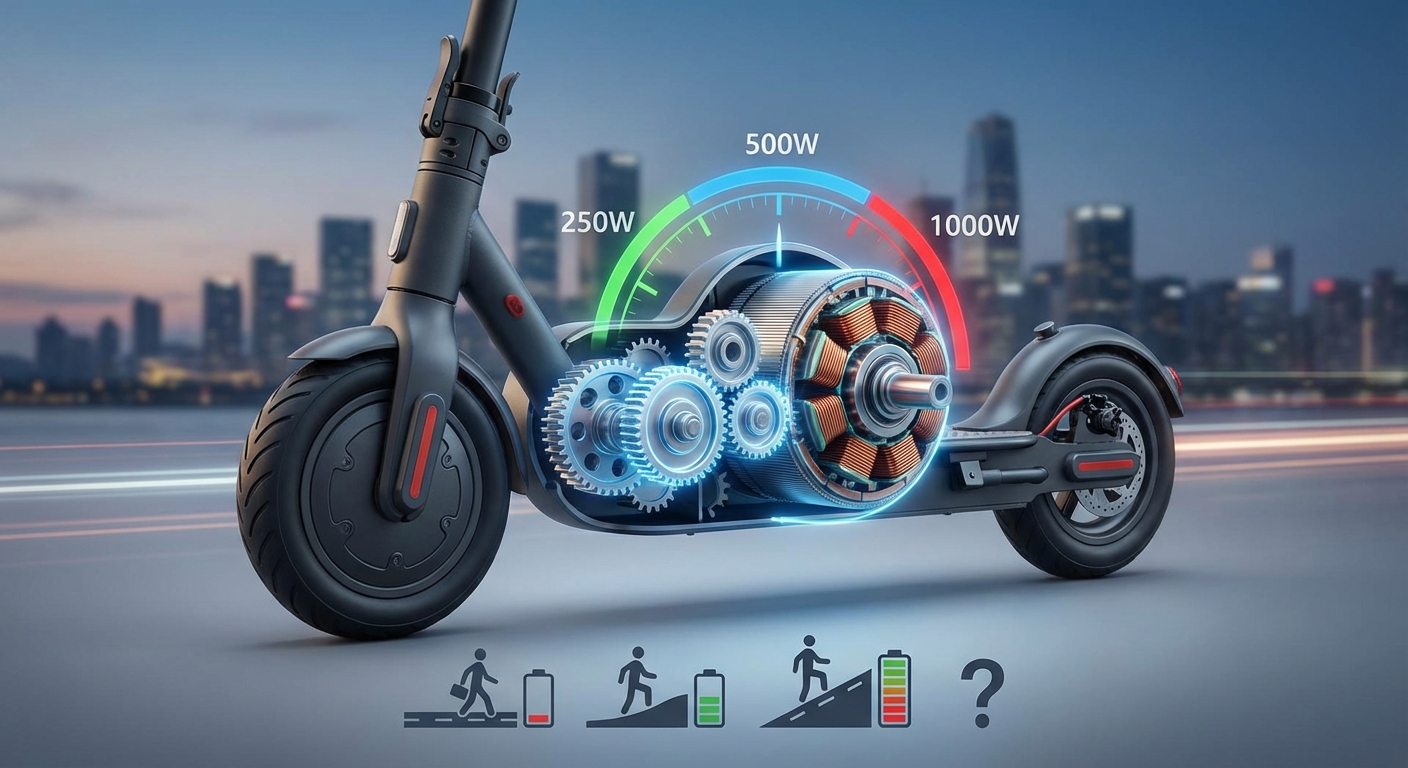
Electric Scooter Motor Power Guide: How Many Watts Do You Really Need?
You’re standing in front of two scooters. One has a 500W motor. The other boasts 2000W. The price gap is huge. But which one actually gets you where you need to go?
Motor power isn’t just a number on a spec sheet. It determines whether you’ll cruise smoothly or struggle up that bridge on your daily commute. It affects how fast you accelerate, how well you handle inclines, and even how far you can travel on a single charge.
Electric scooter motors range from 250W to over 3000W. Most urban commuters need 350W to 700W for flat terrain, while hilly routes require 800W to 1200W. Heavier riders and performance enthusiasts benefit from 1500W+ motors. Your ideal wattage depends on terrain, rider weight, desired speed, and local regulations rather than simply choosing the highest number available.
What wattage actually means for your ride
Watts measure electrical power. In scooters, they tell you how much energy the motor can consume to move you forward.
Higher wattage doesn’t automatically mean better. A 3000W motor is overkill for a two-mile flat commute. You’ll pay more upfront, drain your battery faster, and possibly break local laws.
Lower wattage isn’t always worse either. A 350W motor can be perfect for lightweight riders on smooth paths. It’s efficient, affordable, and legal almost everywhere.
The real question is matching watts to your specific needs.
Breaking down motor power by riding scenario
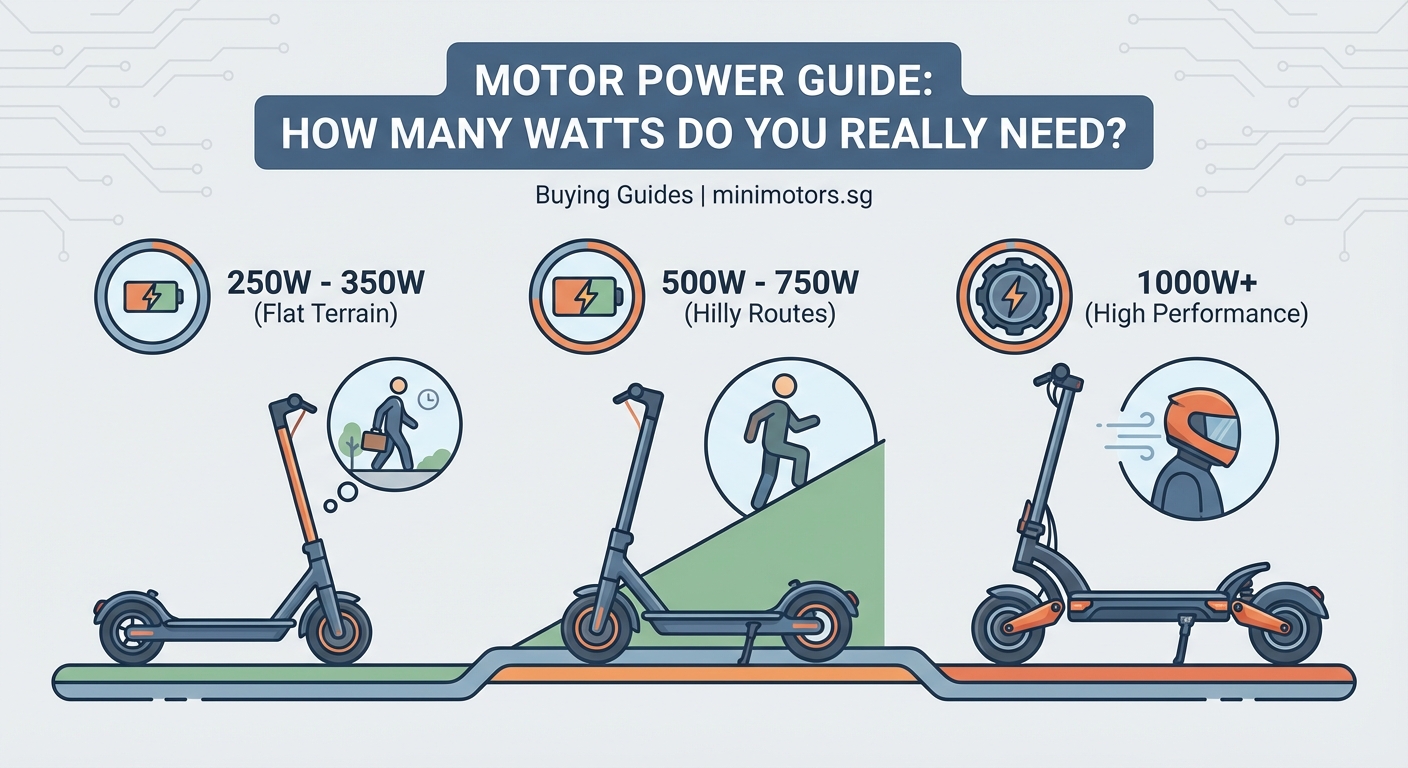
Different riders need different power levels. Here’s how wattage translates to real-world performance.
250W to 500W: city sidewalks and smooth paths
These entry-level motors work best for:
- Riders under 150 pounds
- Completely flat terrain
- Short trips under three miles
- Casual speeds around 12 to 15 mph
A 250W motor will get you moving, but expect slow acceleration. Hills become challenging, even gentle ones. If you weigh more than 160 pounds, you’ll feel the motor strain.
These scooters shine in dense urban areas with smooth pavement and no inclines. Think Singapore’s East Coast Park or flat downtown districts.
350W to 700W: the commuter sweet spot
This range handles most urban riding conditions. You get:
- Decent acceleration from stops
- Ability to tackle gentle slopes
- Comfortable speeds of 15 to 20 mph
- Good balance between power and battery life
A 500W motor can handle riders up to 200 pounds on moderate terrain. You won’t win any races, but you’ll keep pace with traffic on bike lanes.
This wattage works well for choosing your first electric scooter because it covers most everyday scenarios without breaking the bank.
800W to 1200W: hill climbers and heavier riders
Step up to this range when you face:
- Regular hills or bridges
- Rider weight above 200 pounds
- Longer commutes needing sustained power
- Desire for speeds around 25 mph
An 1000W motor transforms hill climbing. What felt impossible on a 500W scooter becomes manageable. Acceleration improves noticeably, making it easier to merge into traffic or cross busy intersections safely.
Battery consumption increases, but the performance trade-off is worth it for challenging terrain. These motors typically appear in scooters designed for heavy riders who need reliable power.
1500W to 3000W+: performance and off-road territory
High-power motors serve specific purposes:
- Steep hills and mountain paths
- Off-road trails with loose surfaces
- Speeds exceeding 30 mph
- Dual motor setups for maximum traction
A 2000W motor feels like a different vehicle entirely. Acceleration pins you back. Hills disappear. But you’ll also face higher costs, heavier weight, and stricter legal limits.
These belong in the off-road category rather than daily commuting unless you live somewhere with extreme terrain.
How to calculate the wattage you actually need
Follow this process to find your ideal motor power:
-
Weigh yourself with typical riding gear. Add your backpack, helmet, and anything you normally carry. Be honest about the total weight.
-
Map your regular route. Note every hill, bridge, or incline. Use your phone’s elevation tracking to measure grade percentages.
-
Check local speed limits and power restrictions. Many cities cap motors at 500W or limit speeds to 15 mph on bike paths.
-
Calculate your minimum wattage. A rough formula: your total weight in pounds multiplied by 5 gives a baseline wattage for flat terrain. Add 300W for every 5% grade you’ll regularly climb.
-
Add a 20% buffer. Motors running at maximum capacity constantly wear out faster and drain batteries quicker.
For example: you weigh 180 pounds with gear. Your route has one 8% hill. You need at least 900W (180 × 5) plus 480W for the hill, totaling 1380W. With a buffer, look for 1600W motors.
Single motor versus dual motor setups
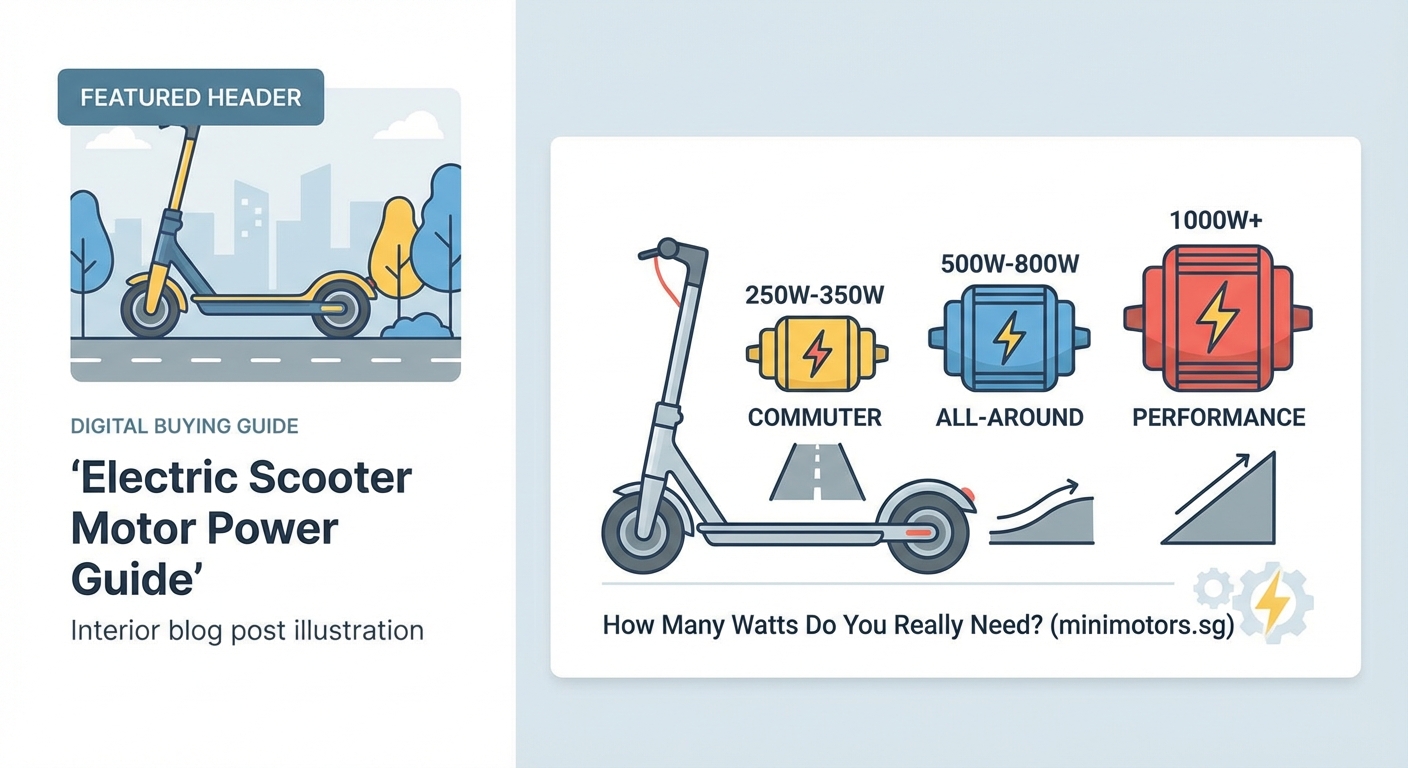
Motor count matters as much as total wattage.
Single motor scooters place one motor in either the front or rear wheel. They’re simpler, lighter, and more efficient. A single 1000W motor works perfectly for most riders.
Rear motors provide better traction on hills. Front motors improve steering feedback but can feel twitchy in rain.
Dual motor scooters split power between both wheels. A scooter with two 1000W motors delivers 2000W total, but with advantages beyond raw power:
- Better traction on loose surfaces
- Improved stability during acceleration
- Option to run one motor for efficiency or both for power
- Redundancy if one motor fails
The downside is weight. Dual motor scooters often weigh 60 to 80 pounds, making them harder to carry or store.
Most commuters don’t need dual motors. Save them for serious off-road riding or extreme hills.
Understanding nominal versus peak power ratings
Scooter specs list two different wattage numbers. Both matter.
Nominal power represents continuous output. A motor rated at 500W nominal can sustain that power indefinitely without overheating.
Peak power shows maximum short-term output. That same motor might hit 800W peak for 10 to 15 seconds during hard acceleration or steep climbs.
Manufacturers love advertising peak numbers because they look impressive. But nominal power determines real-world performance.
| Rating Type | What It Means | When It Matters |
|---|---|---|
| Nominal Power | Sustained output over time | Maintaining speed, long hills, overall performance |
| Peak Power | Brief maximum burst | Initial acceleration, short steep sections |
| Combined (Dual Motor) | Total of both motors | Maximum capability, off-road traction |
Always compare nominal ratings when shopping. A scooter with 600W nominal and 1000W peak outperforms one with 400W nominal and 1200W peak.
How motor power affects battery life and range
More watts drain batteries faster, but the relationship isn’t linear.
Running a 1000W motor at full throttle constantly will empty your battery in 30 minutes. But most riding doesn’t require full power.
Cruising on flat ground at 15 mph might only draw 300W from that 1000W motor. The extra capacity sits in reserve for hills and acceleration.
Efficiency depends on several factors:
- Motor quality: Better motors waste less energy as heat
- Controller programming: Smart controllers adjust power delivery
- Rider behavior: Smooth acceleration preserves battery better than constant hard starts
- Terrain matching: Underpowered motors work harder, draining batteries faster
A 500W motor struggling up a hill might consume more total energy than an 800W motor climbing the same hill efficiently.
For maximizing your scooter’s range, choose a motor with 20% more power than your minimum needs. It’ll run cooler and more efficiently.
Legal limits on electric scooter motor power
Regulations vary dramatically by location.
Singapore limits electric scooters to 500W on footpaths and 2000W on roads, with separate licensing for higher-powered models.
United States rules differ by state and city. Many cap shared scooters at 500W but allow private owners up to 1000W or more.
European Union generally restricts scooters to 250W for bike path access, though enforcement varies.
Australia sets different limits by state, ranging from 200W to 500W nominal power.
Check your local laws before buying. A 2000W scooter might be illegal where you live, or it might require registration, insurance, and a license.
Some regions regulate by speed rather than watts. You might legally own a 1500W scooter if it’s electronically limited to 15 mph.
Before purchasing any electric scooter, verify both power and speed regulations in your area. Laws change frequently, and enforcement is increasing as scooters become more popular. What’s legal today might not be tomorrow.
Common mistakes when choosing motor power
Buyers often make these errors:
Buying too much power for urban commuting. That 3000W monster is thrilling for five minutes, then becomes a heavy, expensive hassle for daily two-mile trips.
Underestimating weight impact. A 250W scooter works great for a 120-pound rider but fails miserably for someone weighing 200 pounds.
Ignoring terrain completely. Flat-landers buy 500W scooters, then move somewhere hilly and regret it.
Focusing only on top speed. A 1500W motor might hit 35 mph, but acceleration and hill climbing matter more for daily use.
Forgetting about portability. High-wattage scooters weigh more. Can you actually carry it up stairs or lift it into your car?
Skipping local law research. Buying an illegal scooter means you can’t ride it where you need to go.
Match your purchase to your actual riding conditions, not aspirational scenarios or impressive numbers.
How rider weight changes power requirements
Weight dramatically affects motor performance.
A 130-pound rider on a 500W scooter experiences completely different performance than a 220-pound rider on the same model.
Here’s a practical comparison:
- Under 150 pounds: 350W to 500W handles most situations
- 150 to 180 pounds: 500W to 700W provides good performance
- 180 to 220 pounds: 800W to 1200W recommended for hills
- Over 220 pounds: 1200W+ ensures adequate power
Add 100W to 200W for each additional 20 pounds above these ranges.
Also consider what you’re carrying. A laptop bag, groceries, or the right backpack for riding adds weight that affects performance.
Some high-quality motors handle weight better than cheap ones at the same wattage. A well-built 750W motor might outperform a bargain 1000W motor when carrying heavy loads.
Temperature and weather effects on motor power
Motors perform differently across conditions.
Cold weather reduces battery output, which limits available motor power. Your 1000W motor might only deliver 700W in freezing temperatures.
Hot weather risks overheating, especially during long climbs. Motors automatically reduce power to prevent damage, a feature called thermal throttling.
Rain and humidity don’t directly affect wattage, but wet roads increase rolling resistance. You’ll need more power to maintain the same speed.
Altitude matters less for electric motors than gas engines, but thinner air at high elevations provides less cooling. Motors may overheat faster.
If you ride year-round in extreme conditions, add 200W to your calculated needs for a safety margin.
Maintenance considerations for different power levels
Higher-wattage motors don’t necessarily require more maintenance, but they stress other components.
Brakes wear faster on powerful scooters because you’re stopping from higher speeds more frequently. Understanding your braking system becomes crucial with motors above 1000W.
Tires degrade quicker under hard acceleration from high-power motors. Budget for replacements every 1000 to 1500 miles instead of 2000 miles.
Controllers and wiring handle more current in high-wattage setups. Connections can loosen from vibration, causing unusual noises or power loss.
Bearings in motor hubs experience greater stress. Listen for grinding sounds indicating wear.
Lower-power motors typically last longer because they run cooler and face less mechanical stress. A well-maintained 500W motor can operate for years with minimal issues.
High-power setups demand more attention but reward you with better performance when properly maintained.
Future-proofing your motor power choice
Think beyond today’s needs.
Will you move somewhere hillier next year? Gain weight? Start carrying more cargo? Want to ride longer distances?
Buying slightly more power than you currently need provides flexibility. The cost difference between a 500W and 700W scooter is usually small, but the performance gap is significant.
However, don’t overbuy dramatically. A 2500W scooter won’t make sense for commuting even if you move to San Francisco. Rent or borrow a powerful scooter to test hilly terrain before committing.
Consider upgradeability too. Some scooters allow controller or battery upgrades that can boost effective power. Others are fixed at purchase specifications.
Battery longevity also factors into future-proofing. A quality 1000W scooter with a replaceable battery pack outlasts a cheap 1500W model with a proprietary battery that becomes unavailable in two years.
Testing motor power before you buy
Numbers on paper don’t always match real-world feel.
Test ride on your actual route if possible. Many shops allow test rides. Bring the scooter to the steepest hill you’ll regularly face.
Try different power levels back-to-back. Ride a 500W, then a 1000W. The difference becomes obvious immediately.
Check acceleration from stops. This matters more than top speed for city riding. Can the scooter get you across intersections quickly and safely?
Test at your weight. Some shops use lightweight staff for demos. Performance changes dramatically with a heavier rider.
Ride for at least 15 minutes. Initial impressions can mislead. Give yourself time to experience sustained performance.
If test rides aren’t available, read reviews from riders with similar weight and terrain. Video reviews showing hill climbs provide useful comparisons.
Real-world wattage recommendations by scenario
Here’s a practical guide matching common situations to appropriate motor power:
College campus commuting (flat, short distances): 350W to 500W handles everything. Prioritize portability and battery life over power.
Urban commuting with occasional hills: 500W to 750W provides enough power without excessive weight or cost.
Hilly city commuting: 800W to 1200W makes climbs manageable. Consider dual motors if hills exceed 10% grade regularly.
Mixed commuting and recreation: 1000W to 1500W offers versatility for both daily rides and weekend adventures.
Dedicated off-road and trail riding: 1500W to 3000W+ delivers the power needed for loose surfaces and steep terrain.
Heavy riders (over 220 pounds) on any terrain: Add 300W to 500W to the recommendations above.
Most buyers overestimate their needs. Unless you face serious hills or carry heavy loads, motors in the 500W to 800W range handle daily commuting beautifully.
How motor power connects to overall scooter design
Wattage doesn’t exist in isolation. It’s part of a complete system.
A 1000W motor needs:
- Battery capacity to sustain that power for reasonable distances
- Frame strength to handle the torque and speed
- Brake quality to stop safely from higher speeds
- Suspension to maintain control over rough surfaces
- Tire quality to grip during hard acceleration
Cheap scooters sometimes install powerful motors on inadequate frames. The result is dangerous, not just disappointing.
Quality manufacturers balance all components. A well-designed 750W scooter outperforms a poorly-built 1200W model in real-world conditions.
When comparing scooters, evaluate the complete package rather than focusing solely on motor watts. First-time riders especially benefit from balanced designs over raw power.
The relationship between watts and riding safety
More power requires more skill and awareness.
Acceleration from high-wattage motors can surprise new riders. Twisting the throttle on a 2000W scooter produces instant, aggressive acceleration that can throw you off balance.
Speed increases with power. Higher speeds reduce reaction time and increase accident risk if you’re not experienced.
Weight from powerful motors and large batteries affects handling. Heavier scooters are harder to maneuver around obstacles.
Braking distance extends at higher speeds. Your 500W scooter stops from 15 mph in 10 feet. A 1500W scooter traveling 30 mph needs 40 feet or more.
Start with moderate power if you’re new to electric scooters. Master control and safety at lower speeds before upgrading to high-performance models.
Even experienced riders should approach new high-power scooters cautiously. Spend your first few rides in empty parking lots learning how the motor responds.
Finding the right balance for your needs
You don’t need the most powerful motor. You need the right motor for your specific situation.
A 500W scooter that perfectly matches your daily commute beats a 2000W beast that’s illegal, impractical, or overkill for your needs.
Consider your route, your weight, local laws, and your budget. Test ride when possible. Start with slightly more power than your minimum calculation suggests, but resist the temptation to dramatically overbuy.
The perfect electric scooter disappears beneath you. You stop thinking about watts and simply enjoy the ride to work, the store, or wherever you’re going. That’s the motor power sweet spot worth finding.
