Do You Really Need E-Scooter Insurance? Coverage Options Explained
You just dropped $800 on a sleek new e-scooter. It’s faster than walking, cheaper than driving, and makes your morning commute actually enjoyable. But then a friend asks: “Did you get insurance for that thing?” You freeze. Insurance? For a scooter? That’s a thing?
It absolutely is, and whether you need it depends on where you live, how you ride, and what you’re willing to risk.
E-scooter insurance isn’t legally required in most places, but it can protect you from costly liability claims, theft, and damage. Basic liability coverage typically costs $100 to $300 annually, while comprehensive plans run $200 to $600. Your decision should weigh your scooter’s value, local laws, riding frequency, and personal risk tolerance against potential out-of-pocket expenses from accidents or theft.
Is e-scooter insurance legally required?
The short answer: usually no, but it depends.
Most U.S. states don’t require insurance for personal e-scooters. They classify them as low-speed vehicles, similar to bicycles. You can ride without coverage in California, Texas, New York, and dozens of other states.
But there are exceptions.
Some European countries mandate third-party liability insurance for e-scooters. Germany requires it. France requires it. The UK requires it for anything over 15.5 mph. If you’re riding in these places without coverage, you’re breaking the law.
Even in places where insurance isn’t mandatory, your local city might have rules. Some municipalities require registration or proof of liability coverage for e-scooters above certain speeds or power ratings.
Before you assume you’re in the clear, check your state’s Department of Motor Vehicles website and your city’s transportation regulations. Laws change fast as cities figure out how to handle the e-scooter boom.
What does e-scooter insurance actually cover?
E-scooter insurance isn’t one-size-fits-all. Different policies cover different risks.
Liability coverage protects you if you injure someone or damage their property while riding. You hit a pedestrian? Your scooter scratches a parked car? Liability insurance pays for their medical bills, repairs, and legal fees if they sue you.
Theft and damage coverage reimburses you if your scooter gets stolen or damaged. Someone cuts your lock and rides off with your $1,200 scooter? This coverage gets you a replacement. Your scooter gets smashed in a collision? It pays for repairs.
Personal injury protection covers your own medical expenses if you get hurt in an accident. Hospital visits, physical therapy, and lost wages can add up fast. This coverage helps fill the gap if your health insurance doesn’t cover everything.
Roadside assistance is a bonus some policies include. Battery dies five miles from home? They’ll send help. Flat tire on your way to work? They’ll arrange a tow.
Here’s how the main coverage types stack up:
| Coverage Type | What It Protects | Typical Cost Per Year | Best For |
|---|---|---|---|
| Liability Only | Damage/injury you cause to others | $100 to $200 | Budget riders, older scooters |
| Theft & Damage | Your scooter if stolen or broken | $150 to $300 | High-value scooters, urban areas |
| Comprehensive | All of the above plus personal injury | $250 to $600 | Daily commuters, high-risk areas |
| Add-On Roadside | Emergency assistance | $30 to $80 | Long-distance riders |
When you probably don’t need insurance
Not everyone needs e-scooter insurance. If any of these apply to you, you might skip it:
- Your scooter cost under $300 and you can afford to replace it
- You ride infrequently, maybe once or twice a month
- You only ride on private property or controlled paths
- Your homeowner’s or renter’s insurance already covers personal liability
- You live in a low-theft area and store your scooter indoors
Many people don’t realize their existing insurance might already provide some protection. Homeowner’s and renter’s policies often include personal liability coverage that extends to activities like riding an e-scooter. If you accidentally injure someone while riding, your homeowner’s policy might cover the claim.
Call your insurance agent and ask specifically about e-scooter incidents. Get it in writing. Some policies explicitly exclude motorized vehicles, even small ones.
If your scooter is a budget model and you rarely ride it, paying $200 a year for insurance might not make financial sense. You could self-insure by setting aside money in an emergency fund instead.
When you absolutely should get insurance
Some situations make insurance a no-brainer.
You commute daily on busy streets. Every ride puts you in traffic with cars, bikes, and pedestrians. The odds of an accident go up with every trip. One collision could mean thousands in medical bills or legal costs.
Your scooter cost over $1,000. Premium models from brands like Dualtron or Kaabo represent serious investments. Losing one to theft or damage without insurance means you’re eating the entire cost.
You live in a high-theft area. Cities with high rates of bike and scooter theft make insurance worth it. Check local crime statistics. If scooter theft is common in your neighborhood, coverage pays for itself the first time someone tries to steal yours.
You have dependents or significant assets. If you’re sued after an accident, lawyers will come after your savings, home, and income. Liability coverage protects everything you’ve worked for.
“I skipped insurance on my first scooter because I thought I was being careful. Then I clipped a jogger who stepped into the bike lane without looking. Her lawyer sent me a letter demanding $15,000 for her medical bills. I ended up settling for $8,000 out of pocket. Now I pay $180 a year for liability coverage and sleep better at night.” — Former uninsured rider
Understanding your legal obligations when riding helps you assess your risk level.
How to get e-scooter insurance in three steps
Getting coverage is simpler than you might think.
1. Check if your current insurance covers you. Call your homeowner’s, renter’s, or auto insurance company. Ask if their personal liability coverage extends to e-scooter accidents. Ask if they cover theft of electric scooters stored at home. Get specific answers about coverage limits and exclusions.
2. Compare specialized e-scooter insurance providers. Several companies now offer policies designed specifically for electric scooters. Velosurance, Markel, and Oyster are popular options. Get quotes from at least three providers. Compare what each policy covers, the deductibles, and the annual cost.
3. Read the fine print before buying. Insurance policies are full of exclusions and limitations. Some won’t cover you if you’re riding commercially (like for food delivery). Others exclude coverage if you’re riding in violation of local laws. Make sure you understand what voids your coverage.
Most policies activate within 24 hours of purchase. You’ll get a digital insurance card you can show to police if asked.
Cost breakdown: what you’ll actually pay
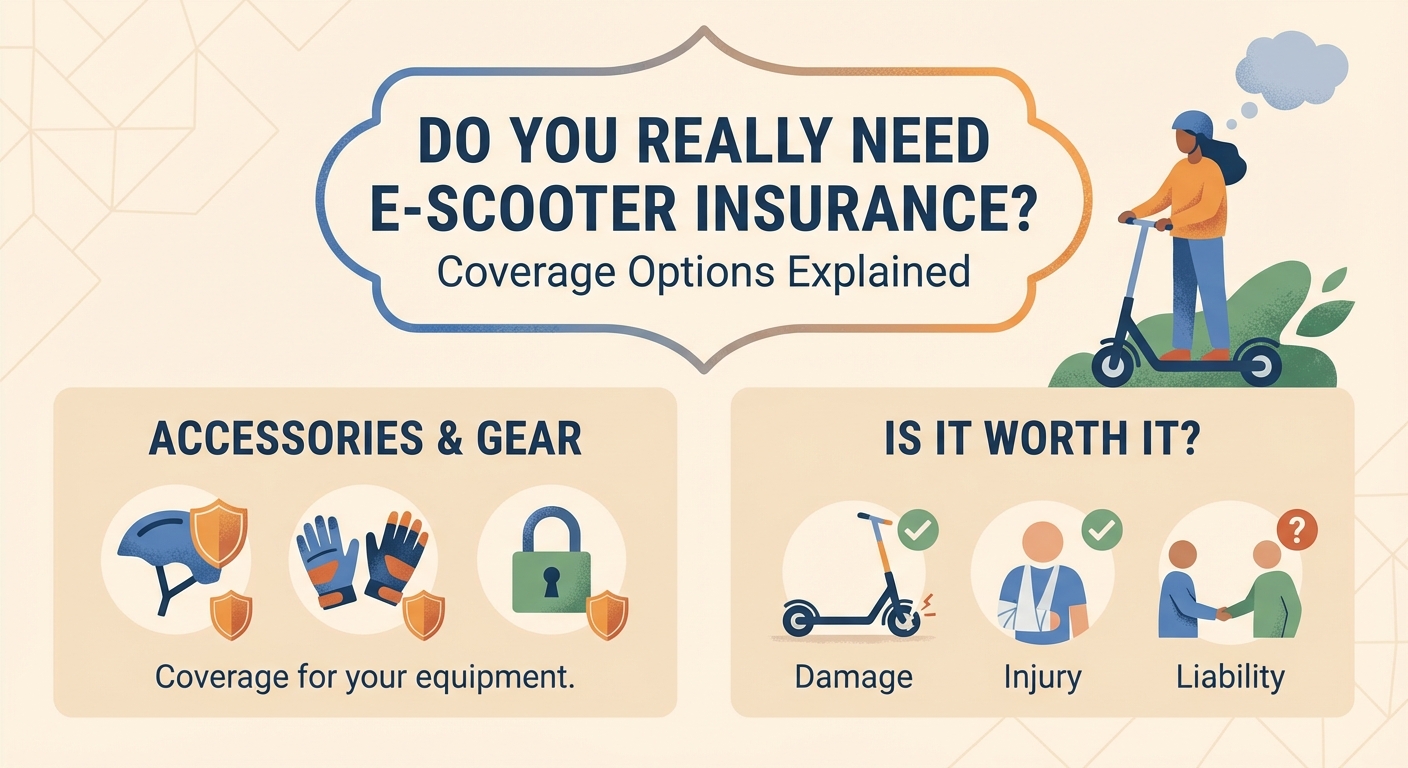
Insurance costs vary based on several factors:
- Scooter value: A $500 scooter costs less to insure than a $2,000 model
- Your location: Urban areas with high theft rates mean higher premiums
- Coverage level: Liability-only is cheapest; comprehensive costs more
- Your riding history: Clean record? Lower rates. Previous claims? Higher rates
- Deductible amount: Higher deductibles reduce your premium
Here’s what real riders pay:
- Basic liability coverage for a $600 scooter in a mid-sized city: $120 per year
- Comprehensive coverage for a $1,500 scooter in a major metro area: $380 per year
- Theft and damage only for a $900 scooter in a suburban area: $190 per year
You can lower your premium by increasing your deductible, bundling with other policies, or installing anti-theft devices. Some insurers offer discounts for GPS trackers or high-quality locks.
Compare that to the cost of common incidents:
- Replacing a stolen $1,200 scooter: $1,200 out of pocket
- Settling a minor injury claim without insurance: $3,000 to $15,000
- Legal fees if someone sues you: $5,000 to $50,000+
- Repairing collision damage to your scooter: $200 to $800
Run the numbers for your specific situation. If you ride a budget model occasionally, self-insuring might make sense. Daily commuters on premium scooters should seriously consider coverage.
Common insurance mistakes that cost riders money
People make predictable errors when dealing with e-scooter insurance.
Assuming their auto insurance covers them. Auto policies typically exclude vehicles without registration. Your car insurance won’t help if you crash your scooter.
Waiting until after an accident to buy coverage. Insurance doesn’t work retroactively. You can’t file a claim for something that happened before you bought the policy.
Underreporting scooter value. Some riders lowball their scooter’s worth to get cheaper premiums. Then when it’s stolen, they only get reimbursed for the undervalued amount. Always report accurate replacement cost.
Ignoring policy exclusions. Many policies won’t cover you if you’re riding illegally, racing, or using your scooter for commercial purposes. Read what voids your coverage.
Skipping documentation. Take photos of your scooter, save receipts, and record the serial number. Without proof of ownership and condition, claims get denied.
Alternatives to traditional insurance
If standard insurance feels too expensive, consider these options:
Homeowner’s or renter’s policy endorsement. Some insurers will add e-scooter coverage to your existing policy for $50 to $100 per year. It’s usually cheaper than a standalone policy.
Credit card protection. Certain premium credit cards offer purchase protection and theft coverage for items bought with the card. Check if yours covers electric scooters.
Membership programs. Organizations like AAA sometimes include coverage for alternative transportation in their membership benefits.
Self-insurance fund. Set aside money each month in a dedicated savings account. If you would pay $300 annually for insurance, save $25 per month instead. After a year, you have $300 to cover minor repairs or theft.
The self-insurance approach works best for riders with cheaper scooters who are primarily concerned about replacement cost, not liability. It doesn’t protect you if you injure someone or get sued.
What to do if you have an accident without insurance
If you crash and don’t have coverage, act fast to minimize damage.
- Stop and check if anyone is injured. Call 911 if needed.
- Exchange contact information with anyone involved.
- Take photos of the scene, damage, and any injuries.
- File a police report if there’s significant damage or injury.
- Don’t admit fault or make statements about what happened.
- Contact a lawyer before discussing the incident with anyone else’s insurance company.
Without insurance, you’re personally liable for all damages and injuries you cause. That means your savings, wages, and property are at risk if someone sues you.
This is exactly why understanding common accidents and proper safety gear matter so much.
Making the insurance decision for your situation
Here’s a practical framework for deciding whether to buy e-scooter insurance:
Get insurance if:
– Your scooter costs over $800
– You ride multiple times per week
– You commute in traffic or crowded areas
– You have significant assets to protect
– Local theft rates are high
– You can’t afford to replace your scooter out of pocket
Skip insurance if:
– Your scooter costs under $300
– You ride occasionally for recreation
– You only ride on private property or quiet paths
– Your existing insurance covers personal liability
– You have an emergency fund to cover replacement cost
Consider partial coverage if:
– Your scooter is mid-range ($400 to $800)
– You ride regularly but not daily
– You’re mainly worried about theft, not liability
– You want protection but need to keep costs down
The decision ultimately comes down to your personal risk tolerance and financial situation. Some people sleep better knowing they’re covered. Others prefer to save the premium and take their chances.
Protecting your investment beyond insurance
Insurance helps, but prevention is better than filing claims.
Invest in a high-quality U-lock and cable. Cheap locks get cut in seconds. A solid lock costs $50 to $100 but makes your scooter much harder to steal.
Register your scooter’s serial number with local police and online databases. If it’s recovered after theft, registration helps prove ownership.
Install a GPS tracker. Some models hide inside the scooter and let you track its location if stolen. They cost $30 to $80 plus a small monthly fee.
Store your scooter indoors whenever possible. Scooters left outside, even locked, are prime targets for thieves.
Perform regular maintenance to prevent mechanical failures that could cause accidents. Check brakes, tires, and lights before every ride.
Follow safe riding practices to reduce your accident risk. Most insurance claims come from preventable crashes.
Your next move depends on how you ride
Insurance isn’t a universal requirement, but it’s a smart choice for many riders.
If you’re commuting daily on a valuable scooter through busy streets, the cost of coverage is negligible compared to your risk exposure. If you’re riding a budget scooter occasionally on quiet paths, you can probably skip it.
The key is making an informed decision based on your specific situation, not just assuming you don’t need it or that it’s too expensive.
Check your existing insurance policies first. You might already have more protection than you realize. If not, get quotes from specialized providers and compare what you’d pay versus what you’d risk going without.
Whatever you decide, take steps to protect yourself and your scooter. Use quality locks, ride defensively, and follow local laws. The best insurance policy is the one you never have to use.
