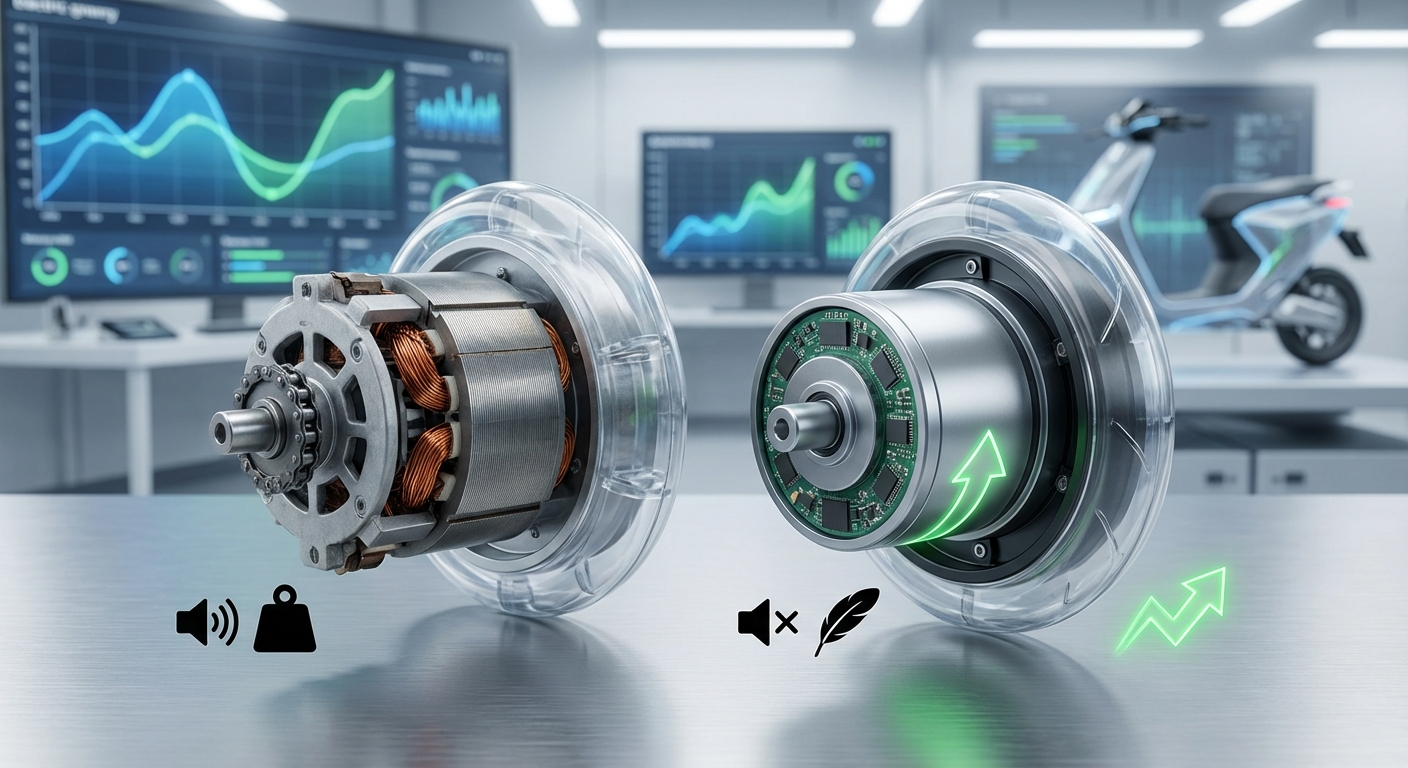
Why Solid-State Motors Are Quieter, Lighter, and More Efficient Than Traditional E-Scooter Motors
The electric scooter world is buzzing about a new motor technology that promises to change how we ride. Solid state motors are starting to appear in premium scooters, and the performance differences are real. If you’ve been hearing about these motors but aren’t sure what makes them special, you’re in the right place.
Solid state motors electric scooters use advanced magnetic materials and integrated electronics to reduce weight by up to 30%, cut noise by half, and improve energy efficiency by 15-20% compared to traditional brushless motors. These motors eliminate external controllers, reduce heat buildup, and deliver smoother acceleration. While currently more expensive, they represent the next evolution in scooter propulsion technology for riders seeking premium performance and reliability.
What makes solid state motors different from traditional scooter motors
Traditional electric scooter motors rely on separate components working together. You have the motor itself, an external controller, and wiring connecting everything. Solid state motors integrate these elements into a single unit using advanced semiconductor technology.
The magic happens at the molecular level. Traditional motors use copper windings and mechanical components that generate friction and heat. Solid state designs replace many of these moving parts with solid electronic components that control magnetic fields more precisely.
This integration means fewer failure points. There’s no external controller box that can get damaged by water or vibration. The motor housing contains everything needed to convert battery power into motion.
The technology borrows concepts from solid state drives in computers. Just as SSDs eliminated spinning hard drive platters, solid state motors reduce mechanical complexity in propulsion systems.
How solid state motors achieve quieter operation
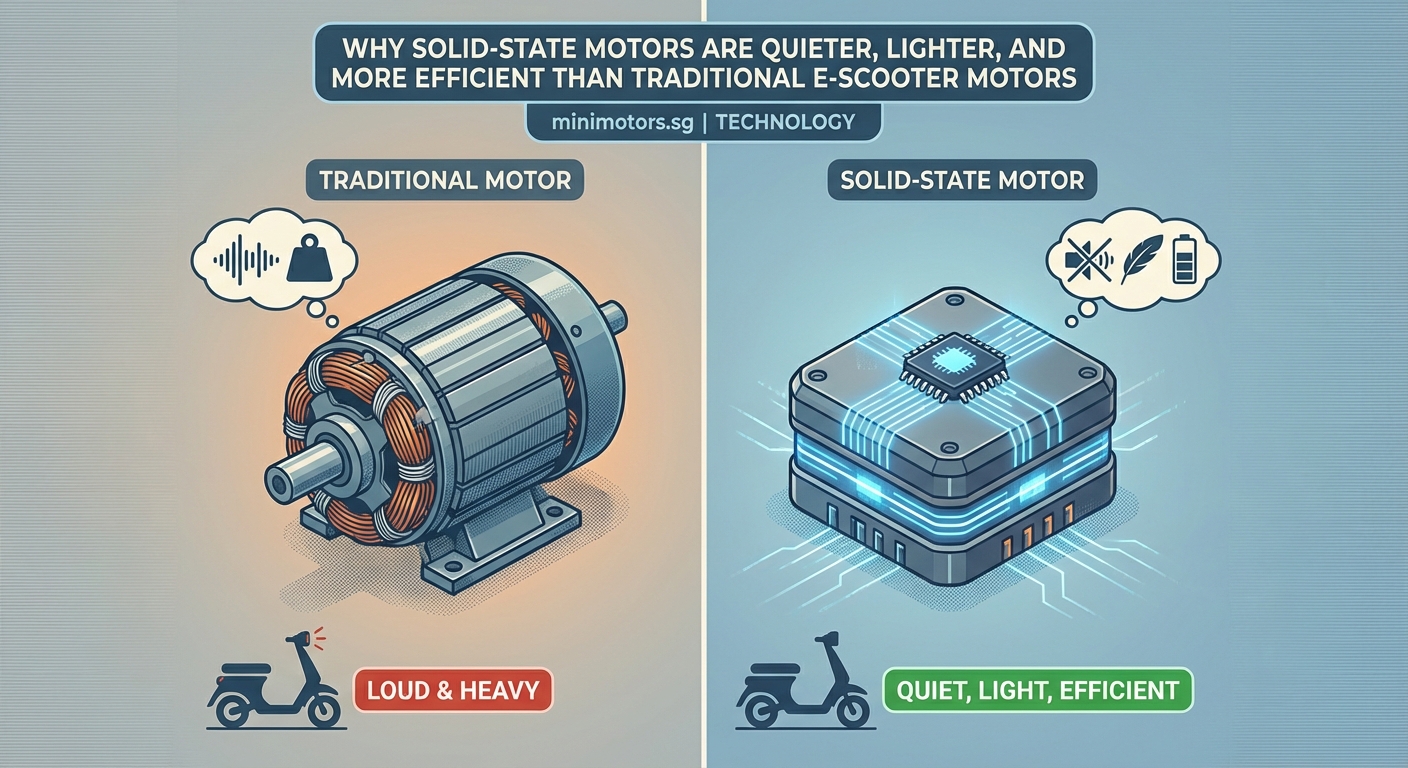
Noise in traditional motors comes from several sources. Coil whine happens when electromagnetic fields cause vibrations in copper windings. Bearing friction creates a constant hum. Controller switching generates high-frequency sounds that some riders find annoying.
Solid state motors address each noise source:
- Integrated power electronics eliminate the separate controller that often produces the loudest switching sounds
- Advanced magnetic materials reduce coil whine by creating more stable electromagnetic fields
- Precision manufacturing tolerances minimize bearing noise
- Software algorithms smooth out power delivery to prevent sudden torque changes that cause clicking sounds
The result is a motor that operates at 40-50 decibels during normal riding, compared to 60-70 decibels for traditional brushless motors. That’s roughly the difference between a library and normal conversation volume.
Riders notice the difference immediately. You can hear traffic better. Conversations with passengers don’t require shouting. Early morning commutes don’t wake the neighbors.
Weight reduction benefits for overall scooter performance
Every gram matters when you’re carrying a scooter up stairs or trying to maximize what is the average range of an electric scooter on a single charge. Solid state motors typically weigh 2-4 kg less than equivalent traditional motors.
The weight savings come from multiple areas:
- Eliminating the external controller saves 0.5-1 kg
- More efficient magnetic materials require less copper, saving 1-2 kg
- Integrated cooling systems weigh less than separate heat sinks and fans
- Compact housing design uses less aluminum or steel
This weight reduction improves several performance metrics. Acceleration feels snappier because there’s less mass to move. Hill climbing becomes easier. Braking distances shorten slightly. Battery range extends by 5-10% because the motor requires less energy to overcome its own inertia.
For portable scooters, the difference is even more significant. A 3 kg weight reduction on a 15 kg scooter represents a 20% improvement in portability. Your back will thank you after a week of commuting.
Energy efficiency improvements and what they mean for range
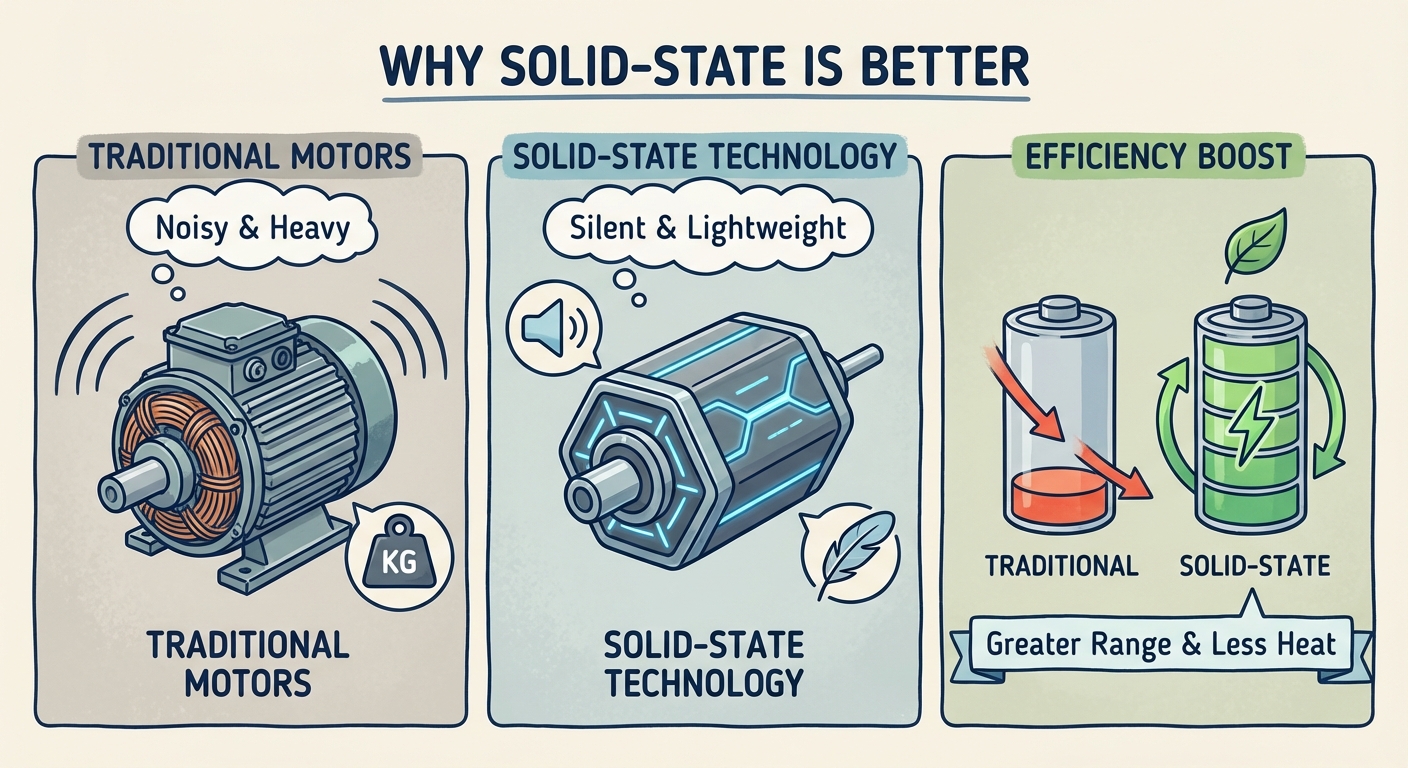
Solid state motors convert battery power to motion more efficiently than traditional designs. The numbers are impressive: 85-90% efficiency versus 70-80% for conventional brushless motors.
Where does the extra efficiency come from? Traditional motors lose energy as heat in several places. Copper windings have electrical resistance. Separate controllers generate switching losses. Bearings create friction. Each loss point wastes battery power.
Solid state designs minimize these losses through better integration and materials. Power flows more directly from battery to magnetic field. Switching happens at higher frequencies with lower losses. Advanced bearing materials reduce friction.
The practical impact on range is significant. A scooter that travels 25 km on traditional motors might reach 28-30 km with solid state motors, assuming the same battery capacity. That extra 3-5 km could mean the difference between making it home or needing to charge at work.
Heat management also improves. Traditional motors can reach 80-90°C under heavy load. Solid state motors typically stay below 60°C. Cooler operation extends component lifespan and maintains consistent performance even during long rides.
Comparing motor technologies side by side
Understanding the differences helps you make informed decisions when choosing your first electric scooter. Here’s how the technologies stack up:
| Feature | Traditional Brushless | Solid State | Advantage |
|---|---|---|---|
| Weight | 6-8 kg | 4-5 kg | Solid state by 30% |
| Noise level | 60-70 dB | 40-50 dB | Solid state by 20 dB |
| Efficiency | 70-80% | 85-90% | Solid state by 10-15% |
| Heat generation | High (80-90°C) | Moderate (50-60°C) | Solid state cooler |
| Component count | 3+ separate units | 1 integrated unit | Solid state simpler |
| Maintenance needs | Moderate | Low | Solid state easier |
| Current cost | $150-300 | $400-600 | Traditional cheaper |
| Availability | Widespread | Limited | Traditional easier to find |
The table reveals why solid state motors haven’t completely replaced traditional designs yet. Cost and availability remain significant barriers for many riders.
Real world performance differences you’ll actually notice
Theory matters less than how motors perform during your daily commute. Riders who’ve switched to solid state motors report several consistent improvements.
Acceleration feels more linear. Traditional motors can have a slight lag as the controller ramps up power. Solid state motors respond instantly to throttle input. The difference is subtle but noticeable when merging into traffic or starting from stops.
Hill climbing performance improves noticeably. The higher efficiency means more battery power reaches the wheels. A 15% grade that slowed your old scooter to 15 km/h might maintain 18-20 km/h with a solid state motor.
Temperature stability helps in extreme weather. Traditional motors lose efficiency when hot or cold. Solid state designs maintain consistent performance across wider temperature ranges. Your winter commute won’t feel as sluggish.
The reduced noise creates a more pleasant riding experience. You’ll notice sounds you missed before: birds chirping, conversations on sidewalks, approaching vehicles. This improved awareness contributes to safer riding, complementing good practices from 7 essential things every first-time e-scooter rider should know.
Maintenance and reliability considerations
Fewer components mean fewer things that can break. Solid state motors eliminate several common failure points found in traditional systems.
Traditional motor maintenance typically includes:
- Checking controller connections every few months
- Inspecting wiring for damage or wear
- Monitoring bearing condition
- Ensuring adequate cooling system function
- Replacing worn brushes (in older brushed motors)
Solid state motors simplify this list significantly. The integrated design means no external controller connections to check. Sealed units protect electronics from water and dust better than separate components.
“We’ve seen solid state motors run for 5,000+ km with zero maintenance beyond basic cleaning. Traditional systems often need controller replacements or wiring repairs by 3,000 km.” — Motor engineer at a leading scooter manufacturer
The improved reliability matters most for daily commuters. Missing work because your scooter’s controller failed is frustrating. Solid state motors reduce that risk substantially.
Water resistance improves with integration. Traditional controllers mounted externally are vulnerable to rain and puddle splashes. Solid state motors seal everything inside the motor housing, achieving IP67 or better water resistance ratings.
Cost analysis and value proposition
Let’s address the elephant in the room. Solid state motors cost significantly more than traditional alternatives. A quality brushless motor and controller combo runs $200-350. Equivalent solid state motors start around $500 and can exceed $800 for high-performance models.
The price difference stems from several factors:
- Advanced materials cost more to source and manufacture
- Production volumes remain relatively low
- Research and development costs are still being recouped
- Complex manufacturing processes require specialized equipment
But cost isn’t just about upfront price. Total ownership cost includes maintenance, repairs, and replacement frequency. Solid state motors’ improved reliability and longevity can offset the higher initial investment over 3-5 years of riding.
Consider a typical scenario. A traditional motor system might need a controller replacement ($100-150) after 2 years and bearing service ($50-80) annually. A solid state motor might run 5 years without any repairs. The total cost difference narrows considerably.
Energy savings add up too. If you ride 20 km daily and pay $0.12 per kWh for electricity, the 15% efficiency improvement saves roughly $15-20 annually. Not huge, but it helps justify the premium over time.
Current limitations and future developments
Solid state motor technology isn’t perfect yet. Several limitations prevent widespread adoption across all scooter categories.
Availability remains the biggest challenge. Only a handful of manufacturers produce solid state motors for scooters. Most models still use traditional brushless systems because that’s what suppliers offer.
Cost barriers limit solid state motors to premium scooter models. Budget and mid-range scooters stick with traditional motors to hit target price points. This creates a chicken-and-egg problem: prices won’t drop until production scales up, but production won’t scale until more manufacturers adopt the technology.
Power output currently favors traditional motors at the extreme high end. The most powerful scooter motors (3000W+) still use conventional designs because solid state technology hasn’t caught up for ultra-high-performance applications.
Repair infrastructure lags behind. If your solid state motor fails, finding a technician who understands the technology can be challenging. Traditional motors benefit from decades of established repair knowledge.
The future looks promising though. Several developments are accelerating adoption:
- Manufacturing costs are dropping as production techniques improve
- More motor manufacturers are investing in solid state research
- Battery technology improvements complement solid state motor efficiency gains
- Regulatory pressure for quieter urban transportation favors low-noise motors
Expect solid state motors to become mainstream in mid-range scooters within 3-5 years. Premium models already feature them. Budget scooters will likely stick with traditional motors for the foreseeable future.
Choosing the right motor type for your needs
Not every rider needs a solid state motor. Your decision should align with your riding patterns and priorities.
Solid state motors make the most sense if you:
- Commute daily and value reliability over upfront cost
- Live in an apartment and need to carry your scooter regularly
- Ride in noise-sensitive areas where quieter operation matters
- Want maximum range from your battery capacity
- Prefer low-maintenance equipment
- Can afford the premium price
Traditional motors remain the better choice if you:
- Have a tight budget and need to minimize initial cost
- Ride occasionally rather than daily
- Already own a scooter and don’t want to upgrade yet
- Need ultra-high power output (3000W+)
- Live where solid state motor service isn’t available
For most daily commuters, solid state motors deliver meaningful improvements that justify the cost premium. The quieter operation alone makes urban riding more pleasant. Add the weight savings and efficiency gains, and the value proposition becomes compelling.
Recreational riders who use their scooters a few times weekly might not notice enough difference to warrant the extra expense. A quality traditional motor will serve them well.
If you’re comparing commuter vs off-road e-scooters, note that solid state motors currently work best in commuter applications. Off-road scooters often need the raw power that traditional high-wattage motors provide.
Integration with other scooter systems
Solid state motors work best when paired with complementary technologies. The motor is just one part of a complete propulsion system.
Battery management systems benefit from solid state motor efficiency. Because these motors draw power more consistently and generate less heat, battery packs experience less stress. This can extend how long e-scooter batteries actually last by 20-30%.
Regenerative braking works more effectively with solid state motors. The integrated electronics can capture and return more energy to the battery during deceleration. Combined with good understanding of e-scooter braking systems, this improves overall range by another 5-10%.
Smart connectivity features pair naturally with solid state motors. The integrated electronics can communicate detailed performance data to smartphone apps. You’ll see real-time efficiency metrics, temperature monitoring, and predictive maintenance alerts.
Weight distribution improves when you eliminate the external controller. Designers can position the motor optimally without worrying about controller placement. This contributes to better handling and stability, particularly important for heavy riders.
Troubleshooting common concerns
Riders considering solid state motors often have similar questions and concerns. Let’s address the most common ones.
“Will I notice the noise difference in real riding conditions?” Yes, especially at speeds below 25 km/h where motor noise dominates. At higher speeds, wind and tire noise become more prominent, reducing the perceived benefit. The difference is most noticeable during acceleration and hill climbing. If you’re already dealing with why is my electric scooter making noise, switching to solid state can eliminate several noise sources.
“Can solid state motors handle wet conditions?” Better than traditional systems. The integrated design provides superior water resistance. Most solid state motors achieve IP67 ratings, meaning they can handle submersion up to 1 meter for 30 minutes. Traditional motors with external controllers typically max out at IP54 or IP65.
“What happens if a solid state motor fails?” Replacement is usually the only option. Unlike traditional systems where you might replace just the controller or motor separately, solid state units are integrated. This makes repairs more expensive but also less frequent.
“Do solid state motors work with any battery?” Generally yes, but they perform best with high-quality battery packs that can deliver consistent voltage. Cheap batteries with voltage sag under load will limit any motor’s performance.
“How do I know if my scooter has a solid state motor?” Check the manufacturer’s specifications. Solid state motors are usually marketed prominently because they’re a premium feature. If the specs mention an integrated motor controller or solid state propulsion, that’s your answer.
Why motor technology matters for your riding experience
The motor is the heart of your electric scooter. It determines how your scooter accelerates, climbs hills, handles varying terrain, and responds to your throttle inputs.
Traditional motors have served the industry well for over a decade. They’re proven, affordable, and widely supported. But they represent older technology that hasn’t fundamentally changed in years.
Solid state motors represent the next evolution. They address the main weaknesses of traditional designs: excessive noise, unnecessary weight, wasted energy, and reliability concerns. The improvements aren’t revolutionary for every rider, but they’re significant for daily commuters who log thousands of kilometers annually.
The technology is still maturing. Early adopters pay a premium and accept limited availability. But that’s how all technology advances. Smartphones were expensive and rare before they became ubiquitous. Solid state motors are following a similar trajectory.
If you’re shopping for a new scooter today, consider whether the benefits align with your needs. The quieter operation, lighter weight, and better efficiency create a noticeably improved riding experience. Whether that’s worth the extra cost depends on how much you ride and what you value.
For riders keeping their current scooters, don’t feel pressured to upgrade immediately. Traditional motors will continue working fine for years. But when replacement time comes, solid state options will likely be more affordable and widely available than they are today.
The road ahead for electric scooter propulsion
Motor technology shapes the entire scooter ownership experience. Solid state motors deliver measurable improvements in the areas that matter most to daily riders: noise, weight, efficiency, and reliability.
The premium pricing currently limits solid state motors to higher-end models. But manufacturing scale and competition will drive prices down over the next few years. What costs $600 today might cost $300 in 2028.
For now, solid state motors remain a premium feature that delivers real benefits. If you ride frequently, value quiet operation, and can afford the upfront cost, they’re worth serious consideration. The improved efficiency alone can pay back part of the premium through reduced charging costs and extended battery life.
Traditional motors aren’t going away anytime soon. They’ll continue serving budget-conscious riders and high-power applications well. But solid state technology represents where the industry is heading. Understanding the differences helps you make informed decisions about your next scooter purchase.
