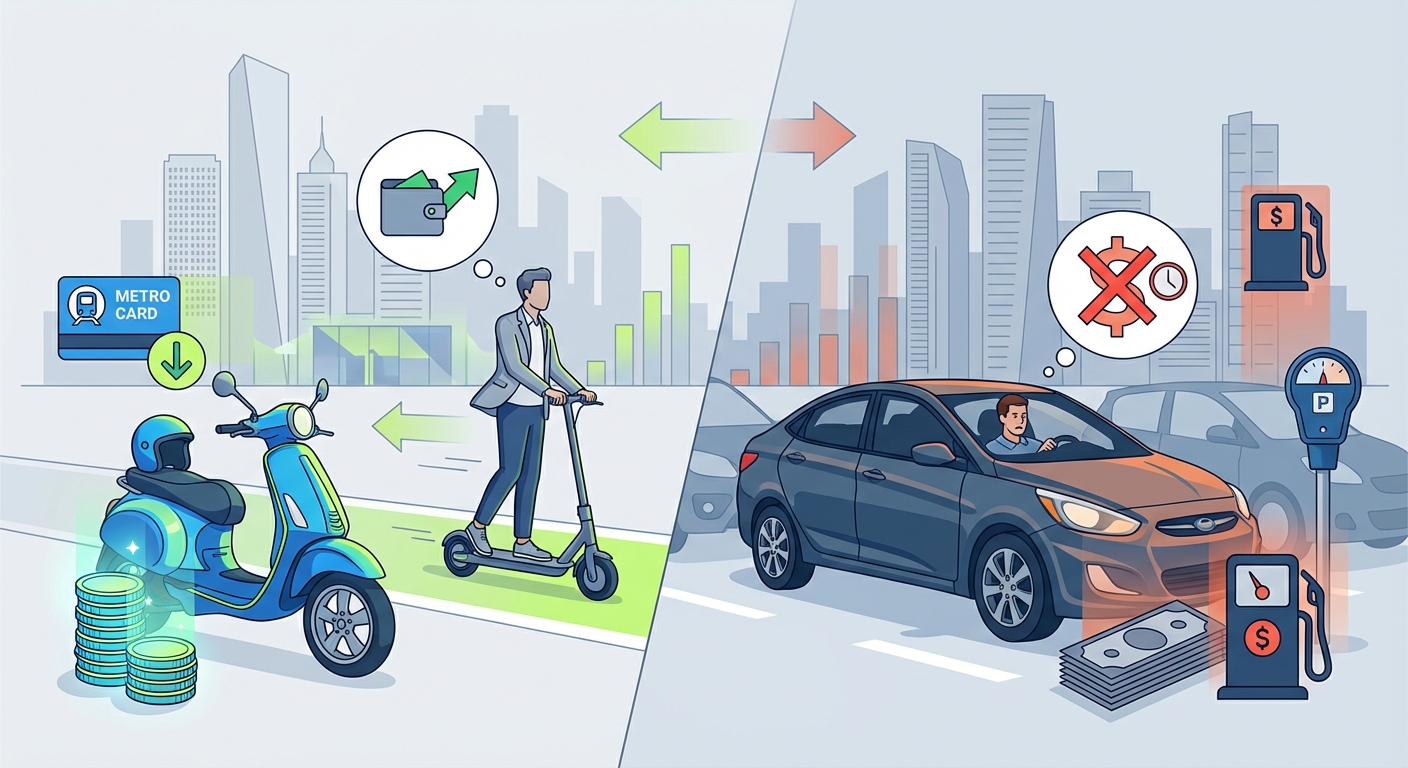
The Economics of E-Scooter Commuting vs Car Ownership in Cities
Your monthly car payment just hit. Again. Insurance is due next week. The parking garage raised rates. And you still need an oil change.
Meanwhile, your coworker glides past traffic on an electric scooter, spending less per month than you drop on a single tank of gas.
The numbers tell a story most car owners don’t want to hear.
Switching from car ownership to e-scooter commuting can save urban dwellers $8,000 to $12,000 annually. Initial e-scooter costs range from $400 to $2,000, while cars demand ongoing expenses including payments, insurance, fuel, parking, and maintenance. For trips under 10 miles, e-scooters deliver comparable convenience at a fraction of the cost, making them ideal for city commuters seeking financial relief without sacrificing mobility.
The real cost of owning a car in the city
Let’s start with the uncomfortable truth.
The average new car costs $48,000 in 2026. Used vehicles still run $28,000 or more. That’s just the beginning.
Finance that new car at 7% interest over five years, and you’re paying $950 monthly. Add insurance at $200 per month for urban drivers. Parking in major cities averages $250 monthly for a dedicated spot.
You’re already at $1,400 before turning the key.
Fuel adds another $180 monthly for a 12-mile daily commute. Maintenance and repairs average $120 monthly when you factor in oil changes, tire rotations, brake pads, and the occasional major repair.
Registration, inspection, and miscellaneous costs tack on $50 monthly.
Total monthly cost: $1,750
Annual cost: $21,000
That’s more than some people’s rent.
What an e-scooter actually costs you
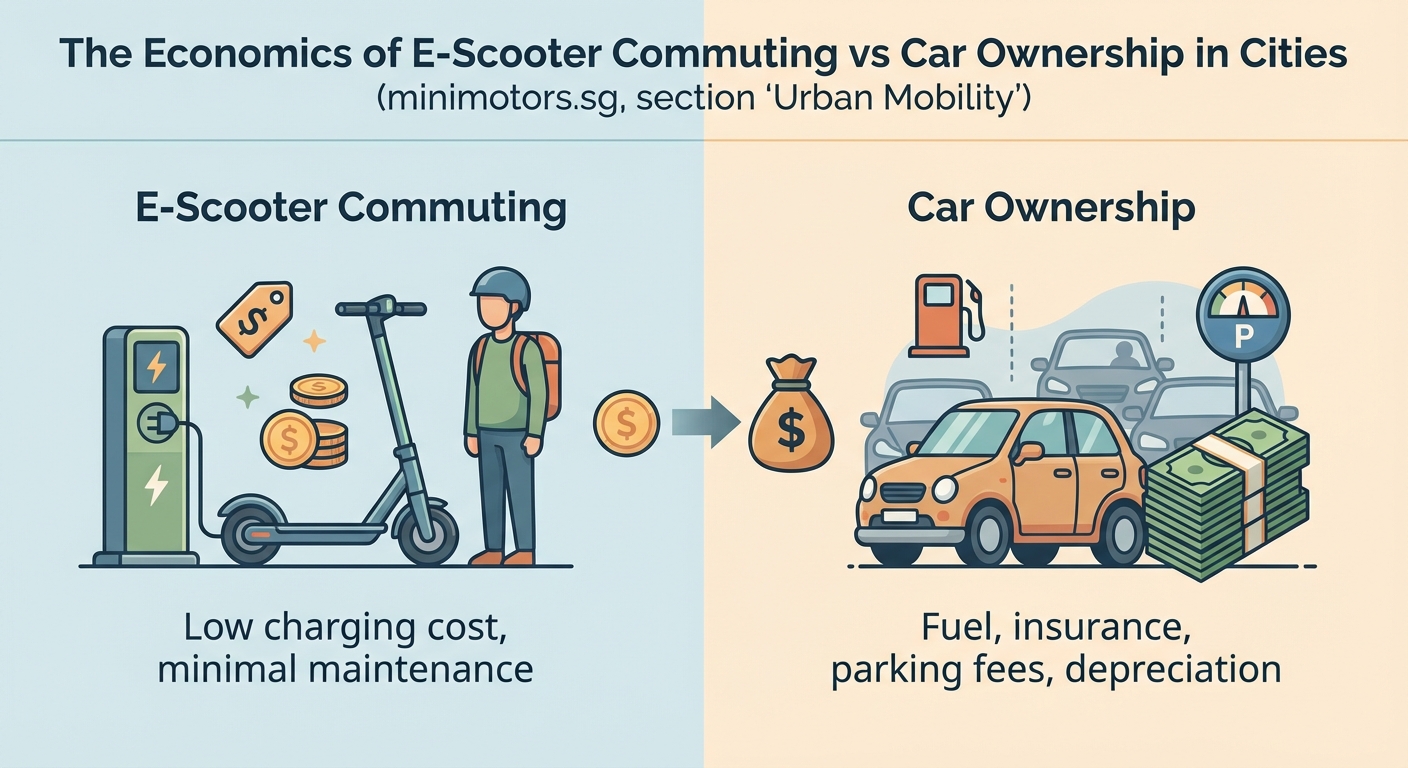
The contrast is stark.
A quality commuter e-scooter costs between $600 and $1,500 upfront. Premium models with extended range and durability reach $2,000. There’s no financing needed for most buyers.
Electricity to charge your scooter runs about $2 monthly. That’s based on daily charging at typical residential rates.
Insurance is optional but recommended. When you do get coverage through specialized e-scooter insurance, it costs $8 to $15 monthly.
Maintenance is minimal. Budget $30 monthly for tire replacements, brake adjustments, and occasional part swaps.
No parking fees. No registration in most cities. No inspection requirements.
Total monthly cost: $40 to $50
Annual cost: $480 to $600
Add the purchase price amortized over three years, and you’re still under $1,200 annually.
Breaking down the five-year comparison
Here’s what happens when you commit to either option for five years.
| Expense Category | Car (5 Years) | E-Scooter (5 Years) | Savings |
|---|---|---|---|
| Purchase/Financing | $57,000 | $1,500 | $55,500 |
| Insurance | $12,000 | $720 | $11,280 |
| Fuel/Electricity | $10,800 | $120 | $10,680 |
| Parking | $15,000 | $0 | $15,000 |
| Maintenance | $7,200 | $1,800 | $5,400 |
| Registration/Fees | $3,000 | $0 | $3,000 |
| Total | $105,000 | $4,140 | $100,860 |
That’s over $100,000 in savings.
You could buy a house down payment with that money. Or retire earlier. Or just breathe easier knowing you’re not hemorrhaging cash every month.
How to calculate your personal break-even point
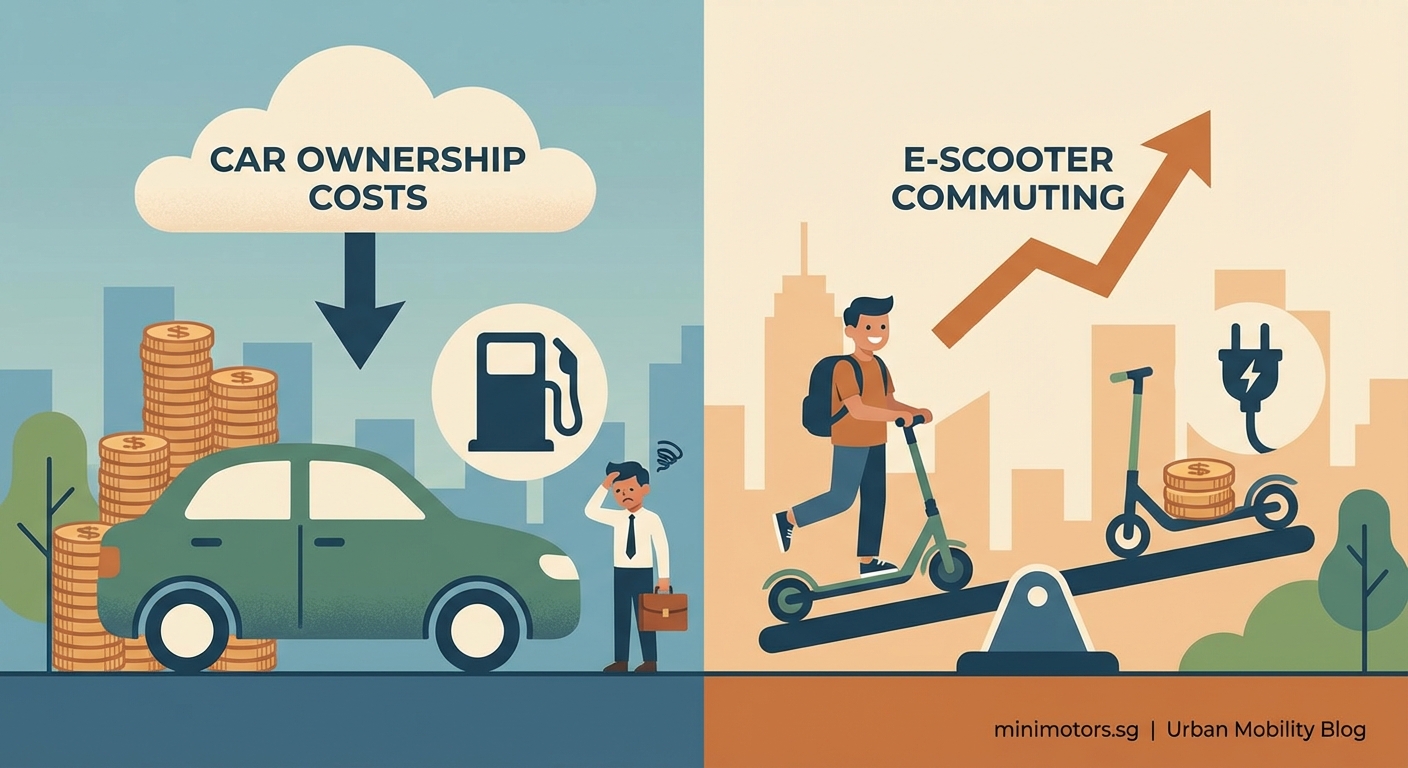
Your situation might differ from the averages.
Follow this process to find your real numbers:
- List every car expense you paid last month, including the loan payment, insurance premium, fuel receipts, parking charges, and any maintenance.
- Multiply that monthly total by 12 to get your annual car cost.
- Research e-scooter models that match your commute distance, checking specifications for range and durability.
- Add up the e-scooter purchase price, estimated annual electricity cost ($24), insurance ($120 to $180), and maintenance ($360).
- Subtract the e-scooter annual cost from your car annual cost to find your yearly savings.
- Divide the e-scooter purchase price by your monthly savings to see how many months until you break even.
Most commuters break even within three to six months.
After that, every month is pure savings.
The hidden costs nobody mentions
Cars carry invisible expenses that drain your wallet slowly.
Depreciation hits hardest. New cars lose 20% of their value the moment you drive off the lot. They lose another 15% each year for the first five years.
Your $48,000 car becomes worth $20,000 after five years. That’s $28,000 evaporated.
E-scooters depreciate too, but losing value on a $1,200 purchase stings far less than watching $28,000 disappear.
Time is another hidden cost. The average urban driver spends 54 hours yearly searching for parking. That’s more than a full work week spent circling blocks.
E-scooters fold up and come inside with you. No circling. No meters. No tickets.
Traffic delays cost the average city driver 99 hours per year sitting in congestion. E-scooters use bike lanes and paths, often cutting commute times by 30% to 50% compared to cars in dense areas.
When cars still make financial sense
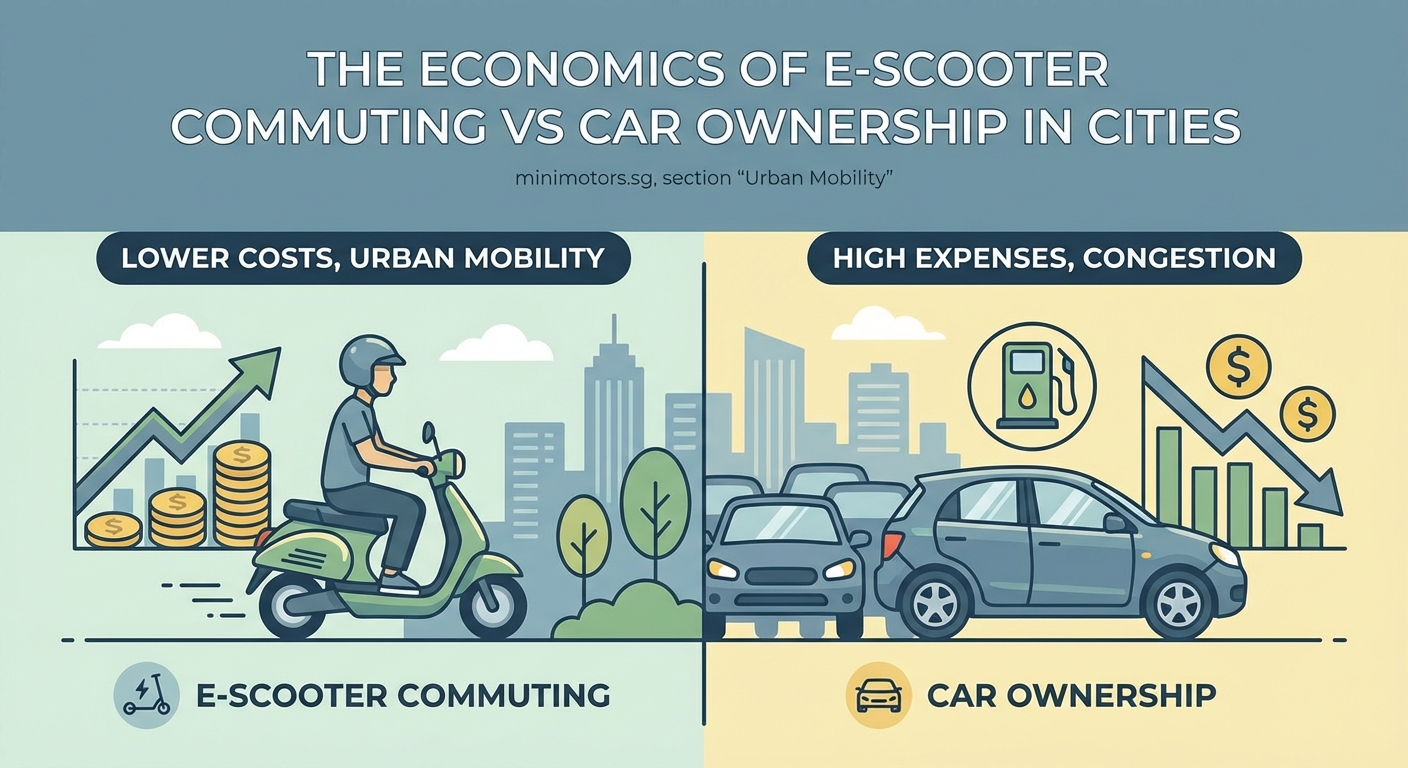
E-scooters aren’t always the answer.
If your commute exceeds 15 miles one way, you’ll struggle with most e-scooter ranges. Some premium models reach 40 miles per charge, but that’s pushing the limits for daily use.
Families with children need car seats and cargo space. An e-scooter can’t replace a minivan for weekend soccer tournaments.
Extreme weather matters. Riding in heavy rain or snow isn’t just uncomfortable, it’s dangerous. Cities with harsh winters need weather-appropriate transportation.
Job requirements sometimes demand a car. Sales representatives visiting multiple client sites, delivery drivers, and field service technicians can’t operate on e-scooters.
But here’s the key insight: many families can downsize from two cars to one car plus e-scooters.
That single change saves $10,000 to $15,000 yearly while maintaining the flexibility a car provides for longer trips and bad weather.
Real commuter scenarios with actual numbers
Scenario 1: The downtown office worker
Sarah lives 4 miles from her office in Chicago. She sold her Honda Civic and bought a $900 e-scooter.
Previous monthly car costs: $1,650
Current monthly e-scooter costs: $45
Monthly savings: $1,605
Break-even time: 0.5 months
She recovered her e-scooter investment in two weeks.
Scenario 2: The suburban commuter
James lives 8 miles from work in Austin. He kept his truck for weekend trips but switched to an e-scooter for daily commuting.
Reduced monthly car costs (less fuel, parking, wear): $450
Monthly e-scooter costs: $50
Monthly savings: $400
His $1,400 premium e-scooter paid for itself in 3.5 months.
Scenario 3: The multi-modal commuter
Maria combines her e-scooter with public transit in Seattle. She rides 2 miles to the train station, takes the train downtown, then rides another mile to her office.
Previous monthly car costs: $1,800
Current costs (transit pass + e-scooter): $220
Monthly savings: $1,580
Her $800 e-scooter broke even in 0.5 months.
“I thought I needed a car to be an adult. Turns out, I needed to ditch my car to afford being an adult. My e-scooter saves me enough money to actually build savings instead of just surviving paycheck to paycheck.” – Transit blogger and former car owner
The maintenance cost reality check
Car maintenance sneaks up on you.
Oil changes every 5,000 miles cost $60 to $100. That’s three to four times yearly for average drivers.
Tire replacements run $600 to $1,200 every 40,000 to 50,000 miles. Brake pad replacements cost $300 to $800 every 50,000 miles.
Battery replacements for modern cars with advanced electronics cost $200 to $300 every five years. Transmission services, coolant flushes, and air filter changes add hundreds more.
Major repairs hit without warning. A failed alternator costs $500. A bad starter runs $400. Transmission problems start at $1,800 and climb to $3,500 for rebuilds.
E-scooter maintenance is predictable and cheap.
Tires wear out every 1,000 to 2,000 miles. Replacements cost $30 to $60 per tire. Most riders change tires twice yearly.
Brake pads last 1,500 to 3,000 miles and cost $20 to replace. The job takes 20 minutes with basic tools.
Battery replacement is the biggest expense. Most e-scooter batteries last 500 to 1,000 charge cycles, roughly three to five years of daily use. Replacement batteries cost $200 to $500 depending on capacity.
Even with a new battery every four years, your total maintenance costs stay under $2,000 for five years of ownership.
Compare that to $7,200 for a car.
Insurance and liability differences
Car insurance is mandatory and expensive.
Urban drivers under 30 pay $250 to $400 monthly. Drivers with accidents or tickets pay even more. Minimum coverage protects others but leaves you vulnerable.
Full coverage with comprehensive and collision protection costs $200 to $300 monthly even for older vehicles.
E-scooter insurance is optional in most regions but smart to carry.
Personal e-scooter policies cost $8 to $20 monthly and typically include liability coverage up to $100,000, medical payments coverage, and theft protection.
Some homeowners or renters insurance policies extend coverage to e-scooters. Check your existing policy before buying separate coverage.
The liability risk differs too. Car accidents involve higher speeds and more severe injuries, leading to larger claims and lawsuits.
E-scooter accidents typically result in minor injuries. The lower speeds and smaller mass reduce both injury severity and liability exposure.
Common objections and honest answers
“What about rain?”
You’ll get wet sometimes. Waterproof gear costs $100 to $200 and solves most problems. Keep a backup plan like ride-sharing for severe weather days.
The cost of occasional rides during storms is still far less than owning a car year-round.
“E-scooters aren’t safe.”
Neither are cars. Vehicle crashes kill 40,000 Americans yearly. E-scooter fatalities number in the hundreds.
Wear a helmet. Follow traffic laws. Ride defensively. The same rules that keep cyclists safe apply to e-scooter riders.
“I’ll look ridiculous.”
You’ll look smart when you’re building wealth instead of making car payments. Status symbols are expensive. Financial freedom is priceless.
“My commute is too far.”
Maybe. But choosing the right e-scooter range matters. Premium models reach 40+ miles per charge. Combine an e-scooter with public transit for longer distances.
“What about groceries?”
A backpack holds plenty for daily shopping. Make multiple smaller trips instead of one weekly haul. Or keep a car for big shopping trips while using your e-scooter for commuting.
You don’t need to replace every car trip. Just replace the expensive daily commute.
The environmental savings bonus
Financial savings matter most to your wallet.
Environmental savings matter to everyone’s future.
The average car emits 4.6 metric tons of CO2 annually. That’s based on 11,500 miles of driving at typical fuel economy.
E-scooters charged with grid electricity emit about 0.1 metric tons annually for the same distance. That’s 98% less carbon output.
Manufacturing matters too. Building a car produces 6 to 35 tons of CO2 depending on size and type. Building an e-scooter produces less than 0.2 tons.
The environmental case reinforces the financial case. You save money while reducing your carbon footprint.
Cities with cleaner electricity grids amplify the environmental benefits. Charge your e-scooter in Seattle or San Francisco, and your emissions drop even further.
What to do with your car savings
Saving $1,500 monthly changes lives.
Here’s what smart people do with the difference:
- Pay off high-interest debt, starting with credit cards charging 20%+ interest
- Build an emergency fund covering six months of expenses
- Max out retirement contributions to capture employer matching
- Save for a house down payment in a high-yield savings account
- Invest in index funds for long-term wealth building
- Start a side business with the extra capital
- Take vacations without going into debt
The compound effect matters most.
Invest $1,500 monthly at 8% average returns for 20 years, and you accumulate $880,000. That’s nearly a million dollars from transportation savings alone.
Keep making car payments for 20 years, and you’ll spend $420,000 while building zero wealth.
The choice determines your financial future.
Making the switch without regret
Transitioning from car to e-scooter takes planning.
Start with a trial period. Rent an e-scooter for a month to test your commute. Most cities offer rental programs for $30 to $50 monthly.
Track every challenge you face. Note the days when weather stops you. Measure the actual distance you travel. Test different routes to find the safest paths.
If the trial works, buy your own scooter. Choosing your first electric scooter requires matching specifications to your needs, not buying the cheapest option.
Keep your car for the first three months. Prove to yourself that e-scooter commuting works before selling your vehicle.
When you’re confident, sell the car. Use the proceeds to pay off any remaining loan balance. Bank the rest or invest it immediately.
Set up automatic transfers of your car payment amount into savings or investments. If you don’t see the money, you won’t spend it on other things.
Track your savings monthly. Watching the numbers grow reinforces your decision and keeps you motivated during challenging weather days.
Choosing the right e-scooter for commuting
Not all e-scooters work for daily commuting.
Budget models under $400 use weak motors, small batteries, and cheap components. They’ll frustrate you within weeks and cost more in repairs than you saved upfront.
Budget e-scooters under $500 can work for short, flat commutes, but most urban riders need more capability.
Look for these minimum specifications:
- 500-watt motor for hills and acceleration
- 25-mile minimum range for daily use with buffer
- Solid or pneumatic tires rated for 2,000+ miles
- Disc or drum brakes, never electronic-only
- IP54 or better water resistance rating
- 220-pound minimum weight capacity
Premium features worth paying for include suspension for rough roads, dual motors for steep hills, and swappable batteries for extended range.
Commuter-specific e-scooters prioritize reliability and range over speed and tricks. That’s what you need for daily transportation.
Expect to spend $800 to $1,500 for a solid commuter scooter that lasts three to five years with proper maintenance.
The bigger picture beyond personal savings
Your individual choice creates ripple effects.
Every car removed from daily commutes reduces traffic congestion for everyone. Studies show that replacing just 10% of car trips with micro-mobility options cuts average commute times by 15%.
Parking demand drops when more people ride e-scooters. Cities can repurpose parking lots into parks, housing, or businesses. That increases property values and quality of life.
Air quality improves as emissions decrease. Children in cities with high e-scooter adoption rates show reduced asthma rates and better respiratory health.
Local businesses benefit when people can stop easily without parking hassles. E-scooter riders spend more at neighborhood shops than drivers who only visit big-box stores with massive parking lots.
Your switch from car to e-scooter isn’t just personal finance. It’s urban planning, public health, and community building.
The more people who make the switch, the better cities become for everyone.
Your money or your car payment
The math is clear.
Cars cost $15,000 to $25,000 yearly in major cities. E-scooters cost $1,000 to $1,500 yearly including the purchase price amortized over three years.
That’s $14,000 to $23,500 in annual savings.
The question isn’t whether e-scooters save money. The question is whether your specific situation allows you to capture those savings.
For urban commuters traveling under 10 miles each way, the answer is almost always yes.
Start with a rental trial. Test your commute. Face the weather. Experience the reality before committing.
If it works, buy a quality scooter and sell your car. Put the savings somewhere you can watch them grow.
Your future self will thank you for choosing financial freedom over expensive status symbols.
The road to wealth is often paved with two wheels instead of four.
