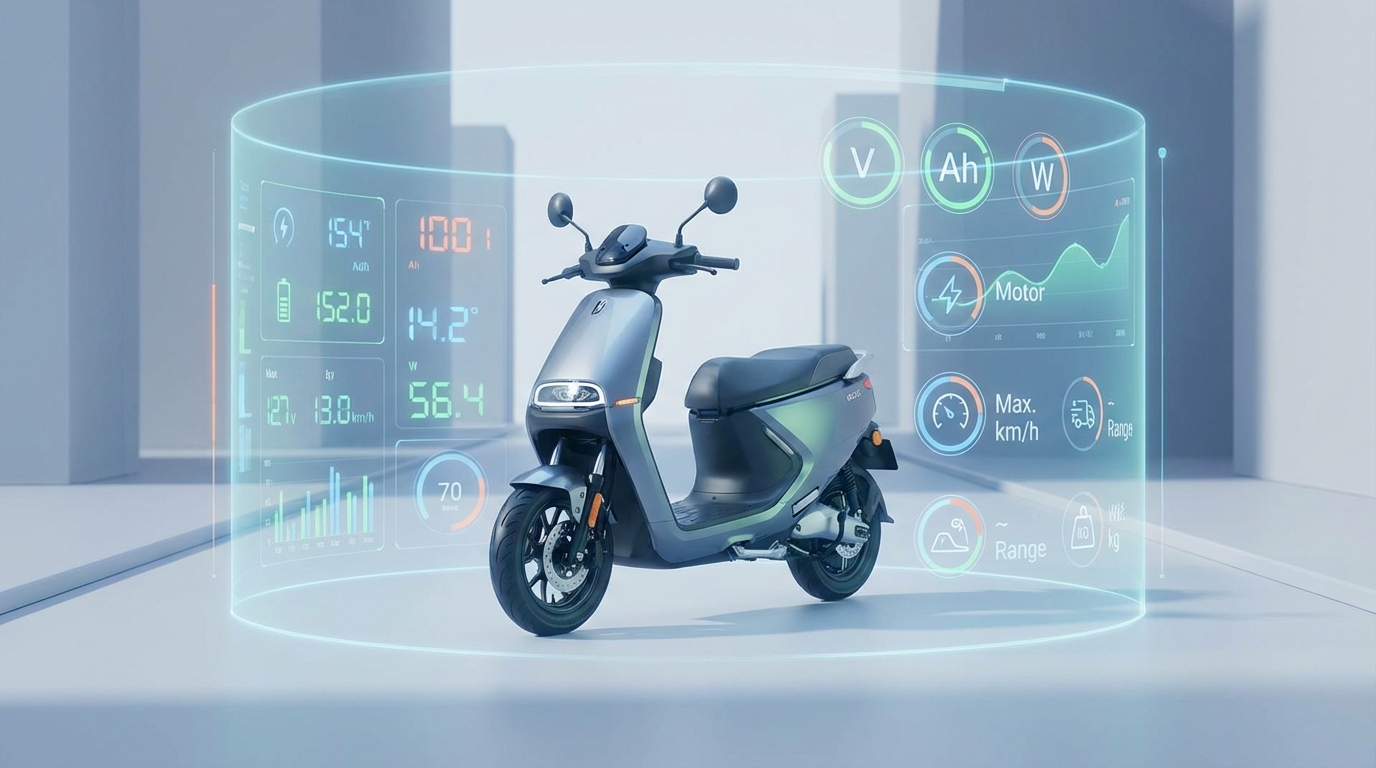
What Do All Those Numbers Mean? Decoding E-Scooter Specifications for Beginners
You’re standing in front of two scooters that look almost identical. One costs $400, the other $800. The spec sheets are covered in numbers: 500W, 36V, 10Ah, 25km range. You’re not sure which matters most, or if you’re about to pay double for features you’ll never use.
Understanding electric scooter specifications doesn’t require an engineering degree. It just needs someone to translate the jargon into real-world riding scenarios. That’s exactly what we’re doing here.
Electric scooter specs tell you how fast, how far, and how reliably your scooter will perform. Motor power affects hill climbing and acceleration, battery capacity determines range, voltage influences efficiency, and weight limits impact safety. Learning to read these numbers helps you match a scooter to your actual commute, body type, and terrain instead of falling for marketing hype or overpaying for unnecessary features.
Motor Power and What It Actually Does
Motor power gets measured in watts (W). You’ll see numbers ranging from 250W for basic commuter models up to 2000W or more for performance scooters.
Here’s what those numbers mean for your ride.
A 250W motor handles flat pavement and gentle slopes. It’s fine for short trips on smooth surfaces. But add a hill or a headwind, and you’ll feel the struggle.
A 500W motor climbs moderate inclines without losing much speed. It accelerates faster from stops and handles varied terrain better. Most urban riders find this the sweet spot.
Motors rated at 1000W and above tackle steep hills, carry heavier loads, and maintain speed over rough ground. They’re built for riders who need serious power or face challenging routes.
Nominal vs. peak power matters too. Nominal power is what the motor delivers continuously. Peak power is the short burst it can handle when you need extra acceleration or hill-climbing force. A scooter listed as “500W nominal, 800W peak” will perform better than a “500W” model with no peak rating mentioned.
“Don’t just look at the wattage number. Ask yourself: what’s the steepest hill on my route? How much do I weigh with my backpack? A 350W motor might work for a 60kg rider on flat ground but struggle with an 85kg rider on even slight inclines.”
Battery Capacity Determines How Far You’ll Go
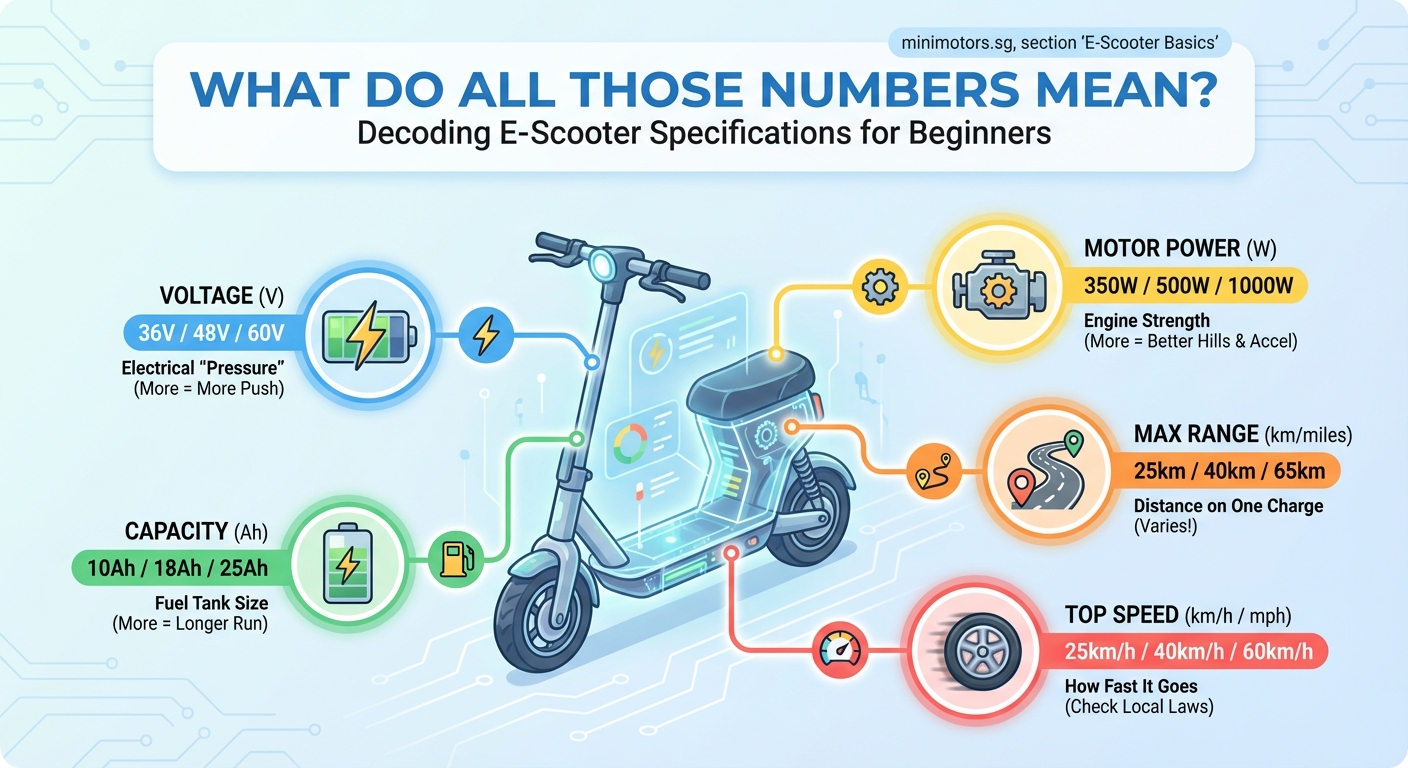
Battery capacity appears as amp hours (Ah) or watt hours (Wh). Both tell you how much energy the battery stores, but Wh gives you the complete picture.
To calculate watt hours: multiply voltage (V) by amp hours (Ah).
For example, a 36V battery with 10Ah capacity equals 360Wh (36 × 10 = 360).
More watt hours means longer range, but only under ideal conditions. Manufacturers test range on flat ground, with a light rider, at moderate speeds, in perfect weather. Your real-world range will be lower.
Factors that drain batteries faster:
- Hills and inclines
- Heavier rider weight
- High speeds
- Cold temperatures
- Frequent stops and starts
- Underinflated tires
A scooter advertised with 25km range might only deliver 15km if you’re climbing hills in winter while riding at top speed. Plan for about 60 to 70 percent of the advertised range when budgeting your commute. If you need more details on typical range expectations, those numbers vary widely by model and conditions.
Voltage Affects Performance and Efficiency
Voltage (V) tells you how much electrical force the battery delivers to the motor. Common voltages are 24V, 36V, 48V, and 60V.
Higher voltage systems run more efficiently. They waste less energy as heat and deliver power more smoothly. A 48V system with a 500W motor will outperform a 36V system with the same wattage, especially on hills.
Higher voltage also means:
- Better acceleration
- More consistent power delivery
- Less strain on electrical components
- Longer component lifespan
Think of voltage like water pressure in a hose. Higher pressure (voltage) pushes the same amount of water (power) through with less effort and more force.
Weight Limits Keep You Safe
Every scooter has a maximum load capacity, usually between 100kg and 150kg. This number includes your body weight plus anything you’re carrying.
Exceeding the weight limit causes several problems:
- Reduced range (battery drains faster)
- Slower acceleration
- Worse hill climbing
- Increased brake wear
- Higher risk of frame damage or failure
If you weigh 80kg and regularly carry a 10kg backpack, you need a scooter rated for at least 100kg, preferably 120kg to leave a safety margin. Heavier riders should specifically look for models designed with higher capacity to ensure both safety and performance.
Top Speed and What Controls It
Top speed ranges from 15km/h on entry-level models to 40km/h or higher on performance scooters.
Local laws often cap legal speeds at 25km/h for bike lanes or shared paths. Check your area’s regulations before buying a scooter that can exceed legal limits.
Advertised top speeds assume ideal conditions: full battery, light rider, flat ground, no wind. Real-world top speed drops as the battery depletes or when you’re climbing hills.
Speed modes let you cap performance for safety or battery conservation. Most scooters offer at least two modes:
- Eco mode (slower, longer range)
- Sport mode (faster, shorter range)
Some models add a third medium mode. New riders should start in eco mode and work up as they gain confidence.
Tire Size and Type Change Your Ride Quality
Tire specifications appear as diameter measurements (usually 8, 8.5, 10, or 11 inches) and type (pneumatic or solid).
Pneumatic tires are air-filled, like bicycle tires. They absorb bumps and provide better traction but require occasional maintenance and can puncture.
Solid tires never go flat but transmit every bump directly to your feet and hands. They work fine on smooth pavement but feel harsh on rough surfaces.
Larger tires roll over obstacles more easily and provide a smoother ride. An 8-inch tire will get caught in cracks and bumps that a 10-inch tire barely notices.
If your route includes cracked pavement, potholes, or uneven surfaces, prioritize larger pneumatic tires. For perfectly smooth bike paths, smaller solid tires work fine and save maintenance hassle.
Braking Systems and Stopping Distance
Scooters use three main brake types, often in combination:
- Electronic brakes (regenerative): Motor resistance slows you down and returns some energy to the battery. Smooth but less powerful.
- Disc brakes: Mechanical or hydraulic calipers squeeze a rotor. Strong, reliable, all-weather performance.
- Drum brakes: Enclosed brake shoes press against a drum inside the wheel hub. Good power, protected from weather, but harder to service.
The best scooters combine two brake types for redundancy and maximum stopping power. A common setup pairs an electronic front brake with a disc or drum rear brake.
Stopping distance depends on brake quality, tire grip, road conditions, and your weight. Heavier riders need more powerful brakes to stop safely. Understanding how different brake systems work helps you evaluate whether a model offers adequate stopping power for your needs.
Suspension and Comfort Features
Suspension absorbs road vibration and impacts. Not all scooters have it.
No suspension: Rigid deck and fork. Lightweight and simple but uncomfortable on anything except smooth pavement.
Spring suspension: Coil springs in the front fork, rear swing arm, or both. Affordable and effective for moderate bumps.
Hydraulic suspension: Oil-damped shocks provide smoother, more controlled absorption. More expensive but significantly more comfortable.
Rubber suspension: Flexible rubber mounts or bushings. Better than nothing but less effective than spring or hydraulic systems.
If your commute involves rough roads, cobblestones, or frequent curb drops, suspension becomes essential for comfort and control. Smooth city bike paths make suspension optional.
IP Rating and Weather Resistance
IP (Ingress Protection) ratings tell you how well the scooter resists dust and water. The rating appears as “IP” followed by two digits.
First digit (dust protection):
- 0 = No protection
- 4 = Protected against objects over 1mm
- 5 = Dust protected
- 6 = Dust tight
Second digit (water protection):
- 0 = No protection
- 4 = Splash resistant
- 5 = Water jet resistant
- 6 = Powerful water jet resistant
- 7 = Immersion up to 1 meter
An IP54 rating means dust protected and splash resistant. Fine for light rain but not heavy downpours or puddles.
IP65 or higher handles serious rain and wet roads. Anything below IP54 should stay indoors when it rains.
No scooter should be submerged or ridden through deep water, regardless of IP rating. Water resistance protects against spray and rain, not swimming.
Folding Mechanism and Portability
Weight and folding design determine how portable your scooter really is.
Scooters range from 10kg for ultra-light commuter models to 35kg or more for high-performance machines. Anything over 20kg becomes difficult to carry up stairs or lift into a car trunk regularly.
Folding mechanisms vary:
- Handlebar latch: Stem folds down to deck. Most common design.
- Two-part fold: Stem and handlebars fold separately. More compact.
- No fold: Performance models often don’t fold at all.
Test the folding mechanism before buying. It should lock securely for riding and release easily without tools. Loose or wobbly stems create safety hazards and wear out quickly.
If you need to carry your scooter daily (up apartment stairs, onto public transport, into your office), prioritize weight and folding convenience over raw performance. First-time buyers often underestimate how much portability matters until they’re struggling with a 25kg scooter on a crowded bus.
Charge Time and Battery Life Cycles
Charge time ranges from 3 to 8 hours depending on battery size and charger output. Larger batteries take longer. Fast chargers (if available) cut charge time but may reduce battery lifespan slightly.
Battery life cycles indicate how many full charge/discharge cycles the battery can handle before capacity drops noticeably. Quality lithium-ion batteries last 500 to 1000 cycles.
If you charge daily, a 500-cycle battery lasts roughly 1.5 years before you notice reduced range. A 1000-cycle battery lasts about 3 years under the same use.
Proper battery care extends lifespan:
- Avoid completely draining the battery
- Don’t leave it fully charged for weeks
- Store at 50 to 70 percent charge if not using for a while
- Keep it away from extreme temperatures
Battery longevity depends heavily on how you maintain it, not just the initial quality.
Display and Control Features
Display types range from basic LED indicators to full-color LCD screens.
Basic displays show:
- Battery level
- Current speed
- Riding mode
Advanced displays add:
- Trip distance
- Odometer
- Voltage and amperage
- Error codes
- Bluetooth connectivity
Smartphone apps (available on some models) provide additional features like GPS tracking, ride statistics, firmware updates, and theft alerts.
For most riders, a simple display showing speed, battery, and mode is enough. Advanced features are nice but not essential unless you want detailed ride data or anti-theft tracking.
How to Read Spec Sheets Like a Pro
When comparing scooters, follow this process:
- Identify your primary need: Commute distance, terrain type, or portability?
- Set minimum requirements: Minimum range, minimum motor power, maximum weight.
- Compare apples to apples: Look at watt hours, not just amp hours. Check nominal power, not just peak.
- Calculate real-world range: Take advertised range and multiply by 0.6 to 0.7.
- Check the details: Brake type, tire size, IP rating, warranty terms.
Here’s a comparison table showing how to interpret common spec differences:
| Specification | Budget Model | Mid-Range Model | Performance Model | What It Means for You |
|---|---|---|---|---|
| Motor Power | 250W nominal | 500W nominal | 1000W+ nominal | More power = better hills and acceleration |
| Battery | 36V 7.5Ah (270Wh) | 48V 10Ah (480Wh) | 52V 18Ah (936Wh) | More Wh = longer range |
| Range (claimed) | 15km | 30km | 50km | Expect 60-70% of this in real use |
| Top Speed | 20km/h | 30km/h | 45km/h | Check local legal limits first |
| Weight | 12kg | 18kg | 28kg | Lighter = easier to carry, heavier = more stable |
| Tires | 8″ solid | 10″ pneumatic | 11″ pneumatic | Bigger pneumatic = smoother ride |
| Brakes | Rear drum only | Electronic + drum | Dual hydraulic disc | More brakes = safer stopping |
| IP Rating | None listed | IP54 | IP65 | Higher = better weather protection |
Common Specification Mistakes Beginners Make
Mistake 1: Focusing only on price and ignoring range needs. A $300 scooter with 12km range won’t work for a 20km daily commute, no matter how cheap it is.
Mistake 2: Buying maximum speed when you need maximum range. High speeds drain batteries fast. If distance matters more than thrills, choose efficiency over speed.
Mistake 3: Ignoring weight limits. A scooter rated for 100kg won’t perform well or last long if you weigh 95kg. Leave headroom.
Mistake 4: Assuming all 500W motors perform equally. Motor quality, voltage, and controller design all affect real-world performance beyond the wattage number.
Mistake 5: Overlooking IP ratings in rainy climates. A scooter without weather protection will fail quickly if you ride in frequent rain.
Mistake 6: Not accounting for hills. Flat-ground specs don’t translate to hilly terrain. Add at least 250W to your motor requirement for every steep hill on your route.
Choosing your first scooter means matching specs to your specific situation, not just picking the highest numbers you can afford.
Reading Between the Marketing Lines
Manufacturers sometimes present specs in misleading ways. Here’s how to spot the tricks:
“Up to 40km range”: That “up to” means ideal conditions with a light rider at low speed. Your range will be less.
“Powerful 800W motor”: Is that nominal or peak? Peak wattage sounds impressive but doesn’t reflect sustained performance.
“Fast charging”: How fast? 4 hours is fast for a large battery but slow for a small one. Get the actual charge time in hours.
“Professional grade suspension”: Marketing fluff. Look for specific suspension types: spring, hydraulic, rubber.
“All-terrain tires”: On an 8-inch wheel with no suspension? Not really. True all-terrain capability needs larger tires and suspension.
Always look for specific numbers and technical terms, not vague marketing language. If a spec sheet doesn’t list voltage, amp hours, nominal power, and IP rating, the manufacturer is hiding something.
Matching Specs to Your Actual Needs
Different riding scenarios need different specification priorities:
Short urban commute (under 10km, flat):
– 250-350W motor sufficient
– 300-400Wh battery adequate
– Lightweight (under 15kg) for portability
– Solid tires acceptable
– Basic brakes fine
Longer commute (15-25km, some hills):
– 500W motor minimum
– 500-600Wh battery
– Moderate weight (15-20kg)
– Pneumatic tires for comfort
– Dual brakes essential
– IP54+ for weather protection
Hilly terrain or heavier rider:
– 750W+ motor
– 600Wh+ battery
– Suspension recommended
– Dual disc or hydraulic brakes
– Larger tires (10″+)
– Weight less critical
Weekend recreation:
– Balance power and portability
– Range less critical
– Consider fun factor over pure efficiency
– Suspension enhances enjoyment
Your specific use case might also influence whether you want a commuter-focused or recreation-oriented design, each of which prioritizes different specifications.
Understanding What You’re Really Paying For
Price differences between scooters reflect component quality, not just specification numbers.
A $400 scooter and an $800 scooter might both claim 500W motors and 48V batteries. The difference shows up in:
- Battery cell quality (affects lifespan and real capacity)
- Motor efficiency and build quality
- Controller sophistication (smoother power delivery)
- Frame materials and welding quality
- Brake components and stopping power
- Suspension damping quality
- Weather sealing and corrosion resistance
- Warranty and customer support
Cheap scooters hit specification numbers on paper but use lower-grade components that wear out faster or perform inconsistently. You’re not just buying watts and amp hours. You’re buying reliability, safety, and longevity.
That said, expensive doesn’t always mean better. Some premium brands charge extra for aesthetics or brand name. Focus on component quality and warranty terms, not just price tags.
Specifications You Can Safely Ignore (For Now)
As a beginner, some specs matter less than marketing suggests:
Acceleration time (0-25km/h): Nice to know but not critical unless you’re racing. Smooth acceleration matters more than raw speed.
Ground clearance: Relevant for off-road riding but not urban commuting. Most scooters have adequate clearance for typical use.
Stem height adjustment range: Useful but not a deal-breaker. Most stems adjust enough for average heights.
Bluetooth connectivity: Convenient but not essential. You can ride perfectly well without an app.
RGB lighting: Looks cool but doesn’t affect performance. Basic lights for visibility matter more than color options.
Focus on the fundamentals first: motor power, battery capacity, weight limit, brakes, and tires. Add-on features are nice once you’ve covered the basics.
Making Specifications Work for Your Budget
If your budget limits your options, prioritize specs in this order:
- Battery capacity (determines if you can complete your commute)
- Weight limit (safety and performance)
- Motor power (adequate for your terrain)
- Brakes (safety critical)
- Weather resistance (if you ride in rain)
- Everything else (nice to have but negotiable)
You can compromise on suspension, display features, folding convenience, or top speed if needed. You cannot safely compromise on battery range, weight capacity, or braking power.
Sometimes buying a less powerful scooter with a quality battery and good brakes beats buying a high-power model with cheap components. Real-world reliability trumps impressive spec sheets.
Turning Numbers Into Confident Decisions
Specifications stop being confusing once you know what they actually affect. Watts tell you about power for hills and acceleration. Watt hours predict your range. Voltage affects efficiency. Weight limits determine safety margins.
You don’t need to memorize formulas or become an electrical engineer. You just need to match the numbers to your real riding conditions: how far you travel, what terrain you face, how much you weigh, and what weather you’ll encounter.
Start by listing your actual requirements. Then find scooters that meet those minimums without paying extra for features you won’t use. The right scooter isn’t the one with the biggest numbers. It’s the one whose specifications align with your daily reality.
Now you can read those spec sheets without second-guessing yourself. You know what matters, what’s marketing fluff, and how to spot the difference. That’s how you avoid overpaying for unnecessary features or underbuying and regretting it three months later.
