
What Is Regenerative Braking and How Does It Extend Your E-Scooter’s Range?
You press the brake lever on your electric scooter and feel that familiar resistance. But something else is happening beneath your feet. Your motor is spinning backward, converting your momentum into electricity, feeding power back into your battery. That’s regenerative braking at work, and it’s one of the smartest features on modern electric scooters.
Regenerative braking electric scooter systems convert kinetic energy into electrical charge during deceleration, extending battery life by 5 to 15 percent per ride. This technology works best on downhill slopes and gradual stops, reducing brake wear while adding range. Understanding how to maximize regenerative braking helps riders get more distance from every charge and reduces long-term maintenance costs significantly.
What regenerative braking actually does
Traditional brakes on any vehicle waste energy as heat. Friction pads grip a disc or drum, slowing you down, and all that motion energy disappears into the air.
Regenerative braking flips that process.
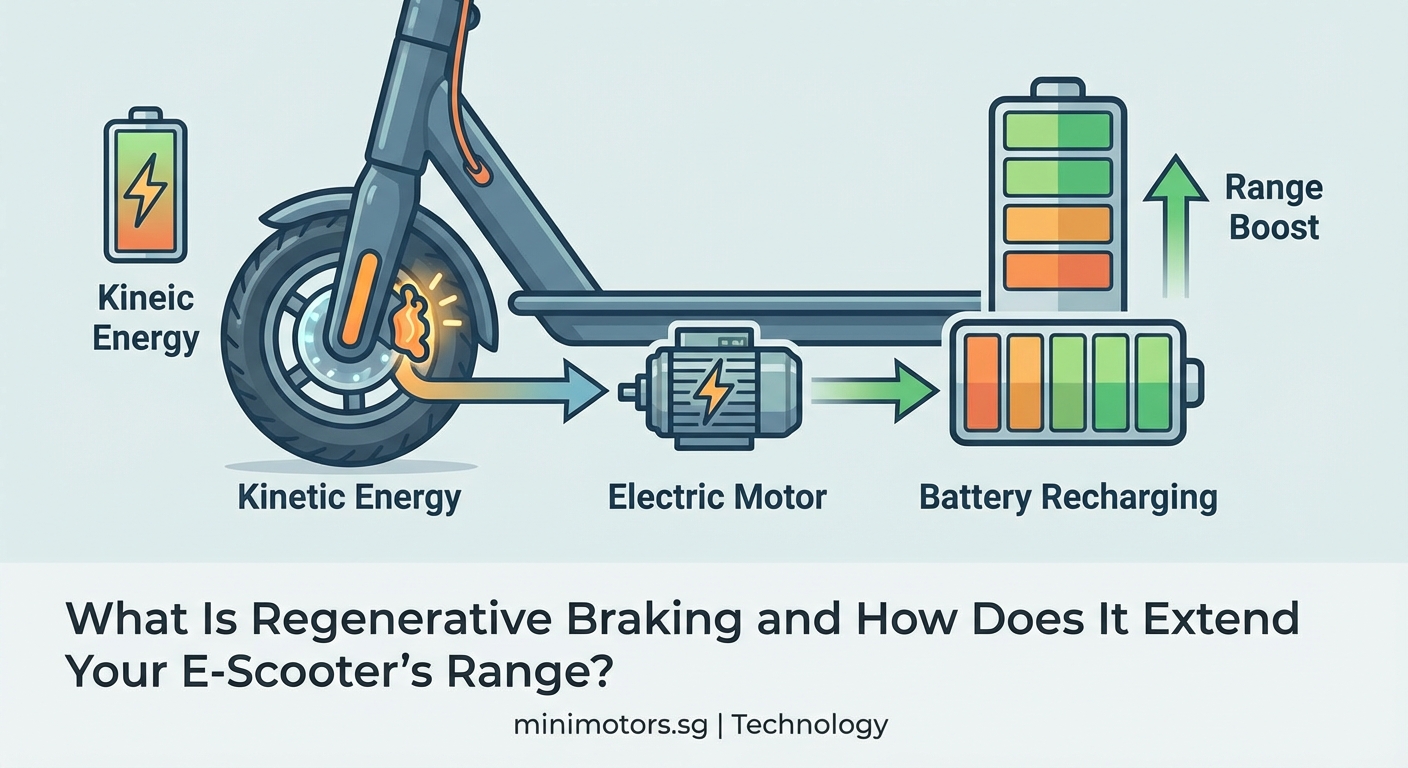
When you engage regenerative braking on your electric scooter, the motor switches roles. Instead of consuming electricity to spin the wheel, it becomes a generator. The wheel spins the motor, which creates resistance and produces electrical current. That current flows back into your battery.
You slow down. Your battery charges. Nothing gets wasted.
Most riders notice regenerative braking as a smooth, controlled deceleration. It feels different from mechanical brakes because there’s no sudden grab or jerk. The resistance builds gradually as the motor converts your speed into stored energy.
How the system converts motion into power
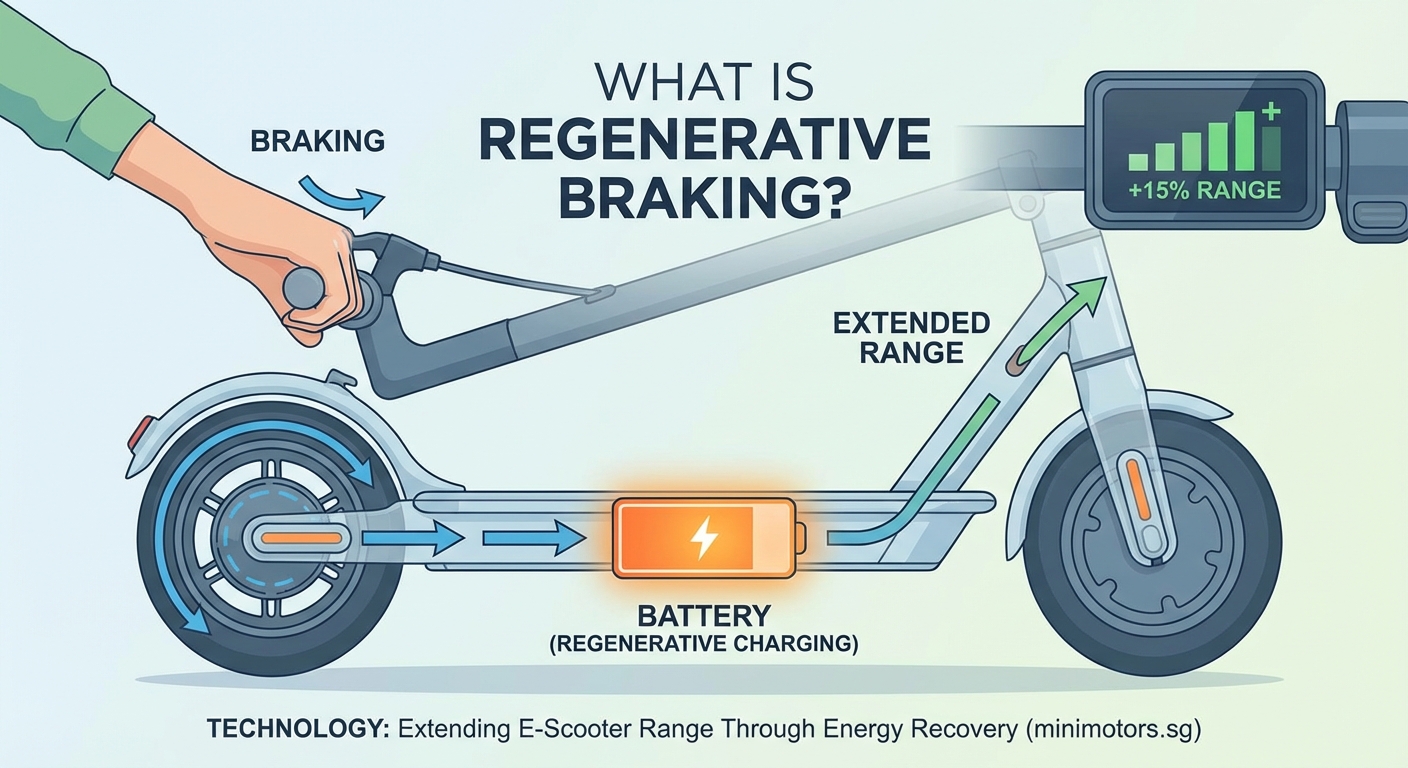
The process starts the moment you release the throttle or pull the brake lever, depending on your scooter’s settings.
Your controller detects the braking signal and reverses the electrical flow to the motor. The motor’s magnets and coils, which normally create rotational force, now generate electricity as the wheel forces them to spin.
This electricity travels through the controller, which regulates voltage and current to match your battery’s specifications. Without proper regulation, the charging current could damage battery cells or create safety hazards.
The battery management system accepts the incoming charge and distributes it across individual cells. Modern lithium-ion batteries can handle this kind of intermittent charging without degradation, unlike older battery chemistries that preferred steady, complete charge cycles.
The entire process happens in milliseconds. You experience it as braking force. Your battery sees it as a small top-up.
When regenerative braking works best
Not all riding conditions generate the same amount of regenerative energy. Understanding when the system performs optimally helps you maximize its benefits.
Downhill sections provide the best regenerative opportunities. Gravity accelerates your scooter, and regenerative braking converts that gravitational potential energy into battery charge. Long descents can recover significant range, sometimes adding 10 to 20 percent back to your battery.
Gradual stops in traffic also benefit from regenerative systems. Instead of burning off speed with friction brakes, you can coast to a stop using motor resistance alone, capturing energy the entire time.
High-speed deceleration generates more power than low-speed braking because kinetic energy increases exponentially with velocity. Slowing from 25 mph to 15 mph recovers more energy than dropping from 10 mph to a complete stop.
Flat terrain offers minimal regenerative benefits. Without gravity or high speeds, there’s less energy to recapture. You’ll still feel the braking effect, but battery recovery remains modest.
Cold weather reduces regenerative efficiency. Batteries accept charge more slowly in low temperatures, and the controller may limit regenerative current to protect battery health. If you’re looking for ways to extend your range when temperatures drop, check out how to store your e-scooter battery during winter or long breaks.
Real-world range extension numbers
Manufacturers often cite optimistic regenerative braking figures. Real-world results vary based on terrain, riding style, and scooter specifications.
Most riders see 5 to 10 percent range extension on mixed terrain with moderate hills. City commuters with frequent stops might reach the lower end of that range. Riders in hilly areas with long descents can exceed 15 percent recovery.
Battery capacity matters. A scooter with a 500Wh battery might recover 25 to 50Wh on a typical commute. That translates to an extra mile or two, depending on your speed and weight.
Motor power affects regenerative potential. Larger motors can generate more braking force and capture more energy. A 1000W motor will recover more power than a 350W motor under identical conditions.
Your riding weight influences results too. Heavier riders carry more kinetic energy, which means more potential recovery during braking. A 200-pound rider will see slightly better regenerative performance than a 150-pound rider, all else being equal.
Setting up regenerative braking on your scooter
Many electric scooters offer adjustable regenerative braking levels. These settings let you balance energy recovery against braking feel and safety.
- Access your scooter’s display or smartphone app to find regenerative braking settings.
- Start with a low or medium setting to get familiar with the braking feel and response time.
- Test your chosen setting in a safe area with no traffic to understand stopping distances and control.
- Adjust upward for more aggressive energy recovery or downward for gentler, more predictable braking.
- Remember that higher regenerative settings increase braking force, which can affect stability on wet or loose surfaces.
Some scooters automatically engage regenerative braking when you release the throttle. Others require brake lever input to activate the system. Understanding your specific model’s behavior prevents surprises during your first rides.
If you’re new to electric scooters entirely, the 7 essential things every first-time e-scooter rider should know covers important basics beyond just braking systems.
Combining regenerative and mechanical brakes
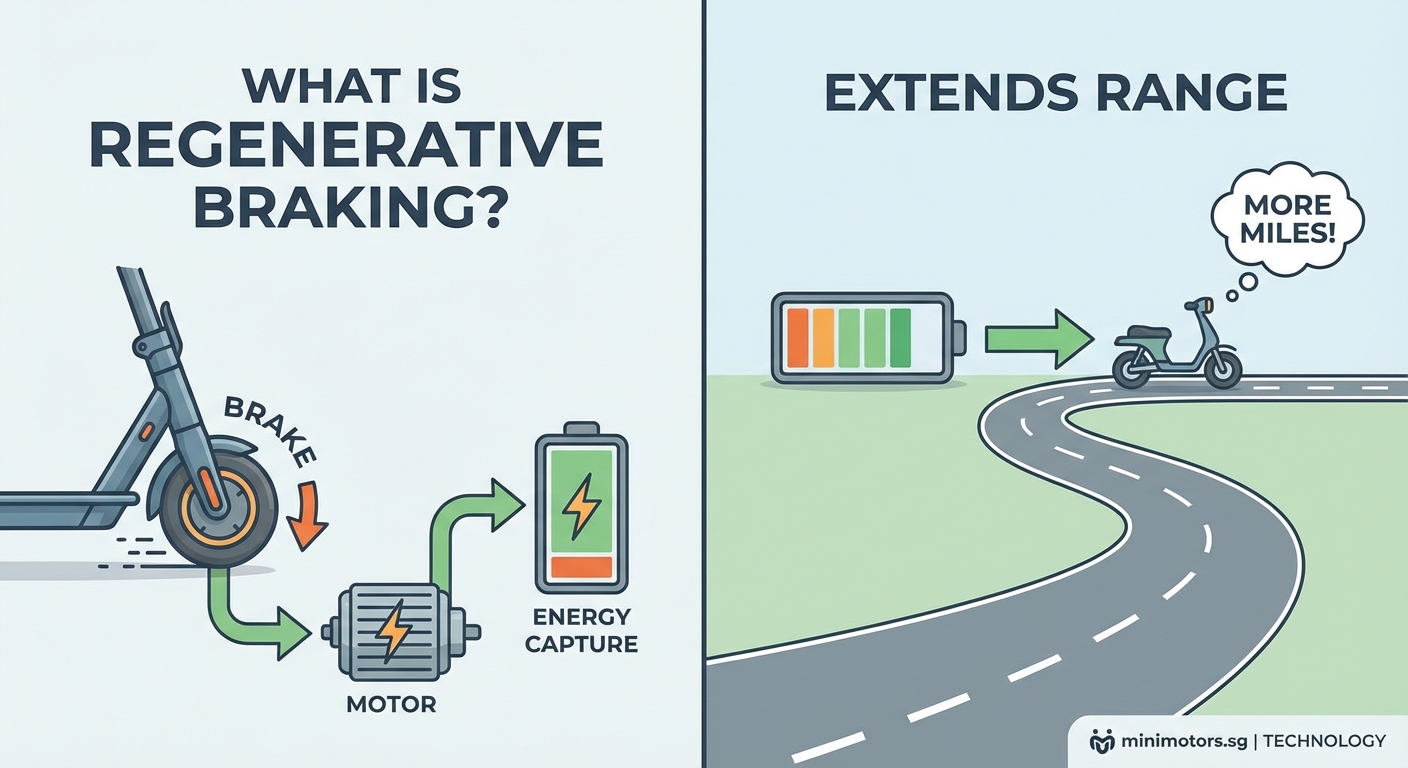
Regenerative braking rarely provides enough stopping power for emergency situations. That’s why electric scooters pair it with traditional mechanical brakes.
Most modern scooters use a hybrid approach. The brake lever activates regenerative braking first, then engages mechanical brakes as you pull harder. This layered system maximizes energy recovery during normal stops while maintaining emergency stopping capability.
The front brake typically remains purely mechanical. Front brakes provide the majority of stopping power, and mixing regenerative systems with front wheel braking creates complexity without significant benefit.
Rear brakes often integrate regenerative systems because the rear motor can function as a generator. When you brake, the motor slows the rear wheel while mechanical brakes handle additional stopping force as needed.
Balancing both systems takes practice. Light brake pressure engages regenerative braking alone. Moderate pressure adds mechanical braking. Hard pressure prioritizes stopping power over energy recovery.
For deeper insight into how different brake types work together, read about understanding e-scooter braking systems.
Limitations and realistic expectations
Regenerative braking isn’t magic. Physics limits how much energy you can recover.
Energy conversion always involves losses. Your motor might capture 70 to 80 percent of available kinetic energy. The controller and wiring lose another 5 to 10 percent. By the time electricity reaches your battery, you’ve converted perhaps 60 to 70 percent of your original braking energy into stored charge.
Battery state affects acceptance. A fully charged battery can’t accept regenerative current because it has nowhere to store additional energy. Many scooters disable or reduce regenerative braking when your battery exceeds 95 percent capacity.
Speed limits matter. Below 5 mph, most scooters produce minimal regenerative braking because there’s insufficient rotational energy to convert. You’ll rely almost entirely on mechanical brakes for the final few feet of stopping.
Terrain determines opportunity. Flat commutes with few stops offer limited regenerative potential. You simply don’t have enough braking events to recover significant energy.
Weather conditions change performance. Rain reduces traction, and aggressive regenerative braking can lock your rear wheel on slippery surfaces. Many riders lower regenerative settings in wet conditions for better control. Learn more about handling challenging conditions in how to ride an e-scooter in the rain without losing control.
Maintenance benefits beyond range extension
Regenerative braking reduces wear on mechanical brake components. Every bit of stopping force provided by the motor is force your brake pads don’t have to handle.
Brake pads last longer. Instead of replacing pads every 500 to 1000 miles, riders with regenerative systems might stretch that interval to 1500 or 2000 miles. Actual lifespan depends on riding style and terrain, but the reduction in mechanical wear is measurable.
Brake discs or drums experience less heat stress. Repeated hard braking heats metal components, causing warping and degradation over time. Regenerative braking handles routine deceleration, reserving mechanical systems for situations requiring maximum stopping power.
Reduced brake dust keeps your scooter cleaner. Brake pads shed particles as they wear. Less mechanical braking means less dust accumulation on your wheels, deck, and frame.
Lower maintenance costs add up. Brake pad replacements, rotor resurfacing, and related service visits become less frequent. Over the life of your scooter, regenerative braking can save you hundreds of dollars in maintenance expenses.
For a complete overview of keeping your scooter in top condition, check out the ultimate e-scooter maintenance checklist.
Riding techniques that maximize energy recovery
How you ride determines how much energy you recover. Small adjustments to your technique can significantly improve regenerative performance.
Plan your stops. Instead of accelerating to maximum speed and then braking hard, anticipate red lights and obstacles. Coast earlier and let regenerative braking slow you gradually. This captures more energy than sudden stops.
Use gravity. On downhill sections, maintain moderate speed with regenerative braking rather than letting your scooter accelerate freely. You’ll convert gravitational energy into battery charge while maintaining safe speeds.
Avoid sudden throttle changes. Smooth acceleration and deceleration improve efficiency. Jerky riding wastes energy through repeated acceleration and braking cycles that could be avoided with better anticipation.
Adjust regenerative settings for terrain. Increase regenerative braking strength in hilly areas where you have more energy to recover. Reduce it on flat terrain where comfort and predictability matter more than minimal energy gains.
Time your rides. If possible, avoid riding with a fully charged battery. Starting at 90 percent instead of 100 percent gives your battery room to accept regenerative charge from the beginning of your trip.
Common myths about regenerative braking
Misconceptions about regenerative systems create unrealistic expectations. Let’s clear up the most common ones.
Myth: Regenerative braking fully recharges your battery during rides.
Reality: You’ll recover 5 to 15 percent of your battery capacity under good conditions. Regenerative braking extends range but doesn’t eliminate the need for regular charging.
Myth: Higher regenerative settings always provide better range.
Reality: Aggressive regenerative braking can feel uncomfortable and reduce your average speed as you compensate for strong deceleration. Moderate settings often provide the best balance between energy recovery and riding enjoyment.
Myth: Regenerative braking works the same on all scooters.
Reality: Motor size, controller programming, and battery specifications create significant variation. A budget scooter’s regenerative system won’t match the performance of a premium model with advanced electronics.
Myth: You can ride indefinitely on downhill slopes with regenerative braking.
Reality: Long descents do recover substantial energy, but battery capacity limits how much charge you can store. Once your battery reaches maximum capacity, regenerative braking provides resistance without adding charge.
Myth: Regenerative braking eliminates the need for mechanical brakes.
Reality: Regenerative systems supplement mechanical brakes but can’t replace them. Emergency stops, low-speed control, and front wheel braking all require traditional friction brakes. Understanding when to use each type properly is covered in mastering e-scooter braking techniques for emergency situations.
Comparing regenerative performance across scooter types
Not all electric scooters implement regenerative braking equally. Design choices create meaningful performance differences.
| Scooter Type | Regenerative Capability | Best Use Case | Typical Range Recovery |
|---|---|---|---|
| Budget commuter | Basic single-motor | Flat urban riding | 3 to 5 percent |
| Mid-range single motor | Adjustable settings | Mixed terrain commuting | 5 to 10 percent |
| Dual-motor performance | Advanced multi-level | Hilly terrain, long rides | 10 to 15 percent |
| Off-road models | Heavy-duty systems | Mountain trails, steep descents | 12 to 18 percent |
Budget scooters often feature simple regenerative systems with limited adjustability. These models provide basic energy recovery but prioritize cost savings over optimization.
Mid-range scooters typically offer three to five regenerative braking levels. Riders can fine-tune the system to match their preferences and riding conditions, balancing comfort against energy recovery.
High-performance dual-motor scooters can engage regenerative braking on both wheels simultaneously. This doubles potential energy recovery and provides stronger, more controlled deceleration. If you’re considering different scooter categories, commuter vs off-road e-scooters helps clarify which type suits your needs.
Battery health and regenerative charging
Frequent regenerative charging affects battery longevity differently than standard wall charging. Understanding these effects helps you maintain optimal battery health.
Regenerative charging delivers lower currents over shorter durations than wall chargers. This gentler charging pattern typically benefits battery health by reducing heat and stress on individual cells.
Battery management systems monitor regenerative charging carefully. If incoming voltage or current exceeds safe parameters, the system limits or stops regenerative charging to protect the battery pack.
Temperature plays a critical role. Cold batteries resist accepting charge, and the management system reduces regenerative current accordingly. Hot batteries also trigger protective limits to prevent thermal damage.
Partial charging from regenerative braking doesn’t harm modern lithium-ion batteries. Unlike older nickel-based batteries that suffered from memory effects, lithium cells handle frequent partial charges without degradation.
Long-term benefits include reduced charging cycles. Every bit of energy recovered through regenerative braking means less energy needed from wall charging. Fewer complete charge cycles extend overall battery lifespan. For more information on battery longevity, see how long do e-scooter batteries actually last.
Safety considerations with regenerative systems
Regenerative braking changes how your scooter decelerates. These differences affect safety in specific situations.
Rear wheel skidding becomes possible with aggressive regenerative settings on slippery surfaces. The motor can apply more braking force than available traction, breaking the rear wheel loose. Reducing regenerative strength in wet or icy conditions prevents this issue.
Unexpected deceleration surprises riders unfamiliar with their scooter’s regenerative behavior. Some models engage strong regenerative braking the moment you release the throttle. Others require brake lever input. Know your scooter’s specific implementation before riding in traffic.
Following distance calculations change slightly. Regenerative braking typically provides gentler, more gradual deceleration than mechanical brakes alone. You may need slightly more distance to stop compared to emergency braking with mechanical systems.
Battery failures disable regenerative braking. If your battery management system detects a problem, it may cut regenerative charging to protect the pack. You’ll still have mechanical brakes, but losing regenerative braking reduces overall stopping power.
Steep descents require active speed management. Regenerative braking alone may not provide sufficient control on very steep hills, especially with a full battery that can’t accept additional charge. Always combine regenerative and mechanical braking on serious descents.
Remember that regenerative braking is a tool, not a replacement for good riding habits. Maintain safe speeds, watch for hazards, and use mechanical brakes whenever you need maximum stopping power. Technology assists you, but your judgment keeps you safe.
Future developments in regenerative technology
Regenerative braking continues to evolve as battery and motor technology advances. Several improvements are coming to electric scooters in the next few years.
Variable regenerative algorithms will adapt braking force based on speed, terrain, and battery state automatically. Instead of manually adjusting settings, your scooter will optimize energy recovery for current conditions.
Improved motor designs promise higher conversion efficiency. Next-generation motors might capture 80 to 85 percent of kinetic energy instead of today’s 70 to 75 percent, meaningfully increasing range recovery.
Advanced battery chemistries will accept regenerative charge more efficiently across wider temperature ranges. Cold weather performance, currently a weak point, should improve significantly.
Predictive systems using GPS and mapping data will optimize regenerative braking before you even reach a hill or stop. Your scooter will know a descent is coming and adjust settings to maximize energy capture.
Integration with smartphone apps will provide real-time feedback on energy recovery. You’ll see exactly how much range you’ve gained from regenerative braking during each ride, helping you refine your technique. These connected features are part of a broader trend explored in how AI and IoT are making e-scooters smarter and safer.
Making regenerative braking work for your commute
Understanding regenerative braking helps you get more from every ride. The technology isn’t revolutionary, but it’s genuinely useful when applied correctly.
Start by learning your scooter’s specific regenerative behavior. Spend time in a safe area testing different settings and understanding how the system responds. This familiarity builds confidence and helps you use regenerative braking effectively in traffic.
Adjust your riding style to maximize recovery opportunities. Plan stops, use hills strategically, and maintain smooth speed control. These small changes add up to measurable range improvements over time.
Balance energy recovery against comfort and safety. The most aggressive regenerative setting isn’t always the best choice. Find the level that feels natural while still providing meaningful energy recapture.
Monitor your results. Pay attention to how much range you recover on typical rides. This feedback helps you understand what works and where you can improve your technique.
Most importantly, view regenerative braking as one tool among many for extending range. Combined with proper battery care, efficient riding habits, and regular maintenance, regenerative braking contributes to a better overall electric scooter experience. The technology works best when you understand its capabilities and limitations, then apply that knowledge to your daily rides.
