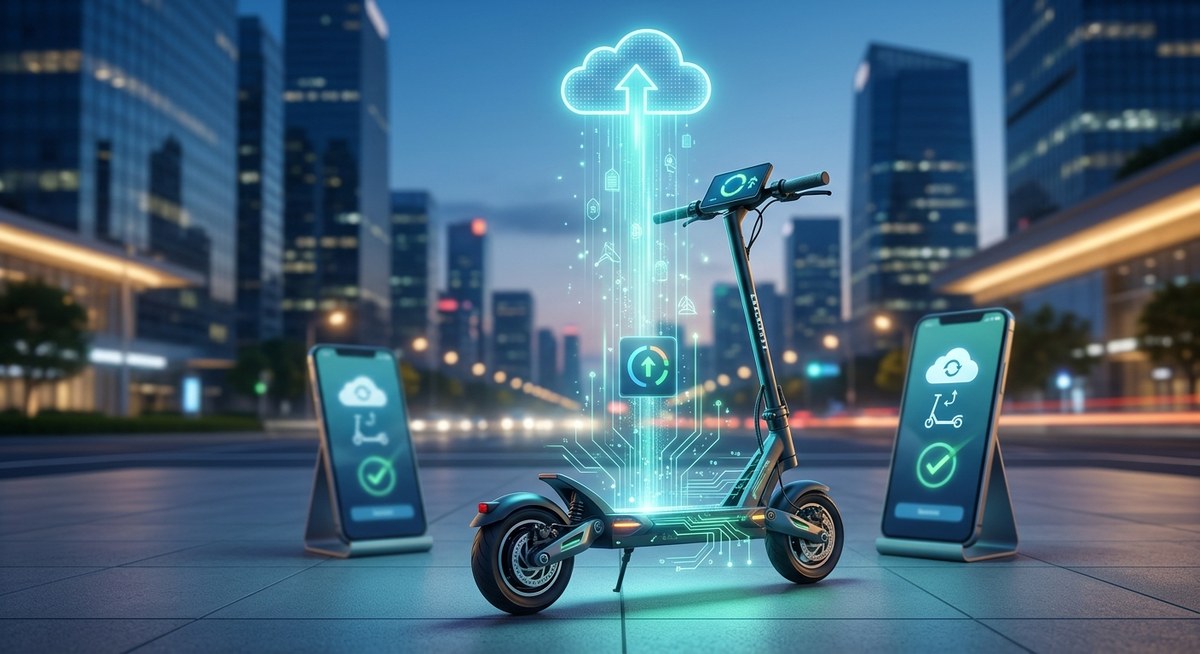
How Over-the-Air Firmware Updates Are Making Your E-Scooter Smarter Every Month
Your electric scooter is about to get a new feature. You do not need to visit a repair shop. You do not need to swap out a circuit board. The change happens while you sleep, pushed directly to your vehicle through a process called an over-the-air firmware update. This technology, once reserved for smartphones and laptops, has become the standard for modern electric scooters. And it is changing what it means to own a personal vehicle.
Over-the-air firmware updates let your electric scooter receive new features, performance tweaks, and safety improvements without any physical work on your part. In 2026, this means your ride can gain AI voice controls, wireless BMS monitoring, and smarter battery management, all delivered remotely. These updates keep your scooter current and extend its useful life.
How a Firmware Update Works Without a Wrench
Think of firmware as the operating system for your scooter. It controls how the motor responds to the throttle, how the battery communicates with the controller, and how the display shows your speed. In the past, updating this software meant taking the scooter apart or visiting a dealer.
Today, a wireless connection handles everything.
When a manufacturer releases a new update, your scooter receives it through a cellular or Bluetooth link. The process runs in the background. You might see a notification on your handlebar display or in the companion app. Once you confirm, the scooter installs the new code and reboots. The whole thing takes a few minutes.
Here is what that process looks like step by step:
- Your scooter connects to the cloud server through its built-in modem or your paired smartphone.
- The server checks your current firmware version against the latest release.
- If a newer version exists, the scooter downloads the update file in small, encrypted chunks.
- The system verifies the file for errors and authenticates the source.
- You get a prompt on the display or app asking for permission to install.
- The scooter installs the update during idle time, often overnight.
- After a restart, the new features or fixes are active.
This cycle repeats as often as the manufacturer pushes improvements. Some brands release updates every few weeks. Others follow a monthly schedule. The result is a scooter that improves with age, just like your phone.
Smart Features That Arrive Through the Air
The most exciting part of over-the-air firmware updates is the arrival of features you did not have when you bought the scooter. In 2026, manufacturers use these updates to roll out capabilities that were not even imagined a year ago.
AI voice controls are one example. Instead of tapping buttons to change riding modes or set a destination, you speak a command. Your helmet microphone or handlebar speaker picks it up. The scooter adjusts regenerative braking, switches to eco mode, or navigates to the nearest charging station. This feature did not exist on most scooters in 2024. A firmware update delivered it.
Wireless battery management systems (BMS) are another breakthrough. Traditional BMS units use wires to monitor each cell group. A wireless BMS removes those cables, reducing weight and failure points. But retrofitting a wired scooter with a wireless system used to require new hardware. Now, manufacturers can enable wireless BMS communication through a firmware update if the hardware already supports it. The scooter learns to talk to the battery in a new way, all through code.
Adaptive performance tuning also arrives via updates. The scooter learns your riding habits and adjusts acceleration curves, braking sensitivity, and top speed limits. A commuter who rides on flat roads gets a different profile than someone who tackles hills. The scooter becomes personalized over time.
The Difference Between a Good Update and a Bad One
Not all firmware updates are equal. Some improve the experience. Others can introduce problems if not handled correctly. The table below shows the common outcomes riders see after an update.
| Outcome | What It Means for You | How to Spot It |
|---|---|---|
| Performance boost | Smoother acceleration, better hill climbing, higher efficiency | Reduced battery drain per mile, less motor heat |
| New feature added | Voice controls, wireless BMS, custom ride modes | New menu options on the display or app |
| Bug fix | Glitchy display, erratic Bluetooth, or sudden shutdowns disappear | Consistent behavior after the update |
| Battery optimization | Extended range, more accurate state-of-charge readings | Battery gauge matches actual mileage more closely |
| Failed update | Scooter may not start, or features stop working | Error message on display, app shows “update failed” |
| Rollback | Manufacturer restores previous firmware to fix a new issue | You receive a second update within days |
If you ever experience a failed update, do not panic. Most scooters have a recovery mode. You can restart the process from the app or contact support. The important thing is to keep your scooter connected to Wi-Fi or cellular data so updates can flow when needed.
Mistakes That Can Disrupt Your Update
Even though the process is automated, a few common errors can cause trouble. Avoiding them keeps your scooter running smoothly.
- Ignoring update notifications. If you postpone an update for weeks, the system may force an install at an inconvenient time. Accept updates when you see them.
- Riding during an update. Never operate the scooter while firmware is installing. The process requires the scooter to be stationary and powered on but not moving.
- Letting the battery run low. An update needs a certain power level to complete. If the battery drops below 20 percent, the installation may fail. Charge your scooter before starting the update.
- Disconnecting from the network. If you walk away from the scooter while it downloads, a weak signal can corrupt the file. Stay within range of your Wi-Fi or ensure cellular coverage is strong.
- Ignoring the release notes. Manufacturers often include instructions for post-update calibration. Skipping these steps can leave features partially enabled.
“The most important thing a rider can do is keep their scooter connected and charged. Firmware updates are designed to be hands-off, but they still need a stable environment to succeed.” — Lead firmware engineer at a major e-scooter brand
Why This Changes the Way You Buy a Scooter
When you shop for a new electric scooter today, the hardware specs still matter. Motor power, battery capacity, and build quality are important. But the software story is becoming just as critical.
A scooter that receives regular over-the-air firmware updates will stay relevant longer. It will gain features that did not exist at launch. It will run more efficiently as the manufacturer fine tunes the algorithms. A scooter that never gets updates will slowly fall behind.
This is a shift from the old model where the scooter you bought on day one was the same scooter you rode for years. Now, the scooter evolves. The chassis stays the same, but the brain gets smarter.
Look for brands that publish a history of firmware releases. Check if they add meaningful features, not just bug fixes. A manufacturer that treats software as a priority is investing in your ownership experience.
For a deeper look at how smart technology is reshaping personal mobility, read our guide on how AI-powered smart features are transforming modern e-scooters. It covers the sensors and algorithms that make these updates possible.
The Real Cost of Skipping Updates
Some riders never install a firmware update. They treat the scooter as a finished product. That approach has hidden costs.
Without updates, you miss out on safety improvements. Manufacturers often patch vulnerabilities that could allow someone to tamper with your scooter remotely. They also fix braking logic that might behave poorly in wet conditions.
You also lose performance gains. A 2026 update might unlock 10 percent more range through better battery management. Skipping it means you leave that range on the table.
And you miss new features. Voice controls, wireless BMS, and adaptive tuning all arrive through the same channel. If you never update, your scooter stays frozen in time.
The process is so simple that there is no reason to ignore it. Set a reminder to check for updates once a month. Most apps will notify you automatically, but a manual check never hurts.
What to Expect in the Next Year
The pace of firmware innovation is accelerating. In the next 12 months, expect to see updates that enable:
- Predictive maintenance alerts. Your scooter will warn you about a failing bearing or a loose connection before it causes a breakdown.
- Geofencing profiles. The scooter will automatically limit speed in school zones or pedestrian areas based on GPS location.
- Peer-to-peer battery sharing. In some cities, scooters will be able to share charge data with each other to balance load on shared charging stations.
- Enhanced anti-theft logic. Firmware will let the scooter lock its wheels and sound an alarm if it detects unauthorized movement.
These features are not science fiction. They are already in development. Over-the-air updates make them possible without changing a single screw.
Keeping Your Scooter Future Ready
The best way to benefit from over-the-air firmware updates is to treat your scooter as a connected device. Keep it charged. Keep it connected. And accept updates when they arrive.
If you are in the market for a new scooter, prioritize models with a strong update track record. A scooter that gets better every month is a better investment than one that stays the same.
For more on choosing the right model, check out our guide on what to look for in an e-scooter for 2026: a buying checklist. It includes questions about software support that most buyers forget to ask.
Your Scooter Is Learning. Let It.
Firmware updates turn a static machine into a dynamic partner. Your scooter learns from every ride. It adapts to your style. It improves with each patch. And it does all of this without you lifting a tool.
The next time you see a notification that an update is ready, do not ignore it. Let the scooter get smarter. In a few minutes, you will have a better ride than you did yesterday.
