What’s the Difference Between a Commuter E-Scooter and a Performance Model?
You are standing at a bike rack after a long day, watching someone unfold a sleek electric scooter and glide past the traffic jam. That could be you. But when you start shopping, the options feel overwhelming. Do you need a lightweight commuter model that folds up neatly, or do you need the raw power of a performance machine? The answer depends on how you actually plan to ride. Let’s break down the commuter vs performance e-scooter comparison so you can make a smart choice.
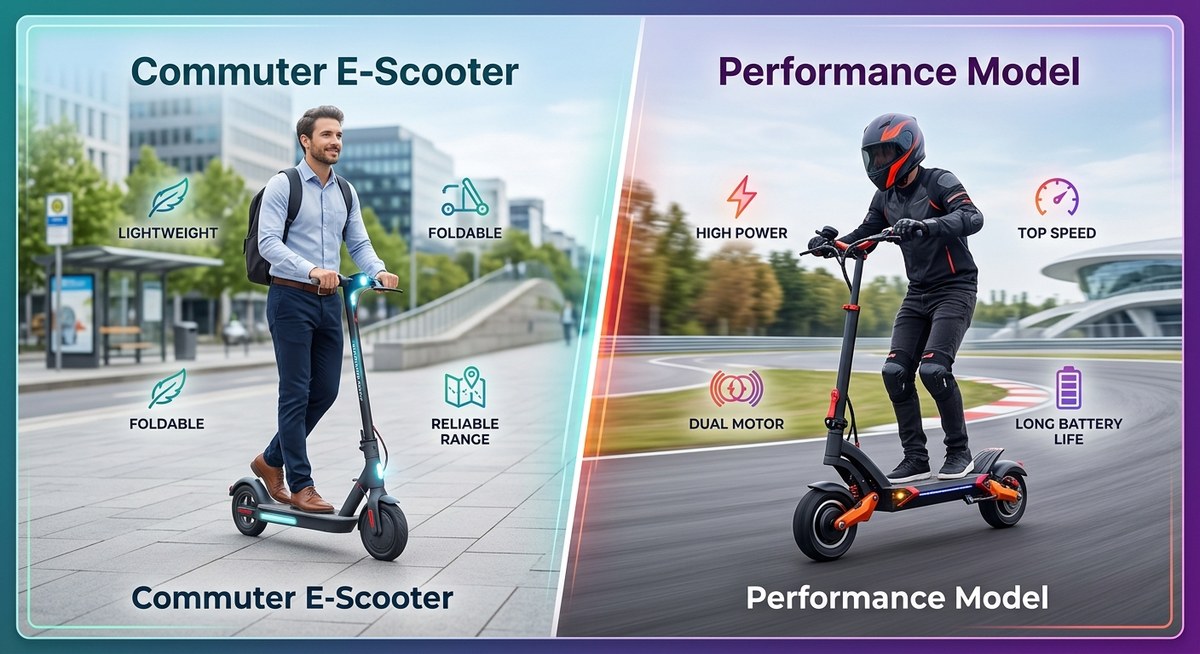
Commuter e-scooters prioritize portability, lighter weight, and moderate speed (around 15-20 mph) for short urban trips under 10 miles. Performance models deliver higher speeds (25+ mph), longer range (25-40+ miles), and stronger motors, but they are heavier and less portable. Your choice depends on your daily distance, storage situation, and local laws.
What Makes a Commuter E-Scooter Different?
Commuter e-scooters are designed for one thing: getting you from point A to point B with minimal fuss. Think of them as the sedan of the e-scooter world. They are built for reliability, ease of use, and portability.
Most commuter models share these traits:
- Lightweight frame: Usually between 25 and 35 pounds. You can carry them up a flight of stairs or onto a crowded bus without breaking a sweat.
- Moderate motor power: Typically a single motor between 250W and 500W. That is enough to handle flat city streets and gentle hills.
- Decent range: Expect 10 to 15 miles of real-world range. Perfect for a round trip to the train station or a 3-mile commute across downtown Chicago.
- Smaller deck and tires: 8 to 9 inch solid or pneumatic tires keep the scooter compact but can feel bumpy on rough pavement.
- Simple features: Basic LED display, a bell, maybe a rear brake light. No frills, just function.
If your commute is under 5 miles each way and you need something you can stash under your desk at the office, a commuter scooter is your best bet. Check out our guide on what’s the best e-scooter range for your daily commute to match your exact distance.
What Makes a Performance E-Scooter Different?
Performance e-scooters are the sports cars of the micro-mobility world. They are built for speed, power, and endurance. If your commute is long, hilly, or you just want the thrill of a faster ride, this is your category.
Here is what sets them apart:
- Heavier build: Expect 40 to 70+ pounds. The trade-off for power is weight. You will not want to carry one up three flights of stairs.
- Dual motors: Many performance models use two motors (often 1000W+ combined) for serious acceleration and hill-climbing ability.
- Long range: 25 to 40+ miles on a single charge. This matters if you commute 10+ miles each way or want to skip charging every single night.
- Larger tires: 10 to 11 inch pneumatic tires with suspension systems. These absorb potholes and cracks much better than smaller tires.
- Advanced tech: Features like regenerative braking, app connectivity, GPS tracking, and customizable ride modes are common.
Performance models shine when your route includes steep hills, long stretches of road, or if you simply want a more exciting ride. But they come with real trade-offs in portability and price. Our article on top features to look for when buying a premium electric scooter covers the must-have upgrades.
The Core Differences at a Glance
This table shows the key differences between a typical commuter and a typical performance e-scooter in 2026.
| Feature | Commuter Model | Performance Model |
|---|---|---|
| Weight | 25-35 lbs | 40-70+ lbs |
| Top Speed | 15-20 mph | 25-40+ mph |
| Real Range | 8-15 miles | 20-40+ miles |
| Motor Power | 250W-500W single | 1000W+ dual |
| Tire Size | 8-9 inch | 10-11 inch |
| Suspension | Often none or basic | Full front and rear |
| Portability | Easy to carry and fold | Hard to carry, bulky fold |
| Price Range | $300-$800 | $1,000-$3,000+ |
How to Decide: A Simple 3-Step Process
You do not need to be an engineer to pick the right scooter. Follow this numbered list to narrow it down.
-
Measure your actual commute distance. Open Google Maps and trace your route. Add 20% for detours or errands. If the total is under 10 miles round trip, a commuter model works. Over 10 miles? Look at performance models.
-
Assess your storage and carrying situation. Do you have a garage or ground-floor apartment? Can you roll the scooter to your desk? If you need to carry it up stairs or onto a subway, keep the weight under 35 pounds. If you have an elevator or a secure bike room, weight matters less.
-
Check your local speed and power laws. Many cities cap e-scooters at 20 mph or limit motor wattage. Riding a performance scooter that goes 35 mph might be illegal on your local bike paths. Read up on understanding e-scooter speed limits before you buy.
Expert advice: “Most first-time buyers overestimate how much speed they need. A 500W commuter scooter at 18 mph feels plenty fast on a bike lane. Save the performance model for riders who already know they need the extra range or have a very long, hilly commute.” – Senior Editor, Minimotors Review Team
When a Commuter Scooter Is the Right Call
A commuter model is the smart choice if:
- You live in a walk-up apartment or need to carry the scooter inside.
- Your commute is under 5 miles each way on mostly flat ground.
- You are on a tighter budget and want something reliable under $600.
- You value simplicity and do not want to mess with app settings or dual motors.
- You need to combine your scooter with public transit like a bus or train.
For example, a 3-mile commute from your apartment in Brooklyn to the subway station is perfect for a lightweight commuter. You fold it, carry it onto the train, and you are done. Our guide on how to choose your first electric scooter walks you through the best entry-level options.
When a Performance Scooter Is Worth the Extra Cost
A performance model makes sense if:
- Your commute is 8 to 15 miles each way and you cannot afford to charge at work.
- You face steep hills every day. A single 350W motor will struggle on a 10% grade.
- You are a heavier rider. Performance models have higher weight limits (300+ lbs) and stronger brakes. See our guide on best e-scooters for heavy riders for specific models.
- You want the scooter for recreation on weekends, not just commuting.
- You have secure storage on the ground floor or in a garage.
Picture this: you live in San Francisco and commute from the Mission district to downtown. That means a steep hill every single day. A commuter scooter will crawl up that hill at 8 mph while draining the battery fast. A dual-motor performance scooter will power up at 20 mph and still have battery left for an after-work ride to the park.
Common Mistakes Buyers Make
People often get tripped up by these issues. Avoid them from the start.
- Buying too much scooter for the commute: A 70-pound performance scooter is miserable to lug into a third-floor walkup. You will end up leaving it locked outside, where it could get stolen.
- Ignoring the real-world range: Manufacturers advertise range on flat ground at low speed with a light rider. Cut that number in half for real-world conditions with hills and stop-and-go traffic.
- Forgetting about charging: Performance scooters have larger batteries that take 8-12 hours to fully charge. If you commute far each day, you need to charge every night. Commuter batteries charge in 4-6 hours.
- Not checking tire type: Solid tires never go flat but give a rough ride. Pneumatic tires are smoother but can puncture. Performance models almost always use pneumatic tires with better suspension.
The Cost Question
Price is often the deciding factor. Here is the honest math.
A good commuter e-scooter costs between $400 and $700. It will last 2 to 3 years with basic maintenance like checking tire pressure and tightening bolts. You can get a solid model from a reputable brand without breaking the bank.
A performance e-scooter starts around $1,000 and goes up to $3,000 or more. You are paying for better batteries (LG or Samsung cells), stronger motors, dual suspension, and premium build quality. These scooters can last 4 to 5 years if you maintain them well.
But do not forget the hidden costs. Performance scooters need more frequent brake pad replacements, tire changes, and battery care. Read our guide on 7 mistakes that are killing your e-scooter battery life to avoid expensive replacements.
Making Your Final Choice
You have the facts. Now it is time to trust your gut and your route.
If you need a lightweight, portable scooter for short trips around the city, go with a commuter model. It will save you money, weight, and hassle. If your commute is long, hilly, or you simply want the thrill of a faster ride, invest in a performance model. Just make sure you have a place to store it that does not require carrying it up many stairs.
The best scooter is the one you actually use every day. Do not buy a machine that sits in your closet because it is too heavy to take out. And do not buy a scooter that leaves you stranded halfway up a hill.
For a deeper look at the technical specs, read our guide on electric scooter motor power guide to understand exactly how many watts you need.
Your Next Step
Grab a tape measure and a notepad. Measure your commute distance. Walk the path you would take and note any hills or rough roads. Then look at your storage situation. With those three data points, you can confidently pick between a commuter and a performance e-scooter.
Still unsure? Reach out to us through our contact page. We are happy to help you find the perfect ride for your 2026 commute.
