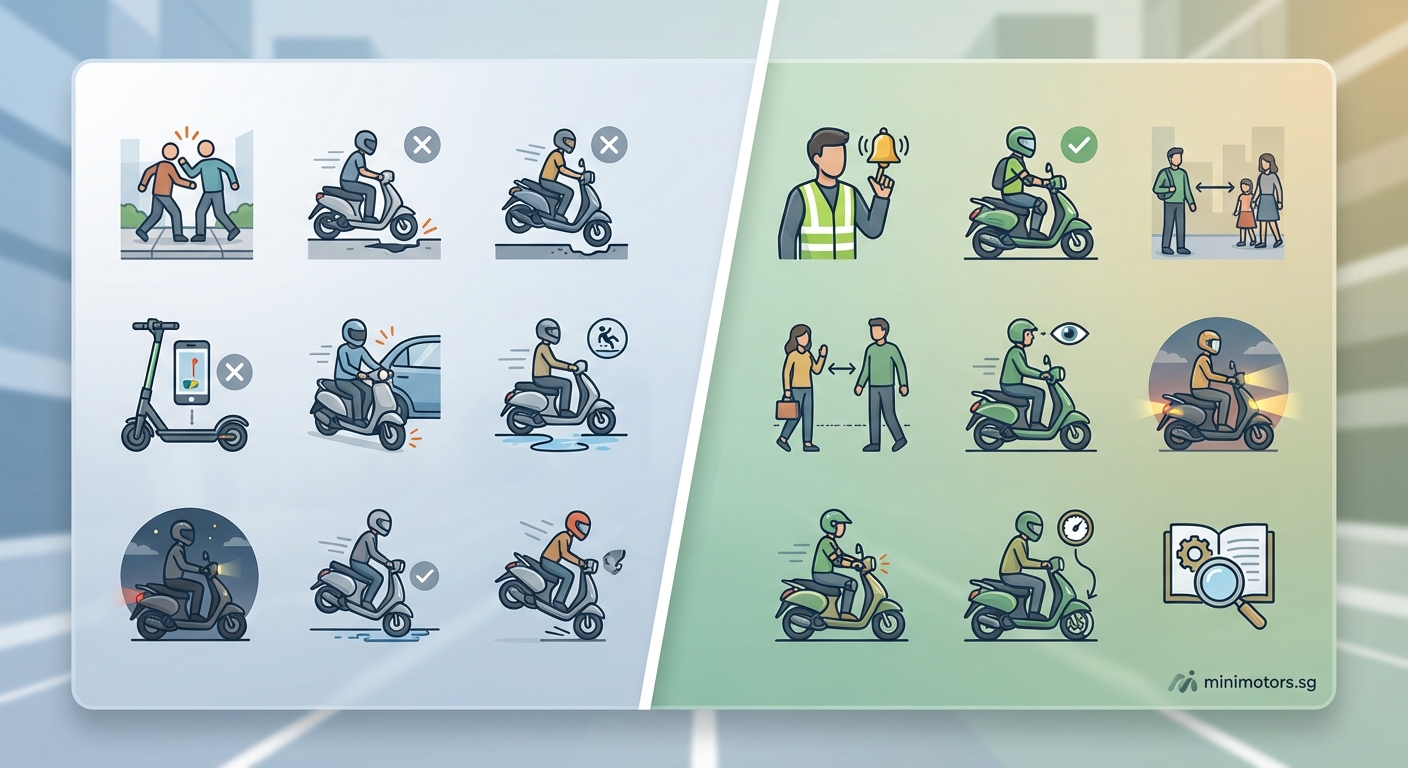
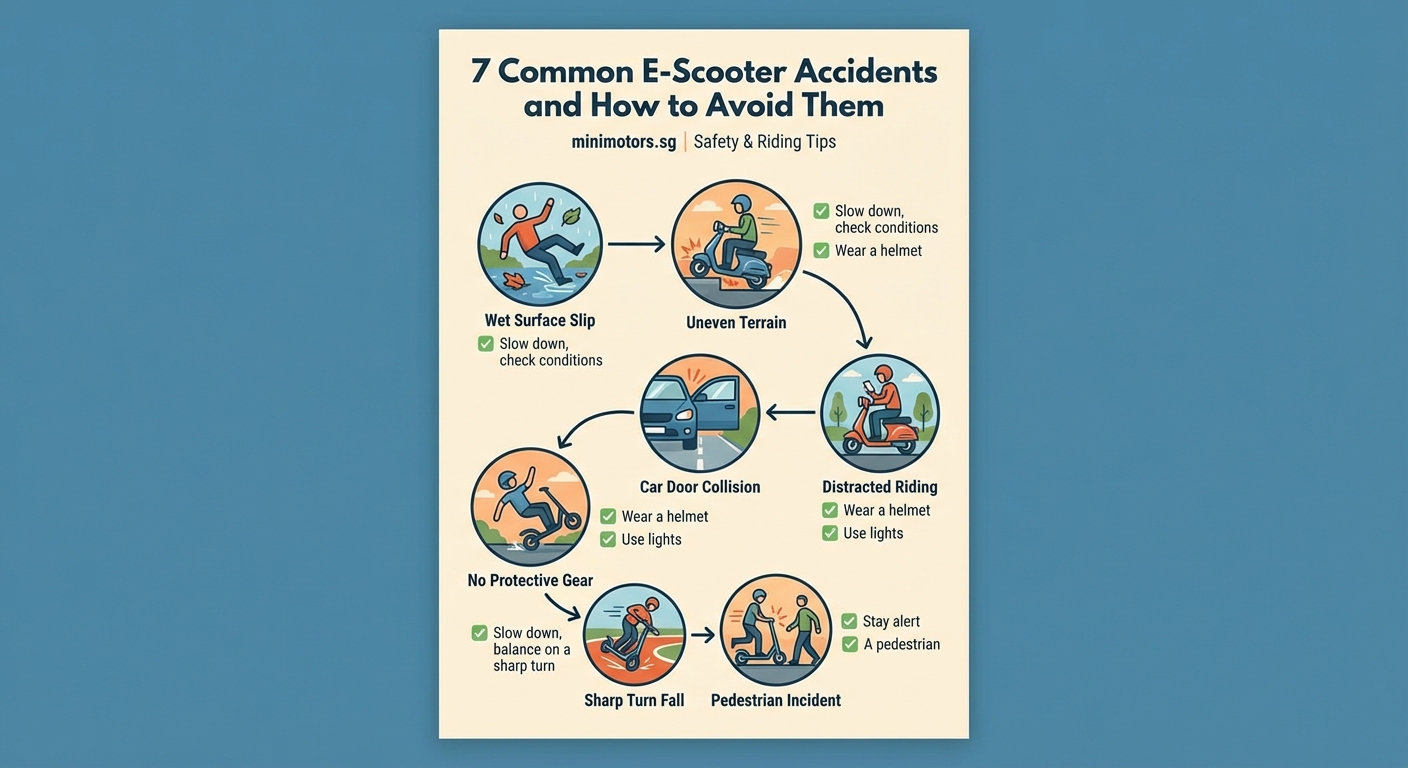
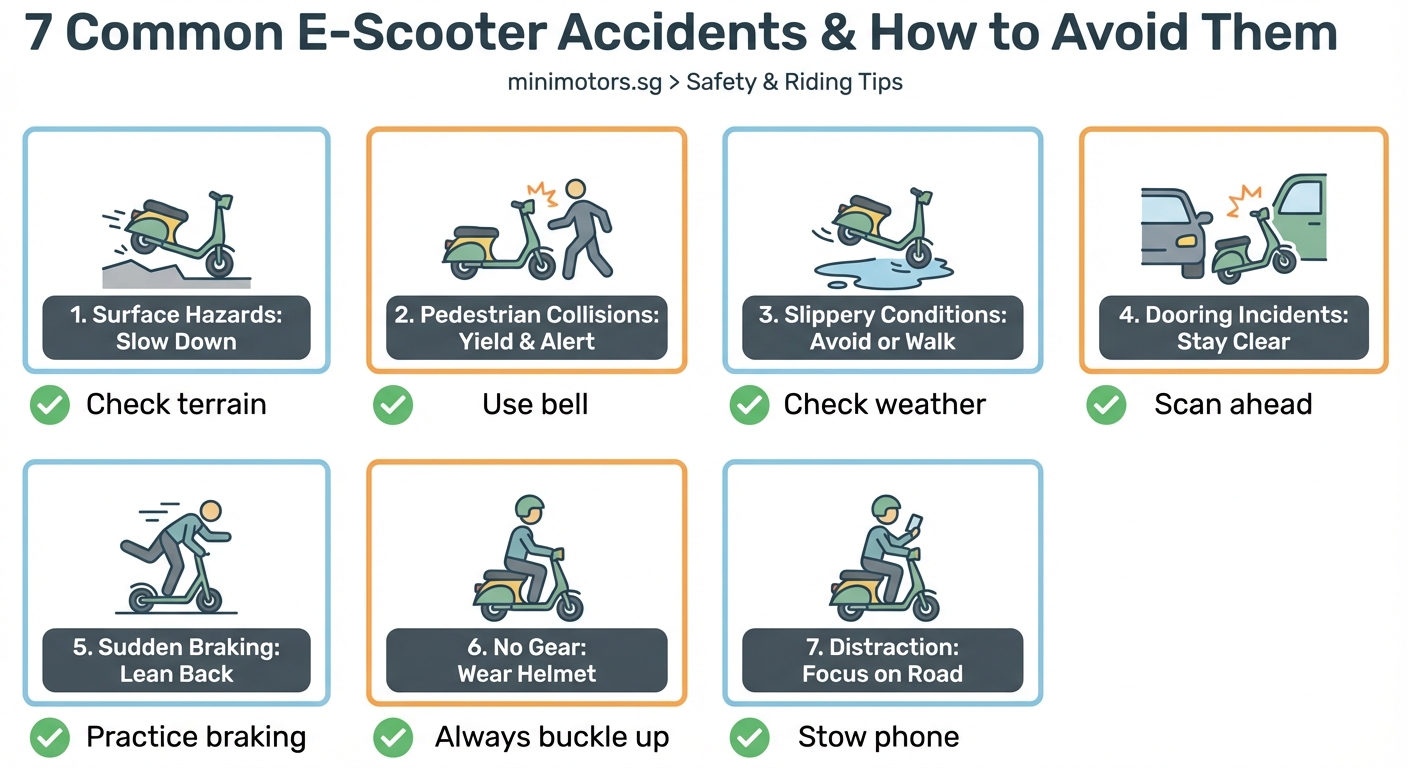
7 Common E-Scooter Accidents and How to Avoid Them
You’re standing on your first e-scooter, ready to glide down the street. The freedom feels incredible. But within seconds, a pothole appears, a car door swings open, or your brakes lock up unexpectedly. Suddenly, you’re on the ground wondering what just happened. These scenarios aren’t rare. They’re the reality for thousands of riders every year who underestimate how different e-scooter riding is from walking or cycling.
Most e-scooter accidents stem from seven predictable scenarios: sudden stops, wet surfaces, potholes, car door collisions, pedestrian conflicts, night visibility issues, and mechanical failures. Understanding these risks and applying specific prevention techniques can reduce your accident risk by over 70%. This guide breaks down each accident type with actionable steps to keep you safe from your first ride forward.
Loss of Control During Emergency Braking
Panic braking causes more crashes than almost any other rider error.
When something unexpected appears, your instinct screams “stop now.” You grab both brake levers hard. The front wheel locks. Physics takes over, and you’re launched forward over the handlebars.
This happens because e-scooters have a much shorter wheelbase than bicycles. The weight distribution shifts dramatically when you brake hard. Your center of gravity moves forward faster than you can compensate.
How to prevent emergency braking accidents:
- Practice controlled braking in an empty parking lot before riding in traffic.
- Apply rear brake first, then gradually add front brake pressure.
- Shift your weight backward as you brake to counteract forward momentum.
- Keep your knees slightly bent to absorb sudden changes in speed.
- Maintain a following distance of at least 15 feet from vehicles ahead.
The mastering e-scooter braking techniques for emergency situations resource explains advanced stopping methods in detail.
“Most riders never practice emergency stops until they need one. By then, muscle memory defaults to panic. Spend 20 minutes practicing controlled stops at different speeds, and you’ll rewire your reflexes for safer riding.” – Urban Mobility Safety Institute
Your braking system matters too. Different brake types respond differently to emergency situations, which you can learn more about through understanding e-scooter braking systems: disc, drum, and electronic explained.
Slipping on Wet or Oily Surfaces
Rain transforms your e-scooter into a completely different machine.
Traction drops by 40 to 60 percent on wet pavement. Painted road markings become ice rinks. Metal grates turn into slip-and-slides. That manhole cover you barely noticed yesterday? Now it’s a crash waiting to happen.
Most riders don’t adjust their technique when conditions change. They take the same corner at the same speed. The tires lose grip mid-turn. The scooter slides out from under them.
Critical wet-weather riding adjustments:
- Reduce your normal speed by 30 to 40 percent
- Avoid all painted surfaces, metal covers, and grates
- Brake earlier and more gently than in dry conditions
- Keep the scooter upright during turns instead of leaning
- Increase following distance to 25 feet minimum
The guide on how to ride an e-scooter in the rain without losing control covers advanced techniques for wet conditions.
Many riders also wonder about their scooter’s water resistance. The article can you ride an electric scooter in the rain? what beginners need to know answers common questions about riding in precipitation.
| Surface Type | Dry Traction | Wet Traction | Risk Level |
|---|---|---|---|
| Asphalt | Good | Moderate | Medium |
| Concrete | Good | Moderate | Medium |
| Painted markings | Moderate | Very Poor | Extreme |
| Metal grates | Poor | Dangerous | Extreme |
| Brick pavers | Moderate | Poor | High |
Hitting Potholes and Road Hazards
Small wheels meet big holes. The results are predictable and painful.
E-scooter wheels range from 6 to 10 inches in diameter. Compare that to a car’s 15 to 20 inch wheels or a bicycle’s 26 to 29 inch wheels. Smaller wheels can’t roll over obstacles the same way. A pothole that barely registers in a car can stop your scooter dead.
The impact sends a shockwave through the frame. If you’re lucky, you stay upright but damage the scooter. If you’re not, the sudden stop throws you forward onto the pavement.
Pothole avoidance strategies:
- Scan the road 20 to 30 feet ahead, not just directly in front of you
- Learn your regular routes and memorize problem spots
- Ride in the smoothest part of the lane, even if it means moving closer to traffic
- Slow down in areas with poor road conditions
- Stand with knees bent to absorb impacts you can’t avoid
When you can’t avoid a pothole, lift slightly off the deck and let the suspension (if you have it) do the work. Keep your weight centered and maintain a firm grip.
Check your scooter regularly for damage. The inspection checklist at is your e-scooter safe to ride? pre-ride inspection checklist helps you spot problems before they cause accidents.
Road hazards extend beyond potholes. Watch for:
- Loose gravel that acts like ball bearings under your tires
- Railroad tracks that catch wheels when crossed at an angle
- Expansion joints in bridges and overpasses
- Storm drain grates with slots parallel to your direction
- Construction debris and broken glass
Getting Doored by Parked Cars
A car door swings open. You have zero time to react. Impact.
Dooring accidents happen in a split second. Someone in a parked car opens their door without checking mirrors. You’re riding in the door zone. The door appears directly in your path. You either hit it at full speed or swerve into traffic trying to avoid it.
These crashes cause serious injuries. The door edge strikes at chest or head height. The sudden impact often throws riders into moving traffic lanes where they risk getting hit by vehicles.
Door zone safety protocol:
- Ride at least 4 feet away from parked cars whenever possible.
- Watch for signs of occupied vehicles: exhaust vapor, interior lights, silhouettes.
- Look for movement in side mirrors and through rear windows.
- Slow down in high-turnover parking areas like shopping districts.
- Use bike lanes when available, as they’re positioned outside the door zone.
Sometimes traffic or road design forces you into the door zone. When that happens, reduce speed to 8 to 10 mph maximum. At that speed, you have more reaction time and less impact force if a door opens.
The 7 essential things every first-time e-scooter rider should know guide covers additional urban riding hazards.
Collisions with Pedestrians
Sidewalk riding puts you on a collision course with people on foot.
Pedestrians don’t expect vehicles moving 15 mph on sidewalks. They step out of shops without looking. Kids dart between adults. Dogs on long leashes create tripwires. Elderly people with mobility aids move unpredictably.
You’re traveling three to four times faster than walking speed. Your stopping distance exceeds their reaction time. Someone steps into your path. You can’t stop in time. Contact happens.
Many cities ban sidewalk riding for exactly this reason. Even where it’s legal, it’s often the most dangerous option. You can learn more about local rules through can you ride an e-scooter on the sidewalk? state-by-state rules explained.
Pedestrian conflict prevention:
- Use bike lanes or roads instead of sidewalks whenever possible
- Reduce speed to walking pace (3 to 4 mph) when sidewalk riding is necessary
- Ring your bell or call out “passing on your left” well in advance
- Give pedestrians at least 3 feet of clearance when passing
- Assume every doorway, alley, and driveway will produce a pedestrian
Watch for behavioral cues. People looking at phones won’t notice you. Groups walking side-by-side may not leave room to pass. Parents with strollers need extra clearance.
The best solution? Avoid the conflict entirely by choosing routes with proper infrastructure. Your commute might take two minutes longer, but you eliminate a major accident risk.
Low Visibility Night Riding Accidents
Darkness hides you from drivers and hides hazards from you.
Your e-scooter’s small profile makes you nearly invisible at night. Most models come with minimal lighting. Drivers scanning for cars and bicycles simply don’t see you until it’s too late.
The reverse problem is equally dangerous. You can’t see potholes, debris, or surface changes in the dark. That crack in the pavement that’s obvious during the day becomes invisible at night. You hit it at full speed.
Night riding visibility requirements:
- Front white light visible from 500 feet minimum
- Rear red light or reflector visible from 600 feet
- Reflective tape on sides of deck and stem
- Reflective vest or jacket for rider visibility
- Helmet with integrated lights or reflective strips
The legal requirements vary by location, but these represent best practices for safety. Many riders underestimate how invisible they are at night.
For comprehensive night safety strategies, check out night riding safety: essential visibility tips for e-scooter commuters.
Lighting upgrades make a measurable difference. Studies show that riders with proper lighting are 70 percent less likely to be involved in night accidents compared to those with stock lights only.
Don’t forget about what you wear. Dark clothing makes you disappear. Light or reflective colors make you visible. The guide what should you wear when riding an e-scooter daily? covers clothing choices that enhance safety.
Mechanical Failures During Riding
Your scooter breaks. You’re moving at 20 mph. The outcome isn’t pretty.
Mechanical failures happen suddenly. A tire blows out. The folding mechanism releases. The throttle sticks. Brakes fail. One moment you’re cruising normally. The next, you’re fighting to stay upright or stop.
These failures often stem from poor maintenance or ignoring warning signs. That clicking noise you’ve been hearing? It was your bearing about to fail. The brake that felt spongy yesterday? Today it doesn’t work at all.
Pre-ride mechanical check (takes 90 seconds):
- Squeeze both brake levers to confirm they engage properly
- Check tire pressure and look for damage or wear
- Test the throttle response and ensure it returns to zero
- Verify the folding mechanism is locked securely
- Inspect the deck for cracks and the stem for looseness
- Confirm all lights function correctly
The detailed resource the ultimate e-scooter maintenance checklist: daily, weekly, and monthly tasks provides a complete maintenance schedule.
| Component | Check Frequency | Common Failure Signs |
|---|---|---|
| Brakes | Before every ride | Spongy feel, grinding noise, reduced stopping power |
| Tires | Before every ride | Low pressure, cracks, bulges, worn tread |
| Folding lock | Before every ride | Looseness, incomplete engagement, damaged latch |
| Battery | Weekly | Reduced range, swelling, overheating |
| Bearings | Monthly | Clicking, grinding, wheel wobble |
Tire problems cause the most mechanical failures. A flat tire at speed can throw you to the ground instantly. Learn the warning signs through 5 signs your e-scooter tires need replacement (and how to change them).
Strange noises mean something is wrong. Don’t ignore them. The article why is my electric scooter making noise? troubleshooting common sounds helps you identify problems before they cause accidents.
Building Your Accident Prevention Routine
Prevention becomes automatic when you build it into every ride.
Start by choosing the right equipment. Not all e-scooters handle the same. Some have better brakes, larger wheels, or superior build quality. The guide how to choose your first electric scooter: a complete beginner’s guide helps you select a scooter that matches your safety needs.
Essential safety accessories matter too. A quality helmet, proper lights, and protective gear reduce injury severity when accidents do happen. The resource 7 must-have accessories every e-scooter commuter should own covers the critical items.
Consider insurance coverage. Accidents can result in medical bills, liability claims, or property damage. The article do you really need e-scooter insurance? coverage options explained breaks down your options.
Practice defensive riding:
- Assume every driver doesn’t see you
- Expect pedestrians to step into your path
- Treat every parked car as if the door will open
- Scan continuously for road hazards
- Leave yourself an escape route in every situation
Your skill level matters. New riders crash more frequently than experienced ones. Take time to develop your abilities in safe environments before tackling challenging routes.
Staying Safe Starts With Awareness
Understanding common e-scooter accidents transforms how you ride. Each scenario in this guide represents real crashes that happen daily. The difference between riders who avoid them and those who experience them comes down to awareness and preparation.
Start implementing these prevention strategies on your next ride. Check your brakes before you leave. Scan further ahead. Slow down in risky conditions. Give yourself more space and time to react. These small adjustments compound into dramatically improved safety over hundreds of rides. Your future self will thank you for building these habits now rather than learning them the hard way.
