Night Riding Safety: Essential Visibility Tips for E-Scooter Commuters
Riding your e-scooter home after work shouldn’t feel like a gamble with your safety. Yet every evening, thousands of commuters zip through dimly lit streets, often invisible to drivers until it’s almost too late. The difference between a safe ride and a close call often comes down to how well you’ve prepared for low-light conditions.
Night riding safety depends on three core elements: powerful front and rear lights, reflective clothing that makes you visible from all angles, and adjusted riding techniques for reduced visibility. Most accidents happen because drivers simply don’t see riders until it’s too late. By combining proper lighting with defensive riding habits, you can reduce your risk by over 80% during evening commutes.
Why visibility matters more than you think
Your eyes adjust to darkness gradually. Drivers’ eyes don’t.
When a car approaches at 40 mph, the driver has roughly three seconds to see you, process what they’re seeing, and react. In poor lighting, that window shrinks to less than two seconds. Without proper lights and reflective gear, you might only become visible at one second or less.
That’s not enough time for anyone to brake safely.
The human eye struggles with depth perception in low light. Drivers often misjudge both your speed and distance. They might think you’re farther away than you actually are, or moving slower than your actual pace. This explains why so many intersection accidents happen at dusk, even when riders have some lighting.
Building your lighting system from the ground up
Your scooter’s built-in lights probably aren’t enough. Most factory lights are designed for being seen, not for seeing. There’s a big difference.
Here’s what you actually need:
-
Front light with at least 500 lumens. This should illuminate the road 20 to 30 feet ahead. Mount it at handlebar height, angled slightly downward so you don’t blind oncoming traffic.
-
Rear light with multiple flash patterns. Steady lights blend into urban backgrounds. Flashing patterns catch attention. Choose one with at least three modes so you can switch based on conditions.
-
Spoke lights or wheel strips. These create a visible circle of light when you’re moving, making you visible from the side. This matters at intersections where drivers approach from perpendicular angles.
-
Helmet light as backup. If your main light fails, you still have visibility. Plus, helmet lights move with your head, illuminating wherever you look.
Consider investing in 7 must-have accessories every e-scooter commuter should own to round out your safety setup beyond just lighting.
Mounting positions that actually work
Where you place lights matters as much as the lights themselves.
Front lights should sit at handlebar level, not on the deck. Deck-mounted lights create confusing shadows and don’t project far enough ahead. Angle them down about 15 degrees. You want to see potholes and obstacles, not the sky.
Rear lights work best at seat height or on your backpack. The higher the light, the more visible you are to drivers in tall vehicles like SUVs and trucks. Some riders mount two rear lights at different heights for redundancy.
Side visibility gets overlooked constantly. Add reflective tape to your scooter’s vertical surfaces. The stem, the footboard edges, even the brake cables. When headlights hit these surfaces from the side, you light up like a Christmas tree.
Clothing choices that keep you visible
Black might look sleek, but it makes you invisible after sunset.
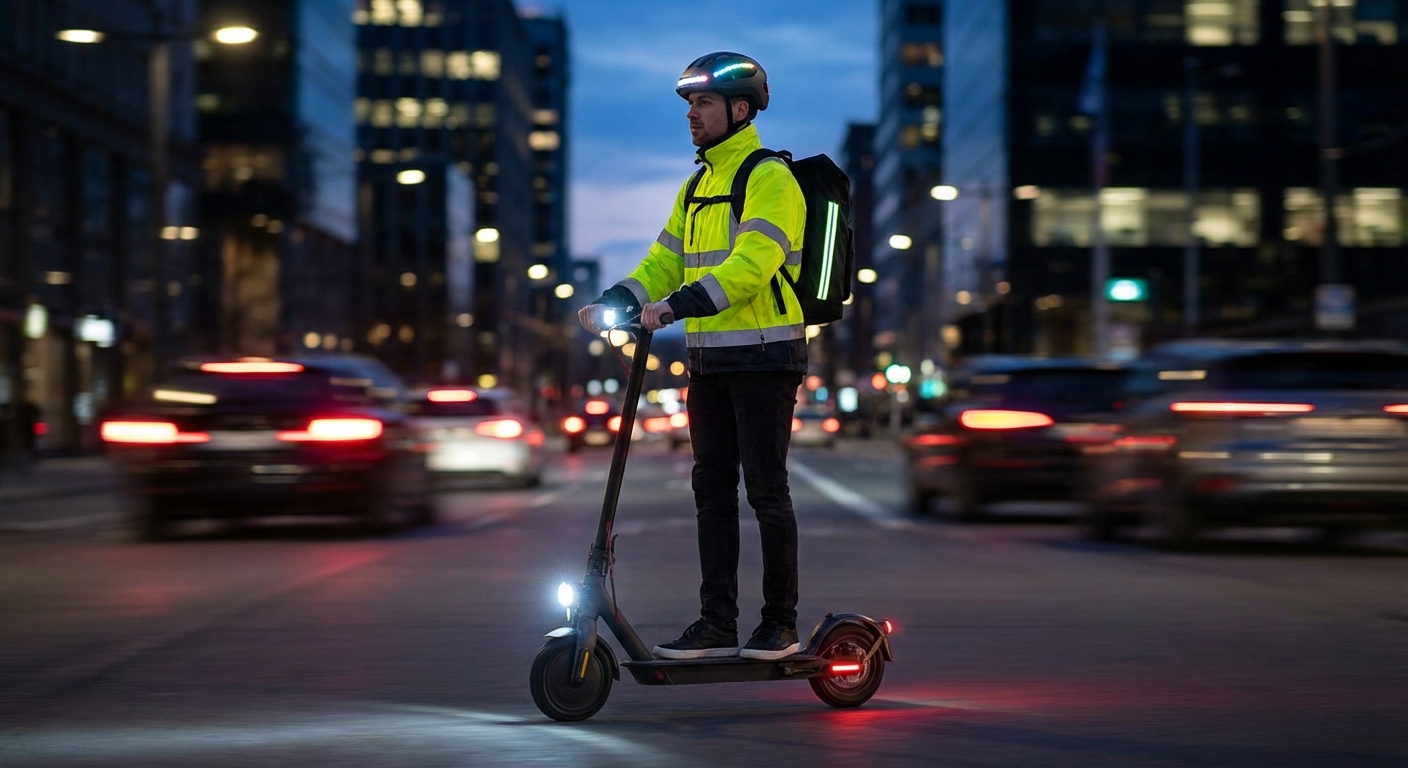
Reflective clothing works through retroreflection. Light from car headlights bounces directly back to the driver’s eyes, making you appear to glow. This works at distances up to 500 feet, giving drivers plenty of time to react.
- Reflective vest or jacket (covers your torso, the largest visible area)
- Ankle bands (movement attracts attention, and your feet move constantly while riding)
- Reflective backpack cover (adds visibility from behind without extra layers)
- Bright colored helmet with reflective strips (makes you visible from all angles)
- Gloves with reflective knuckles (your hands move during turns and signals)
The best reflective gear uses 3M Scotchlite or similar materials. These reflect light more efficiently than cheap alternatives. You can test reflective quality by shining a flashlight at the material from 15 feet away. Good material will glow brightly. Poor material barely shows up.
Temperature matters too. You need visibility without overheating. Mesh reflective vests work well in warm weather. In cold conditions, reflective jackets serve double duty for warmth and safety.
Adjusting your riding technique after dark
Speed feels different at night. Your perception changes when you can’t see as far ahead.
Reduce your normal cruising speed by 20 to 30 percent after sunset. This gives you more reaction time for obstacles you spot late. A pothole that’s obvious in daylight becomes a hazard when you’re relying on a narrow beam of light.
Increase your following distance behind vehicles. At night, you want at least 20 feet between you and the car ahead. This buffer gives you time to react if they brake suddenly. It also keeps you out of their blind spots longer.
Watch for the ground texture changes that signal hazards. Wet pavement looks different than dry. Oil slicks create rainbow patterns under streetlights. Loose gravel has a distinct appearance. Train your eyes to read these cues in artificial light.
Intersection strategy for low-light conditions
Most accidents happen at intersections. Here’s why: drivers scan for cars, not scooters. Your smaller profile makes you easy to miss, especially when turning.
Before entering any intersection, make eye contact with drivers. If you can’t see their eyes, assume they can’t see you. Slow down or stop until you’re certain they’ve noticed you.
Use hand signals earlier than you would during daytime. Give drivers at least 50 feet of warning before any turn. Exaggerate your signals. Make them obvious. Your goal is to eliminate any doubt about your intentions.
Position yourself in the lane where drivers expect to see vehicles. Don’t hug the curb at intersections. Take the lane. You have the same rights as a bicycle, and positioning yourself like a vehicle makes you more predictable to drivers.
For more comprehensive guidance on staying safe, check out 7 common e-scooter accidents and how to avoid them.
Dealing with different lighting environments
Not all darkness is equal. Urban areas, suburban streets, and park paths each present unique challenges.
Well-lit downtown areas have plenty of ambient light but also lots of visual noise. Neon signs, storefronts, and traffic signals create distractions. Your lights need to stand out against this backdrop. Use brighter settings and multiple flash patterns.
Dimly lit residential streets lack ambient light but have less visual competition. Here, steady lights work better than flashing. You want drivers to track your movement smoothly, not lose sight of you between flashes.
Completely dark paths require maximum illumination. Use your brightest settings. Slow down significantly. Your light beam becomes your entire visible world. Obstacles outside that beam are invisible until you’re dangerously close.
Weather multiplies these challenges. Rain scatters light and reduces visibility for everyone. Fog creates a wall of white when lights hit moisture droplets. Learn more about how to ride an e-scooter in the rain without losing control for weather-specific strategies.
Battery management for your lighting system
Dead lights equal zero visibility. Battery management matters more than riders realize.
Most rechargeable bike lights run 2 to 4 hours on high settings, less in cold weather. Know your commute time and add 30 percent as a buffer. If your ride takes 40 minutes, you need lights that run at least an hour.
Check your light batteries as part of your pre-ride routine. Make it automatic, like checking tire pressure. Many lights have battery indicators. Learn what those indicators mean before you’re stuck in the dark trying to interpret them.
Carry backup lighting. A small clip-on light costs ten dollars and fits in your pocket. It won’t match your primary lights, but it keeps you legal and visible if your main system fails.
Cold weather drains batteries faster. A light that runs four hours at 70 degrees might only last two hours at 30 degrees. In winter, charge your lights more frequently and consider keeping them in an inside pocket until you’re ready to ride.
Before you head out, review is your e-scooter safe to ride? pre-ride inspection checklist to ensure everything is working properly.
Route planning for safer night commuting
The fastest route during the day might not be the safest after dark.
Look for routes with consistent street lighting. An extra five minutes on well-lit streets beats saving two minutes on a dark shortcut. Use mapping apps during daylight to scout potential night routes. Note which streets have lighting, bike lanes, and lower traffic volumes.
Avoid routes with known hazards that become worse at night:
- Unpaved shoulders that hide potholes
- Streets with poor drainage that collect water
- Areas with overhanging trees that block streetlights
- High-speed roads where drivers don’t expect slower vehicles
- Industrial areas with large truck traffic
Bike paths seem safer but often lack adequate lighting. A dedicated bike lane on a lit street usually beats a dark multi-use path, even if the path is technically safer from cars.
Consider your emergency options along each route. Where can you stop safely if something goes wrong? Which businesses stay open late? Where’s the nearest well-lit public area? These details matter when you’re troubleshooting a mechanical issue or waiting for help.
Understanding driver behavior and blind spots
Drivers don’t see the world the way you do. Understanding their perspective keeps you safer.
| Driver Situation | What They See | What You Should Do |
|---|---|---|
| Left turn across your path | Often nothing until too late | Take the lane, make eye contact, be ready to brake |
| Right turn from behind you | Small object in their blind spot | Stay visible, watch their wheels, give space |
| Pulling out from parking | Looking for car-sized objects | Position yourself in their sight line, slow down |
| Changing lanes | Checking mirrors for cars | Use bright lights, avoid lingering beside vehicles |
| Backing up | Focused on rear obstacles | Give wide clearance, assume they don’t see you |
Drivers scan for threats at car height. Your scooter sits much lower. This height difference means you disappear in blind spots that wouldn’t hide a car. You need to actively manage your position to stay in their field of view.
Headlight glare affects drivers differently than it affects you. When a car’s headlights hit you, you might feel blinded temporarily. But those same headlights illuminate you for other drivers. Don’t shy away from well-lit areas just because the light feels harsh.
Tech solutions that enhance night safety
Modern technology offers tools beyond traditional lights and reflectors.
Smart lights with brake sensors automatically brighten when you slow down, alerting drivers behind you. These systems detect deceleration and switch from steady to flashing mode, creating the same visual cue as car brake lights.
Turn signal systems designed for e-scooters mount on your arms or backpack. They’re controlled by a handlebar remote and display clear arrow patterns. While hand signals work, electronic signals are visible from farther away and stay lit longer.
Smartphone apps can enhance safety through route sharing. Apps like Strava or Life360 let friends or family track your ride in real-time. If something goes wrong, someone knows your location and can verify you arrived safely.
Reflective paint and tape technology has improved dramatically. New products use microscopic glass beads that reflect light more efficiently. Some even glow after being exposed to light, providing passive visibility even without direct illumination.
Discover how how AI and IoT are making e-scooters smarter and safer to learn about emerging safety technologies.
Common mistakes that reduce your visibility
Even experienced riders make these errors.
Wearing dark clothing because it’s what you already own. Your wardrobe preferences don’t matter if a driver can’t see you. Invest in at least one light-colored or reflective jacket specifically for evening rides.
Relying only on your scooter’s built-in lights. Factory lights meet minimum legal standards, which are often inadequate for real-world safety. They’re a starting point, not a complete solution.
Forgetting about side visibility. Most lighting setups focus on front and rear, leaving your sides dark. Drivers approaching from perpendicular streets can’t see you until you’re already in the intersection.
Riding with dead or dying batteries. Lights that flicker or dim significantly are worse than no lights because they give you false confidence. Replace batteries proactively, not after they fail.
Assuming drivers see you because you can see them. Your eyes are adapted to the dark. Theirs aren’t. Your lights might seem bright to you but barely register to a driver in a lit car cabin.
Not adjusting your setup for different conditions. The lighting that works on clear nights fails in rain or fog. Have backup plans and alternate settings for weather changes.
Maintenance routines that keep you safe
Safety equipment only works when it’s maintained properly.
Clean your lights weekly. Dirt, mud, and road grime reduce light output by up to 40 percent. Use a damp cloth and mild soap. Check lenses for cracks or damage that scatter light inefficiently.
Test all lights before every ride. This takes 30 seconds and catches dead batteries before they become dangerous. Press every button, check every mode, verify every light actually illuminates.
Inspect reflective materials monthly. Reflective tape and clothing lose effectiveness over time. Wash reflective clothing according to manufacturer instructions. Replace tape that’s peeling, cracked, or significantly faded.
Check mounting hardware regularly. Vibration loosens bolts and clips. A light that falls off mid-ride leaves you suddenly invisible. Tighten all mounts and replace any damaged mounting brackets immediately.
Store lights properly when not in use. Extreme temperatures damage batteries. Don’t leave lights in hot cars or freezing garages. Remove them from your scooter and store them at room temperature.
“The best safety equipment is the equipment you actually use. A $200 light sitting at home helps nobody. A $20 light that’s always with you and always charged will save your life.”
Legal requirements you need to know
Laws vary by location, but most places have minimum lighting requirements for night riding.
Most jurisdictions require a white front light visible from at least 500 feet and a red rear light or reflector visible from 600 feet. These are minimums. Meeting the legal minimum doesn’t mean you’re actually safe.
Some areas require side reflectors or lights. Check your local regulations. Fines for inadequate lighting range from $25 to $200 depending on location. More importantly, inadequate lighting can affect liability in accidents.
Helmet requirements sometimes include visibility features. Certain cities require reflective strips or lights on helmets for night riding. Know what your area mandates.
If you’re unsure about local rules, understanding e-scooter speed limits: what’s legal in your city covers broader legal requirements that often include lighting regulations.
Building habits that become automatic
Safety isn’t a checklist. It’s a mindset that becomes second nature.
Create a pre-ride ritual that includes checking all safety equipment. Do it in the same order every time. Lights, reflectors, clothing, battery levels. Consistency builds muscle memory.
Set phone reminders to charge lights. Schedule them for the same time you charge your scooter. Linking these tasks prevents forgotten batteries.
Keep backup supplies at both home and work. An extra set of batteries, a spare clip-on light, reflective tape. If you forget something, you have options.
Practice emergency maneuvers in safe, lit areas first. Learn how your scooter handles during hard braking at night. Understand how much traction you have in different conditions. This knowledge becomes instinct when you need it.
Ride with other people when possible. Group riding increases visibility dramatically. Multiple lights moving together catch attention better than a single rider. Plus, you have immediate help if something goes wrong.
Making night riding part of your routine
Commuting after dark doesn’t have to feel risky. With proper preparation, it becomes just another part of your day.
Start by auditing your current setup honestly. Test your visibility by having a friend drive past you at night. Ask them how far away they first noticed you. If the answer is less than 100 feet, you need better lighting.
Upgrade your equipment gradually if budget is a concern. Start with a good front light, then add a rear light, then reflective clothing, then supplementary lights. Each addition makes you safer.
Document what works for your specific commute. Take notes on which routes feel safest, which lighting settings work best in different areas, and which gear combinations give you the most confidence. Refine your system over time.
The goal isn’t perfection. It’s consistent improvement. Every ride where you arrive safely reinforces good habits. Every close call teaches you something valuable. Pay attention, adjust your approach, and keep learning.
Night riding opens up your schedule. You’re not limited to daylight hours. You can work late, meet friends for dinner, or simply enjoy the cooler evening temperatures. But only if you do it safely. The strategies here give you that freedom without the risk.
Your evening commute should be routine, not stressful. With the right lighting, gear, and habits, it will be.
